Why centrifugal spray dryer selection matters more than people think
Choosing a centrifugal spray dryer is rarely just a question of “which machine is bigger?” In most plants, the dryer sits at the point where liquid feed becomes a saleable powder, and that shift affects flowability, bulk density, dusting, shelf life, packaging behavior, and even how much rework the line creates. If the atomization step is off, the rest of the operation spends time compensating for it.
For engineers and sourcing teams, the real decision is not whether a centrifugal spray dryer can make powder. It is whether the dryer can make the right powder consistently, at the right throughput, with a layout that suits the plant and a cleaning regime that does not become a hidden bottleneck. That is where the details start to matter.
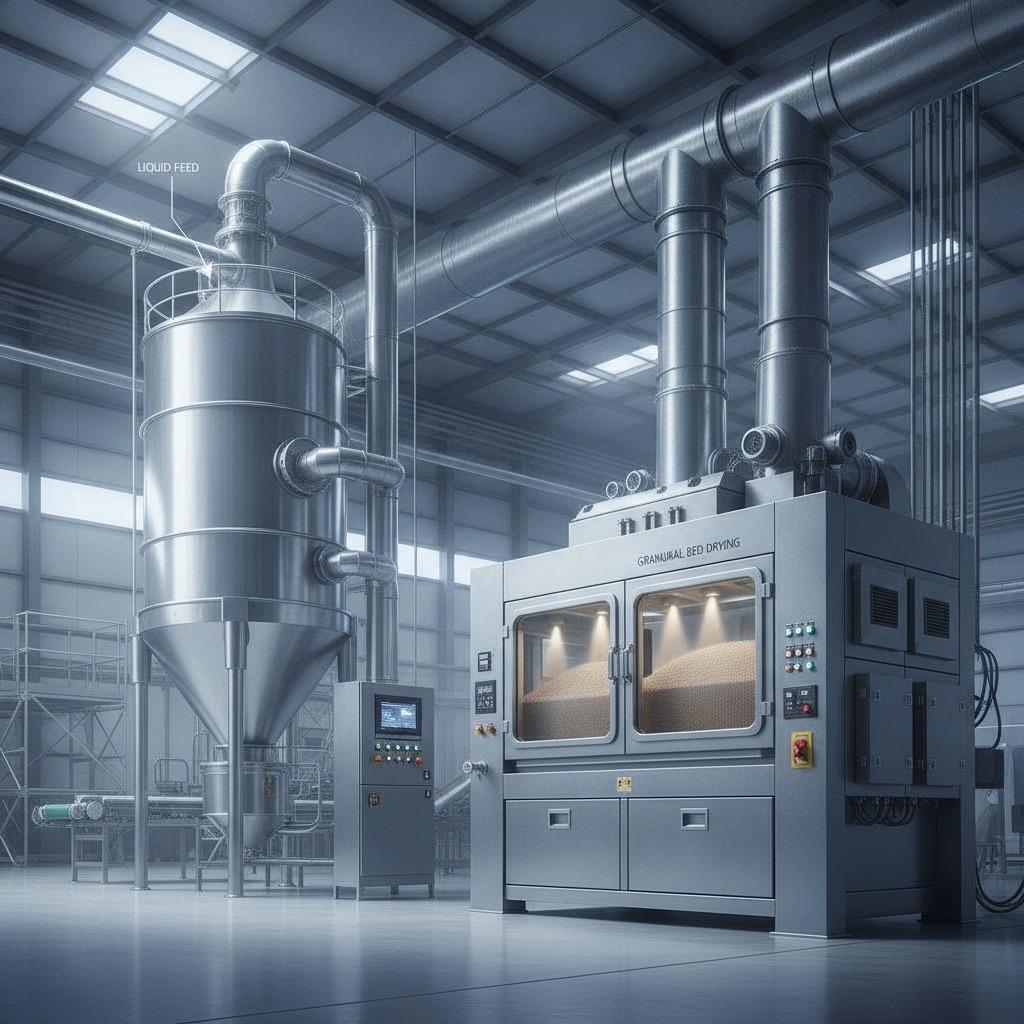
A centrifugal spray dryer uses a high-speed rotating disc or wheel to break liquid feed into fine droplets before hot air removes moisture. Compared with some other drying methods, it is often favored when a plant needs a relatively uniform particle size and a fast route to instant powder production. That broad description is easy to find. The harder part is matching the technology to the product.
What this equipment is really trying to solve
Most buyers come to spray drying because they are converting an unstable or inconvenient liquid into a powder that stores better, ships more efficiently, or handles more predictably in downstream blending and filling. Food ingredients, chemical intermediates, specialty formulations, and certain pharmaceutical or nutraceutical materials all raise similar questions: How sensitive is the product to heat? How sticky is it? Does it cake? Will it disperse quickly when reconstituted?
An industrial spray dryer answers those questions by controlling the interaction between atomized droplets and the drying air stream. With a centrifugal atomizer, the feed is flung outward at speed, turning into a spray of droplets. Smaller droplets dry quickly, but they can also create more fines. Larger droplets may improve yield in some cases, but they can carry more residual moisture if the process is not tuned properly. That balance is usually where the project succeeds or fails.
Quick reference: what to evaluate before you buy
If you are comparing equipment, the shortlist is usually not long, but every item on it matters:
Atomization quality and consistency
Drying chamber geometry and airflow pattern
Product sensitivity to heat and residence time
Powder handling after discharge, including hoppers and transfer points
Cleaning access and changeover burden
Integration with upstream feed tanks and downstream conveying or packaging
Dust control and housekeeping requirements
That last point is easy to underestimate. Even a well-designed spray drying line can create headaches if powder is allowed to accumulate in the wrong places. Once dust escapes into adjacent areas, the maintenance story gets expensive fast.
How centrifugal atomization differs from other drying approaches
A centrifugal spray dryer is often chosen when process teams want strong control over droplet formation without relying entirely on pressure nozzles. The rotating disc can be useful for feeds that vary in viscosity or solids content, though the exact advantages depend on the formulation and the rest of the system design. It is not a universal answer, and that is worth saying plainly.
In practice, the choice between centrifugal atomization and other spray dryer configurations comes down to the product’s behavior and the plant’s operating priorities. If the material is easy to pump, the target particle size distribution is narrow, and the plant values stable, repeatable output, the centrifugal route can be attractive. If the feed is especially abrasive, sticky, or prone to fouling, buyers should ask harder questions about wear parts, cleaning, and uptime.
What the surrounding stainless process equipment tells you
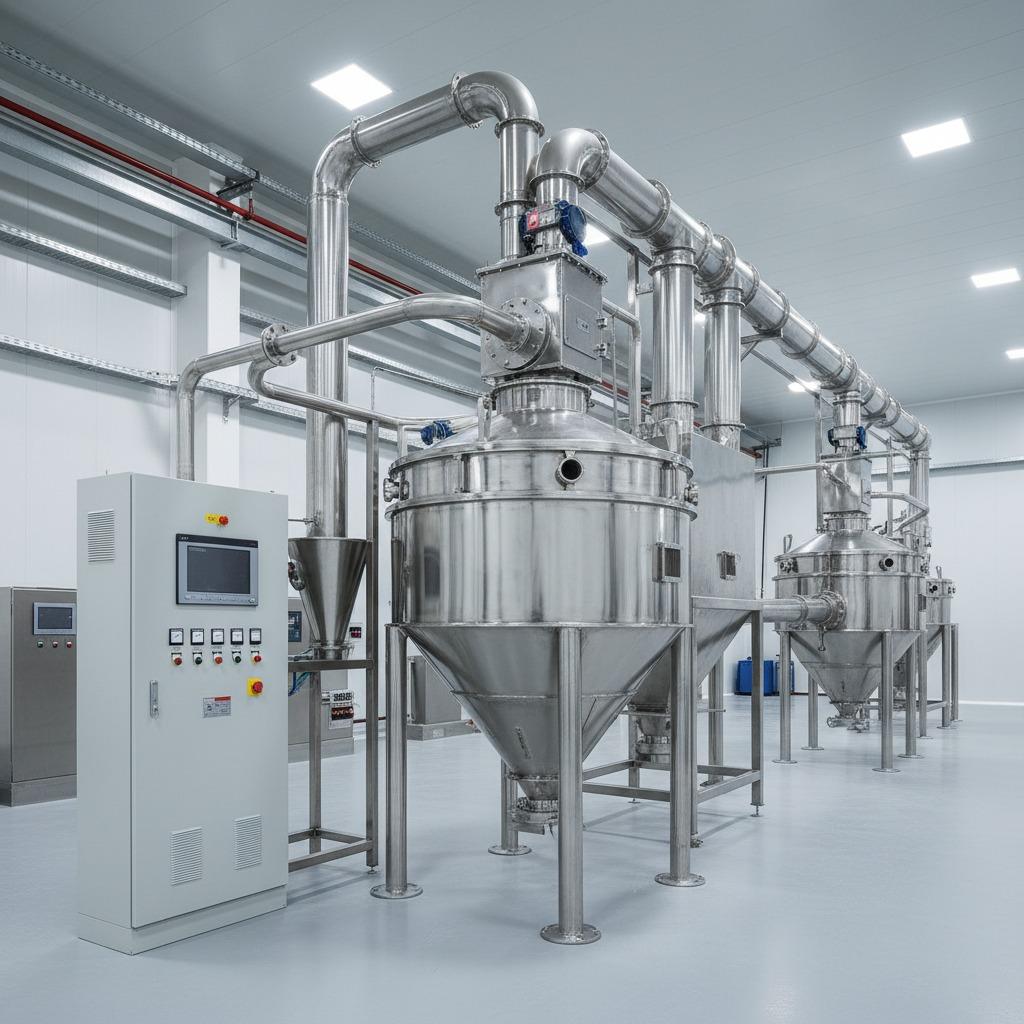
When a spray drying line is installed properly, the dryer is only one part of the story. The surrounding infrastructure often includes stainless storage vessels, conical hoppers, transfer pipes, discharge valves, and control cabinets. That broader layout matters because a dryer does not operate in isolation; it depends on stable feed and careful powder discharge.
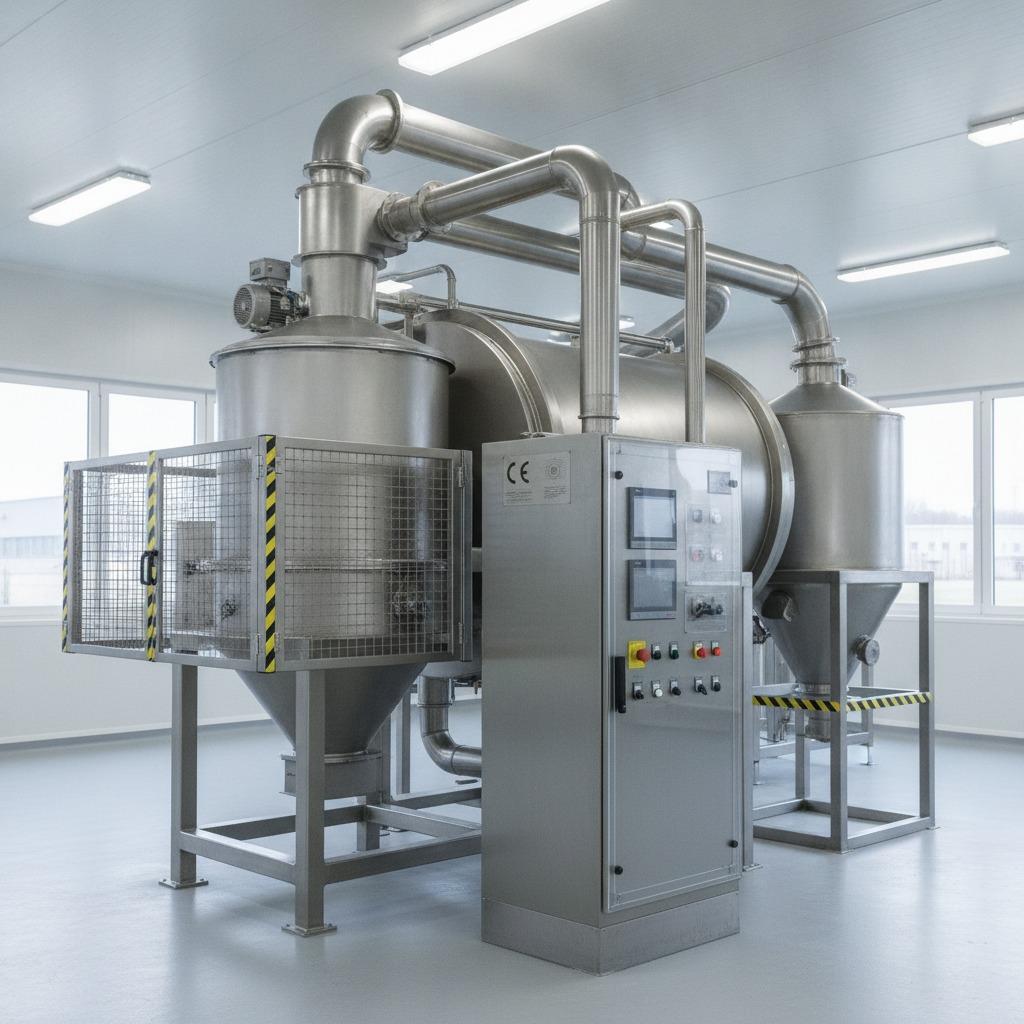
The industrial stainless-steel processing line described in the supplied data is a good example of the kind of upstream and downstream equipment that typically supports drying or powder handling. Multiple conical-bottom vessels suggest bulk storage or gravity-feed staging. Stainless piping points to controlled transfer. Clean, enclosed construction is especially important in food, beverage, pharmaceutical, and chemical environments where contamination control and easy cleaning are priorities.
Even if the exact process function is uncertain from the image alone, the design language is familiar to anyone who has commissioned a dry-material line: repeated vessels, sanitary-looking metal surfaces, organized discharge points, and a plant layout that seems intended to keep material flow controlled rather than improvised.
Selection criteria that go beyond capacity
Product behavior first
The most common buyer mistake is to start with output tonnage before understanding the powder. A liquid feed that dries easily may tolerate a broader process window. A heat-sensitive formulation may not. Viscosity, solids content, surface tension, and stickiness all influence atomization and the final powder characteristics.
Plant integration second
Many projects succeed on paper and fail at the interface points. Feed tanks must deliver stable material. Hoppers must empty cleanly. Conveyors, valves, and packaging lines must not choke on fine powder. If the facility already has bulk ingredient handling systems, the dryer needs to fit them, not force a redesign around them.
Cleaning and maintenance third
This is where buyers sometimes get optimistic. A dryer that looks efficient during the sales stage can become a maintenance burden if access points are awkward or if residue builds up in hard-to-reach corners. For sanitary applications, the ability to clean internal surfaces consistently can matter as much as thermal performance.
Control stability
Process control does not need to be exotic, but it does need to be reliable. Feed rate, inlet air conditions, atomizer speed, outlet temperature, and powder discharge all interact. If the controls are poor, operators spend their day chasing variability instead of running the line.
Common mistakes buyers make
One mistake is assuming all spray dryers produce the same powder quality if the capacity rating is similar. They do not. Two systems with the same nominal throughput can behave very differently depending on atomization, chamber design, and airflow.
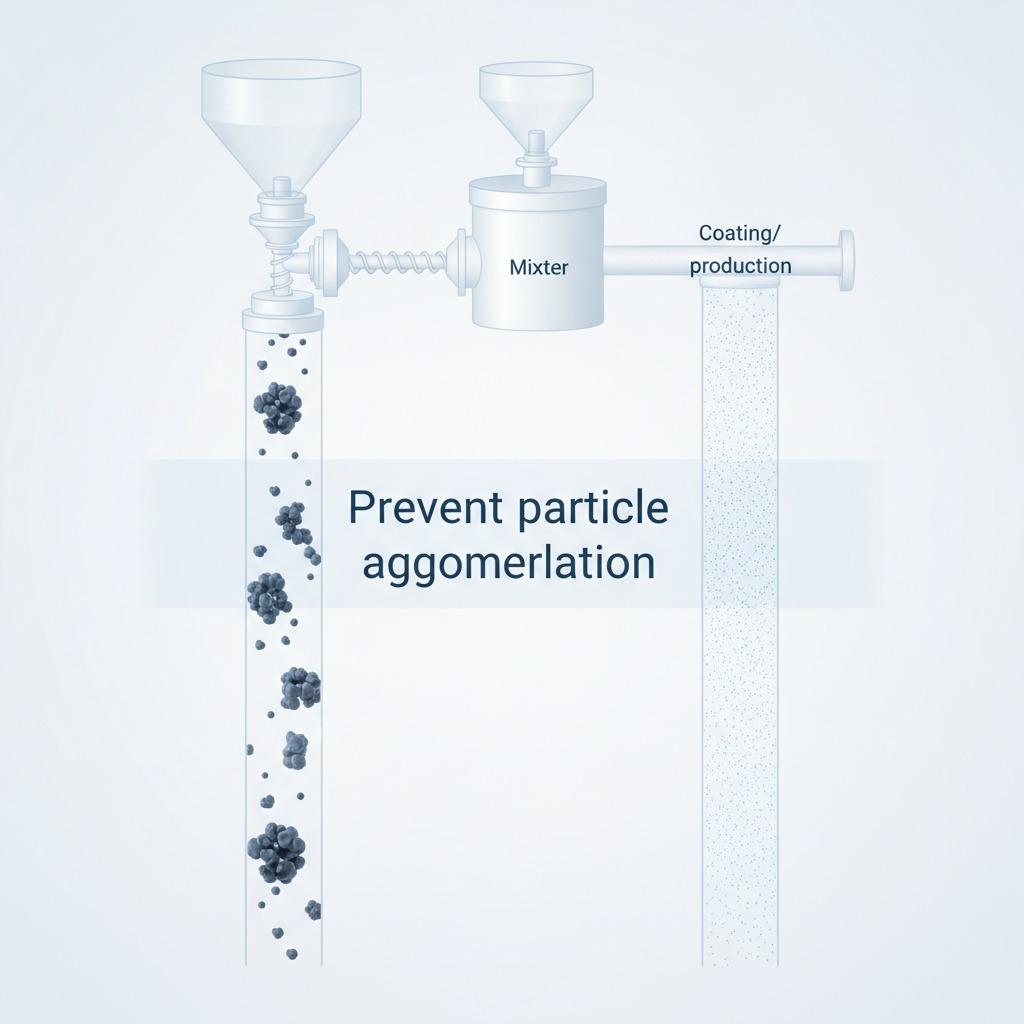
Another common issue is underestimating downstream powder handling. If the powder is light, dusty, or prone to bridging, the best dryer in the world will not save the process if discharge hoppers and transfer equipment are poorly designed. The finishing step matters almost as much as the drying step itself.
A third mistake is treating sanitary construction as a box to tick rather than a process requirement. In a clean production area, stainless-steel construction, enclosed piping, and orderly equipment layout are not cosmetic choices. They affect contamination risk, cleaning time, and plant discipline.
Practical questions to ask suppliers
Before requesting a quotation, it helps to ask a supplier some direct, operational questions:
How does the system handle feed variability?
What powder characteristics can be adjusted by process settings?
How is fine dust controlled and collected?
What access is available for cleaning and inspection?
How does the dryer connect to upstream storage and downstream packaging or batching?
If the supplier cannot explain the powder path in plain language, that is a warning sign. A good process vendor should be able to describe not just the machine, but the line around it.
Where the visible stainless vessels fit into the bigger picture
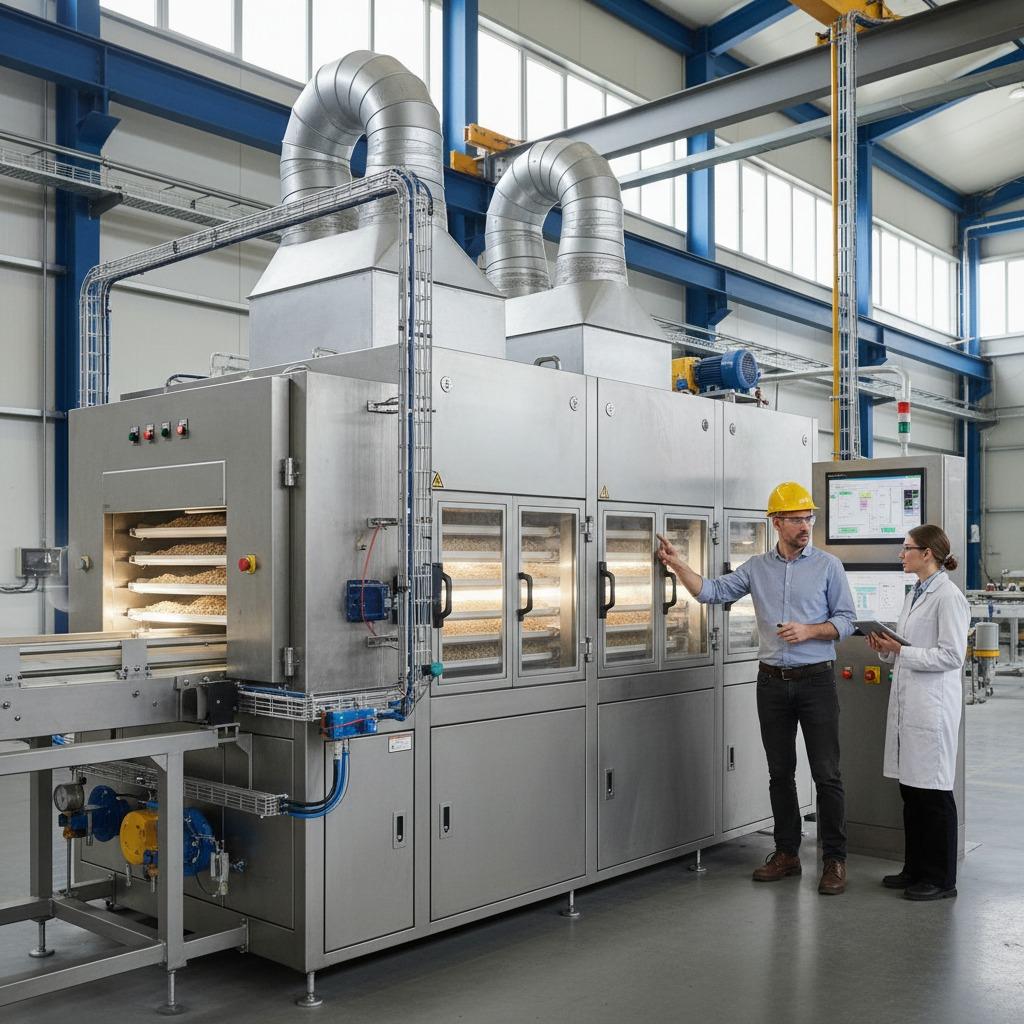
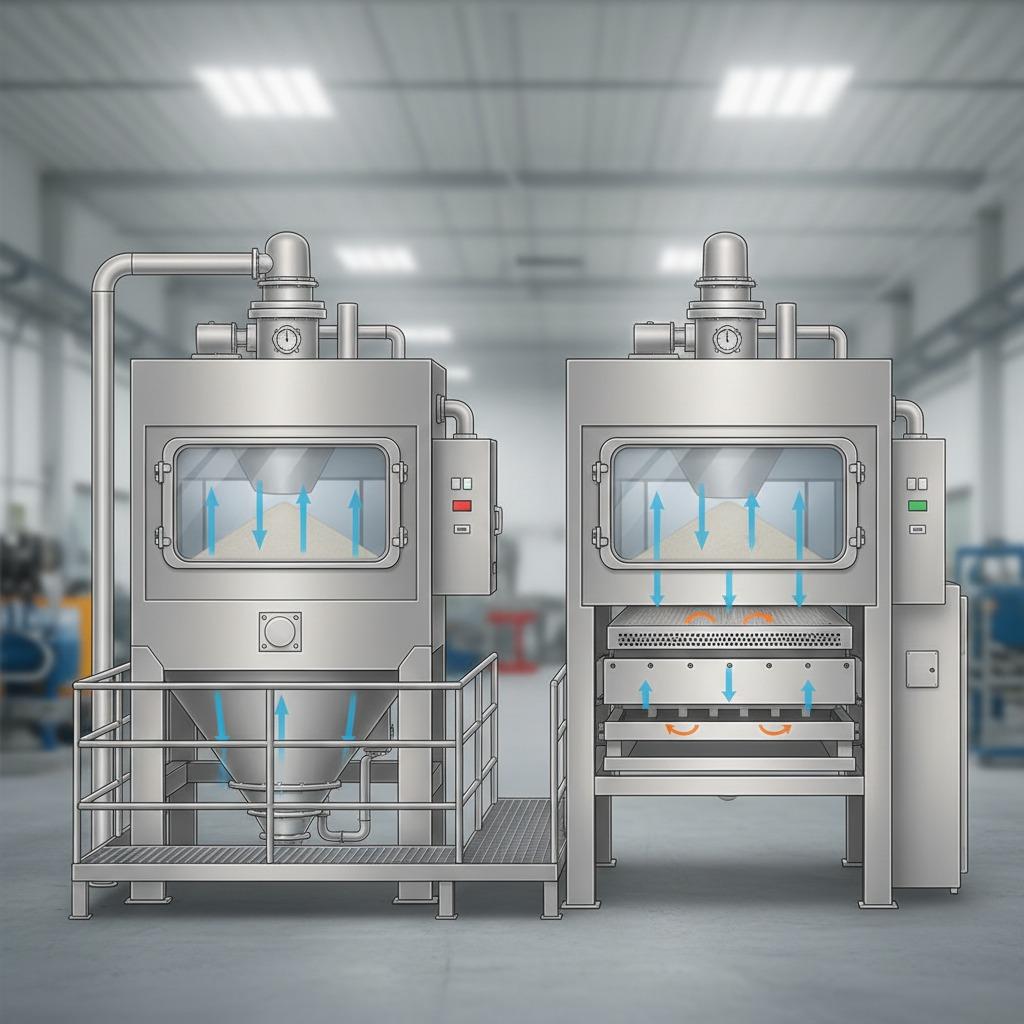
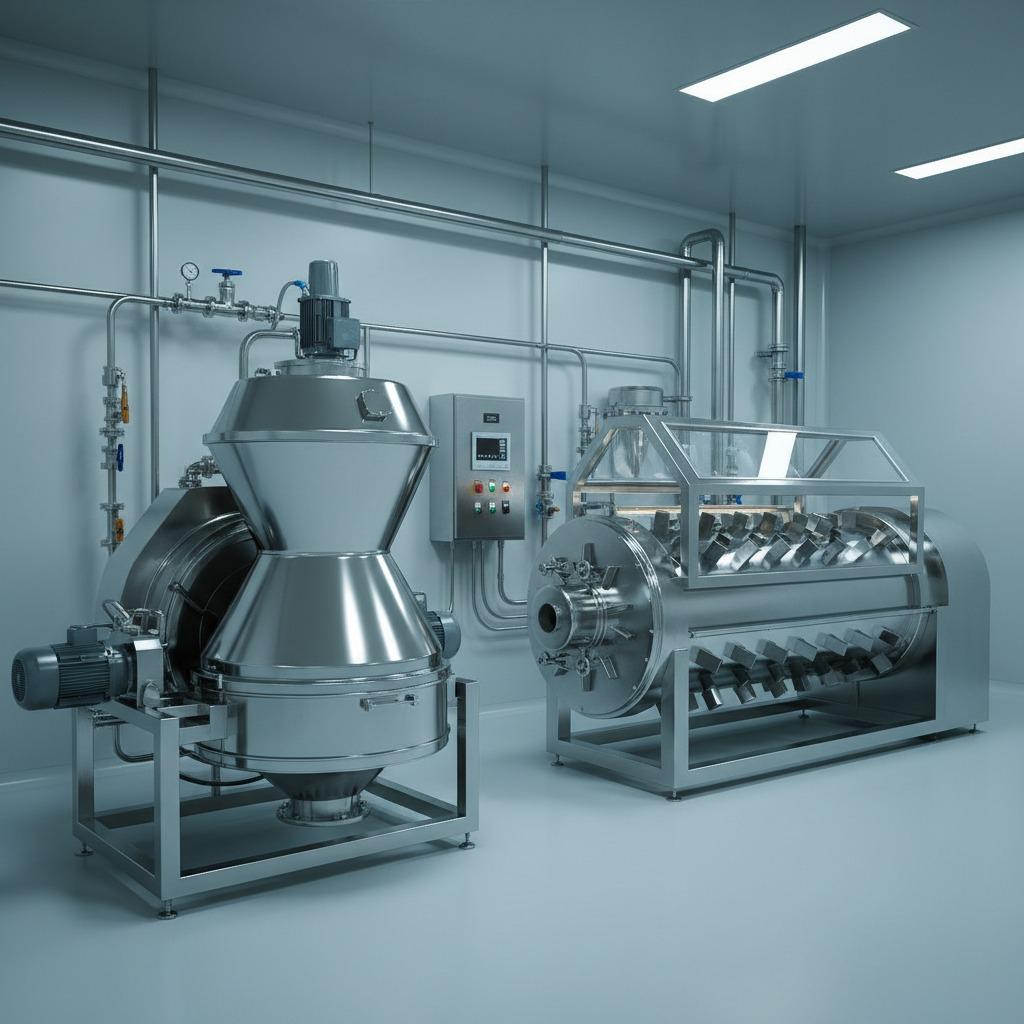
The supplied images show large conical stainless vessels installed in a clean indoor plant environment. That kind of equipment is commonly used for storage, gravity discharge, batching, transfer, or feeding adjacent process machinery. In a spray drying context, similar vessels may support raw material staging, powder collection, intermediate storage, or post-drying handling. The exact role cannot be confirmed from the images alone, and it should not be assumed.
Still, the design cues are useful. Cone-bottom geometry helps with discharge. Repeated modular vessels can support batch or semi-continuous workflows. Stainless construction supports hygienic or corrosion-resistant service. For buyers, these are the kinds of details that influence how a centrifugal spray dryer line performs once it is installed, not just how it looks on the drawing.
FAQ
Is a centrifugal spray dryer always the best option for instant powder production?
No. It can be a strong option when consistent atomization and powder uniformity are important, but the right choice depends on the feed, the target powder, and the plant layout.
Does stainless construction automatically mean sanitary design?
Not automatically. Stainless steel is a good start, but sanitary performance also depends on surface finish, weld quality, access for cleaning, and how the line is arranged.
Should buyers focus on the dryer or the whole line?
The whole line. Feed tanks, transfer systems, dust control, discharge hoppers, and controls can make or break the project.
What to do next
If you are evaluating a centrifugal spray dryer for a new line or a retrofit, start with the powder specification and work backward. Define the product behavior, the required handling characteristics, and the plant constraints before you compare machine names or headline capacities. That approach may sound conservative, but it avoids a lot of expensive correction later.
For teams also planning bulk handling or stainless process equipment around the dryer, it is worth reviewing the full material flow from storage to discharge. A cleanly designed industrial spray dryer line is usually less about one hero machine and more about how well every vessel, pipe, valve, and hopper supports the product on its way through the plant.