What buyers really mean when they search for a Vibrating Fluid Bed Dryer Manufacturer
When engineers and sourcing teams look for a Vibrating Fluid Bed Dryer Manufacturer, they are usually not shopping for a catalog item. They are trying to solve a process problem: how to dry granular or particulate material evenly, keep product moving, and avoid the clumping, hot spots, or over-drying that can show up in a conventional static dryer. In practice, the right choice also affects floor space, cleaning effort, operator attention, and how well the line can handle changing feed conditions.
That matters because drying is rarely just about removing moisture. It can change bulk density, flowability, downstream packaging behavior, and even product appearance. A vibrating fluid bed drying equipment setup may be the difference between a stable process and one that needs constant adjustment. For food, chemical, pharmaceutical, and bulk solids applications, the buyer’s real question is often simpler than the machinery sounds: will this dryer produce consistent results without creating a maintenance headache?
There is also a practical procurement angle. A vibrating fluid bed dryer supplier may offer several configurations, but not every machine is suited to every material. Fine powders behave differently than pellets, and fragile solids can be damaged by aggressive vibration. A good project starts with a clear understanding of the material, the moisture target, and the plant constraints around cleaning, utilities, and discharge.
How vibrating fluid bed drying works in plain terms
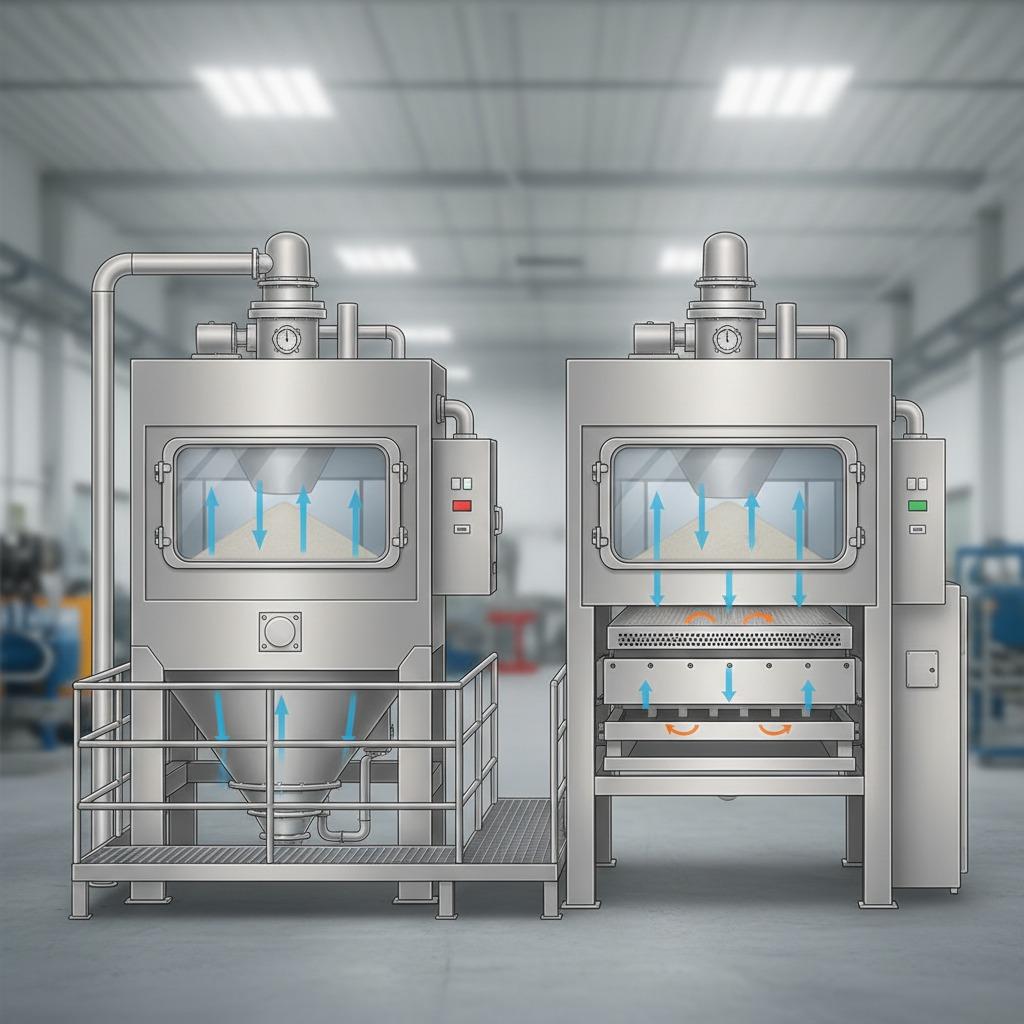
A vibrating fluid bed dryer machine combines two useful effects. Air passes through the product bed to support drying, while vibration helps move material across the deck and reduces stagnant zones. The result is usually a more uniform residence time than a fixed bed, especially when the feed is irregular or the process needs steady discharge.
That combination is attractive for bulk materials because it can turn drying into a continuous process rather than a batch waiting game. Product enters, spreads, and advances under controlled motion. Airflow removes moisture, and the vibration helps keep the bed open enough for heat and mass transfer. The details matter, though. Too much vibration can damage fragile product or create dusting; too little and the bed can compact, slowing drying and making the system harder to control.
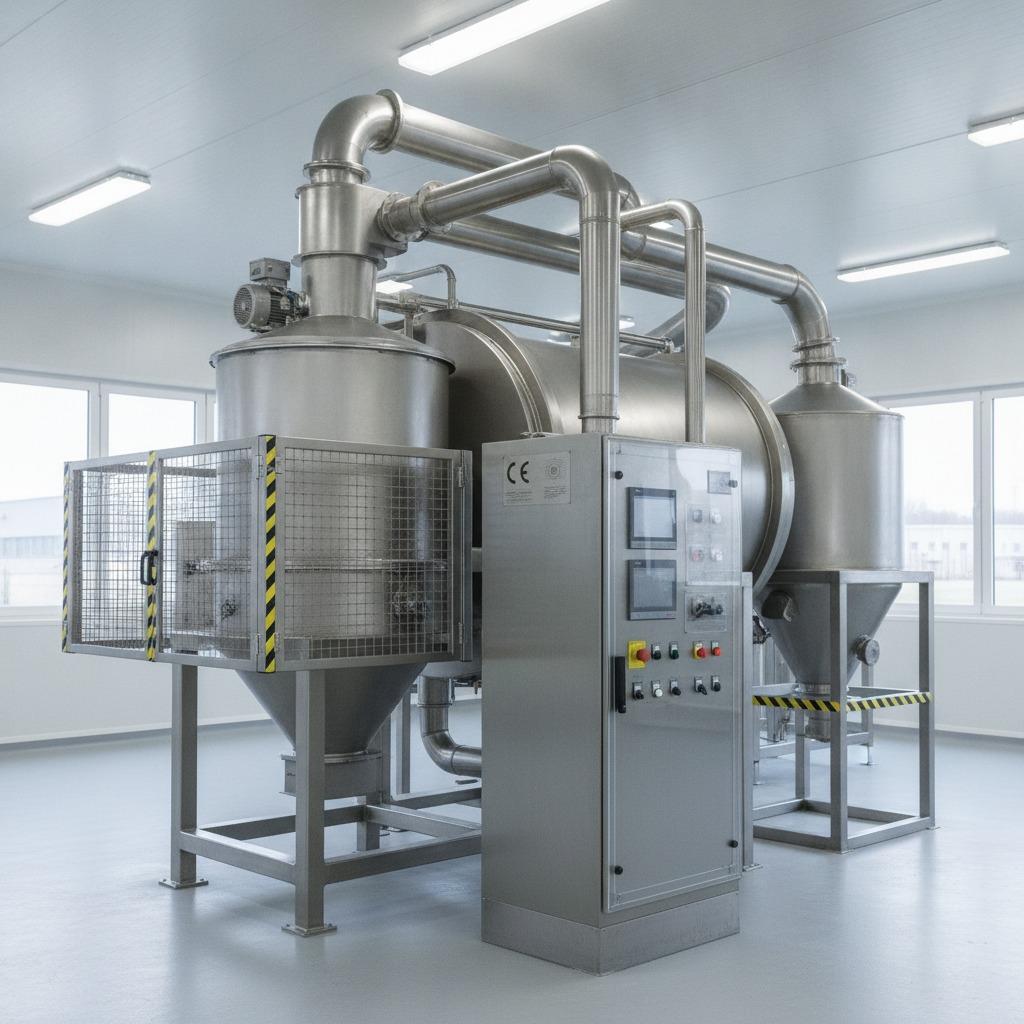
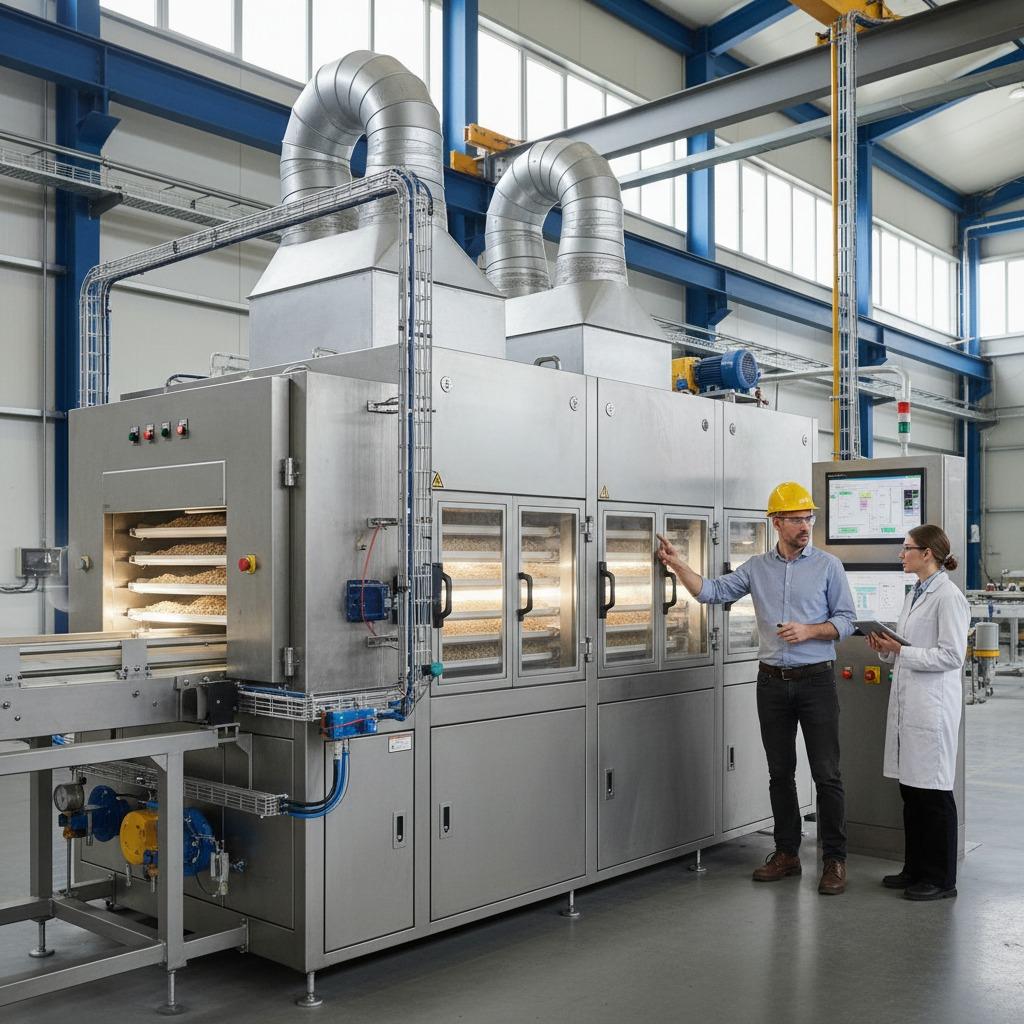
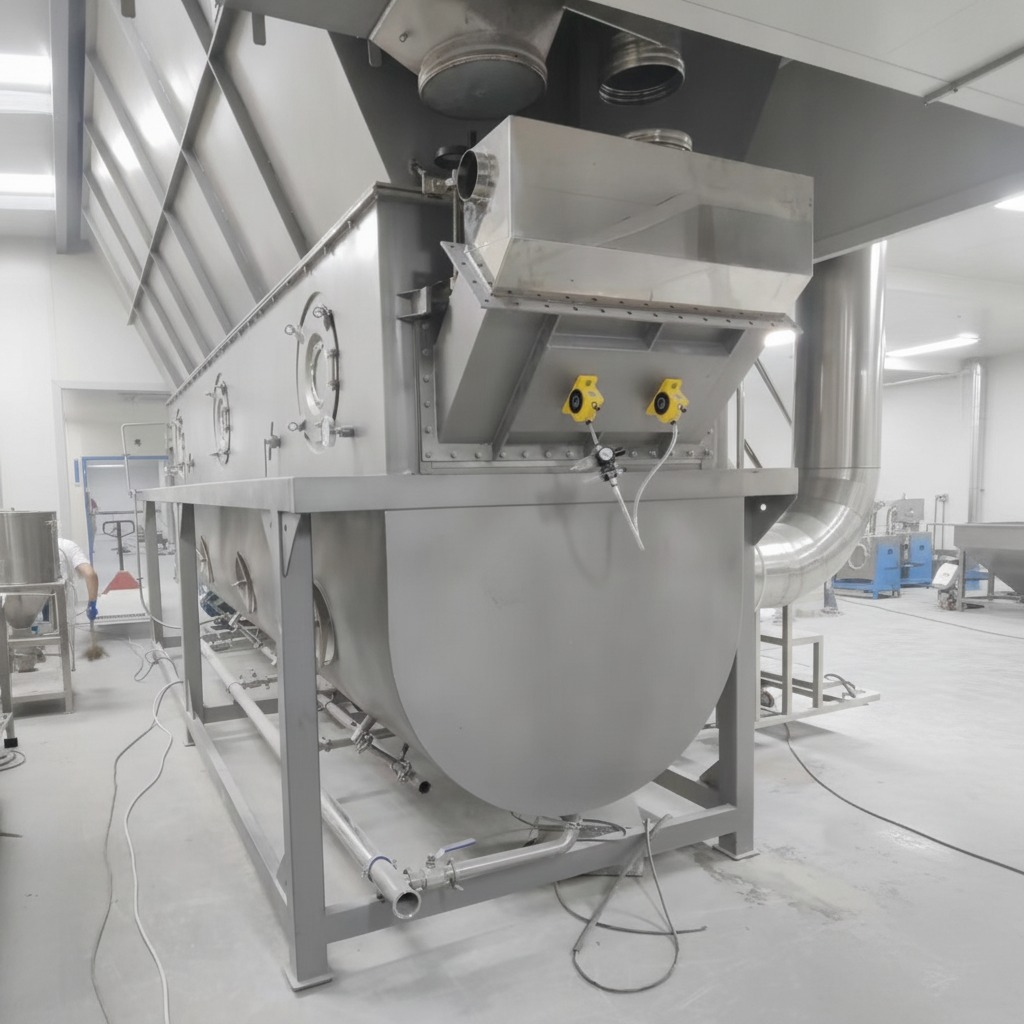
From a fabrication standpoint, these systems are often built as stainless-steel industrial process machines with enclosed chambers, access doors, ducting, and support frames. The visible construction on comparable industrial equipment often includes welded stainless panels, inspection ports, bolted covers, and integrated piping or blower connections. That is not decoration; it is the hardware that lets a plant clean, inspect, and maintain the dryer without taking apart the entire line.
Where this equipment fits in a production line
Vibrating fluid bed equipment is typically used where controlled drying and gentle handling both matter. Food processors may use it for granular ingredients or semi-processed product that needs moisture reduction before storage or packaging. Chemical plants may apply it to crystalline or particulate solids that must stay free-flowing. In some cases, the same style of machine is used for cooling rather than drying, or for a combined thermal step depending on the process design.
The broader point is that the machine is part dryer, part conveying device, and part process-control tool. That is why plant teams often compare it not only with other dryers, but also with alternative material-handling solutions. If a product already arrives well dispersed and low in moisture variation, a simpler system may be enough. If the feed is sticky, heat-sensitive, or hard to move uniformly, the vibrating bed starts to look more attractive.
Quick comparison: what buyers should look at first
Before shortlisting a vibrating fluid bed dryer manufacturer, it helps to compare the machine on a few practical points rather than on glossy brochure language.
- Material behavior: free-flowing, sticky, fragile, dusty, or heat-sensitive
- Drying goal: moisture removal, cooling, conditioning, or combined processing
- Hygiene needs: washdown, cleanability, access for inspection, sanitary construction
- Plant integration: feed rate, discharge height, ducting, blower, dust collection
- Maintenance access: doors, ports, removable sections, and service clearances
- Footprint and support: floor space, vibration isolation, and structural load
That last point is easy to underestimate. A large industrial dryer is not just a box on legs. Once you add ductwork, control panels, safety access, and discharge handling, the actual footprint is usually larger than the occupied machine base. Buyers sometimes discover this only after the layout drawing is already late.
What the visible construction tells you about fabrication quality
On large stainless industrial equipment, the exterior often tells you a lot about how the machine was put together. Clean welded seams, consistent panel alignment, sturdy frames, and sensible access points are not cosmetic details. They are signs that the builder understands plant use, not just sheet metal work.
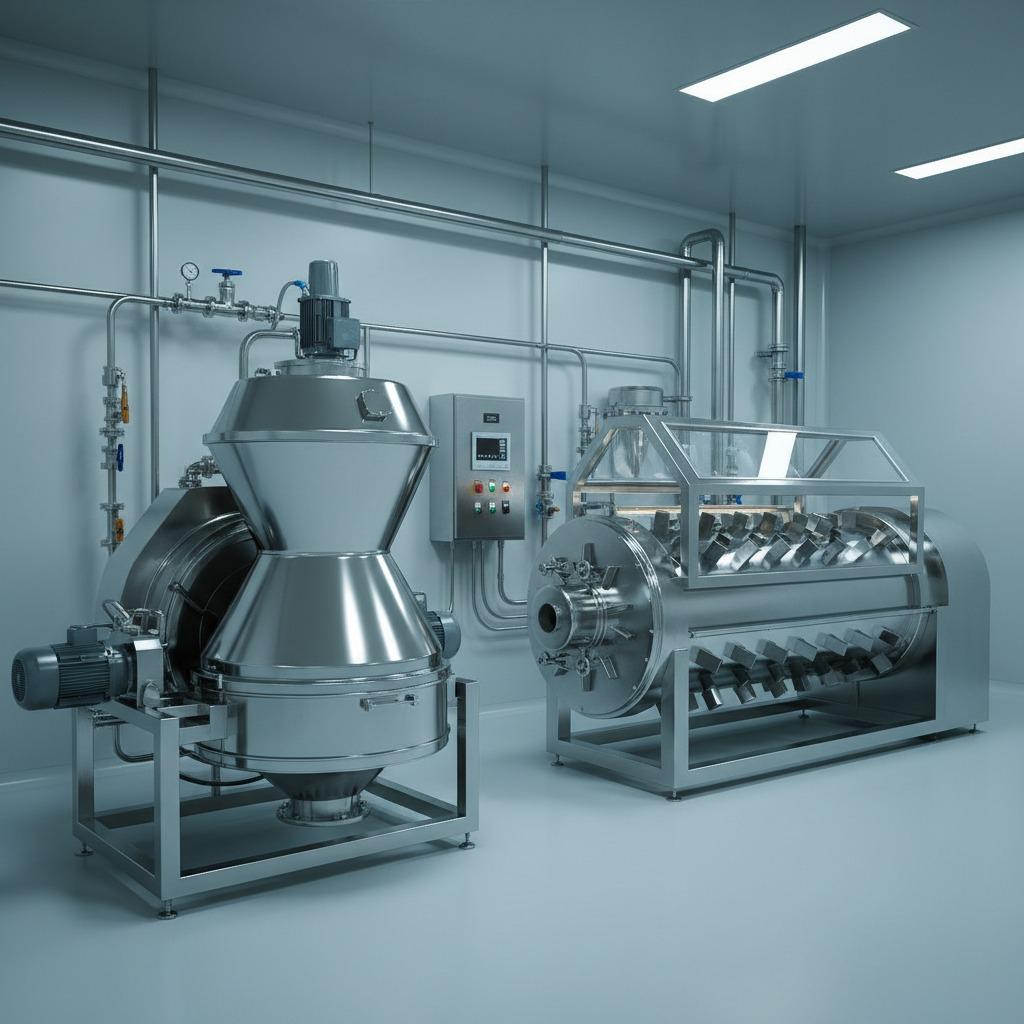
For example, the process equipment described in the provided product information shows the kind of features that usually matter in the field: stainless-steel construction, an enclosed process chamber, round inspection or manway ports, bolted flanged panels, top-mounted duct or pipe connections, and a heavy-duty support frame. Those are the features buyers tend to notice after installation, because they affect maintenance, cleaning, and how safely the equipment can be serviced.
Custom fabricated process vessels and dryers often vary in geometry, but the important thing is whether the design supports the job. A conical hopper or sloped section can help with drainage or discharge. Multiple access doors make cleaning less painful. Raised platforms and guardrails help with routine inspection. None of that guarantees performance, but it does show the builder has thought beyond the initial shipment.
Selection criteria that matter more than marketing claims
1. Product sensitivity
Some materials can take a fairly active bed. Others cannot. If the product chips, breaks, or segregates easily, the mechanical action of vibration has to be matched carefully with airflow and bed depth. This is where the project team should ask for process references or application data relevant to similar materials, not just a general promise that the machine “handles everything.”
2. Residence time control
Drying is only useful if it is repeatable. A machine that moves product too quickly may leave moisture behind; too slowly and you risk overheating or throughput loss. Residence time is shaped by vibration, deck design, feed consistency, and airflow. That is why a vibrating fluid bed dryer supplier should be able to discuss process tuning, not only mechanical construction.
3. Cleanability and access
If the line changes products, or if sanitation is a concern, access points become critical. Inspection doors, cleanout hatches, and well-positioned ports are not minor conveniences. They reduce downtime. They also reduce the temptation to skip cleaning because the machine is awkward to open.
4. Integration with upstream and downstream equipment
Most drying systems fail at the interfaces, not in the drying chamber itself. Feed consistency, discharge handling, dust collection, and exhaust management all affect the final result. A well-built dryer that is badly integrated will still cause headaches.
Common mistakes buyers make
The first mistake is treating every dryer as interchangeable. They are not. A vibrating fluid bed dryer machine built for one class of material may be a poor fit for another, even if the brochure looks similar. The second mistake is underestimating the importance of support structure and plant utilities. Vibrating equipment needs a stable installation, and the surrounding system needs to be designed with maintenance access in mind.
A third mistake is focusing only on throughput. Throughput matters, obviously, but so do cleaning time, operator intervention, and consistency across shifts. A machine that runs fast but needs constant attention can become expensive in a very ordinary way: lost time.
One more practical caution: if the supplier cannot explain how the equipment handles variation in feed moisture or particle size, keep asking questions. Real plants do not deliver perfect feed all day. The dryer has to cope with imperfect conditions.
What to ask a manufacturer before you request a quote
Buyers usually get better proposals when they share more than a target capacity. Useful questions include the following:
- What types of material have been handled in similar machines?
- How is vibration controlled and isolated from the rest of the structure?
- What access is provided for cleaning and inspection?
- How are air inlet, exhaust, and dust-handling connections arranged?
- Can the machine be adapted for cooling or conditioning as well as drying?
- What plant constraints should be checked before installation?
Suppliers that work regularly with custom stainless steel process equipment usually understand these questions because they affect fabrication as much as they affect process performance. If the vendor only answers in generic terms, the proposal may be too shallow for a serious production line.
How to evaluate a supplier beyond the price tag
Price is always part of the discussion, but it should not be the only lens. A lower quote can hide compromises in access design, support framing, or integration support. Equally, an expensive offer is not automatically better if it is oversized for the application.
Look at how the supplier approaches engineering detail. Do they ask about the material, the moisture target, the cleaning method, and the surrounding line? Do they discuss the geometry of the chamber, the support frame, and service access with the same seriousness as the motor or blower? Those are signs you are dealing with a team that understands industrial process machinery rather than just a sales office with a brochure.
For project teams comparing multiple options, the right Vibrating Fluid Bed Dryer Manufacturer is usually the one that can explain trade-offs clearly. No machine is perfect. The better partner will say so, and will help you choose where to optimize and where to stay conservative.
Final buyer takeaway
If your project needs controlled drying, gentle product movement, and a design that can be integrated into a real plant, vibrating fluid bed drying equipment deserves a close look. The best results usually come from matching the machine to the material, the utility package, and the maintenance philosophy of the site.
Start with the process problem, not the catalog photo. Then evaluate the fabricator’s attention to stainless construction, access, support, and integration. That approach will do more for long-term performance than chasing the biggest capacity number on the first page.
If you are narrowing suppliers now, prepare a material summary, feed and discharge requirements, and the space constraints around the installation. That will make the next conversation with a vibrating fluid bed dryer supplier far more useful, and it will usually expose weak proposals quickly.