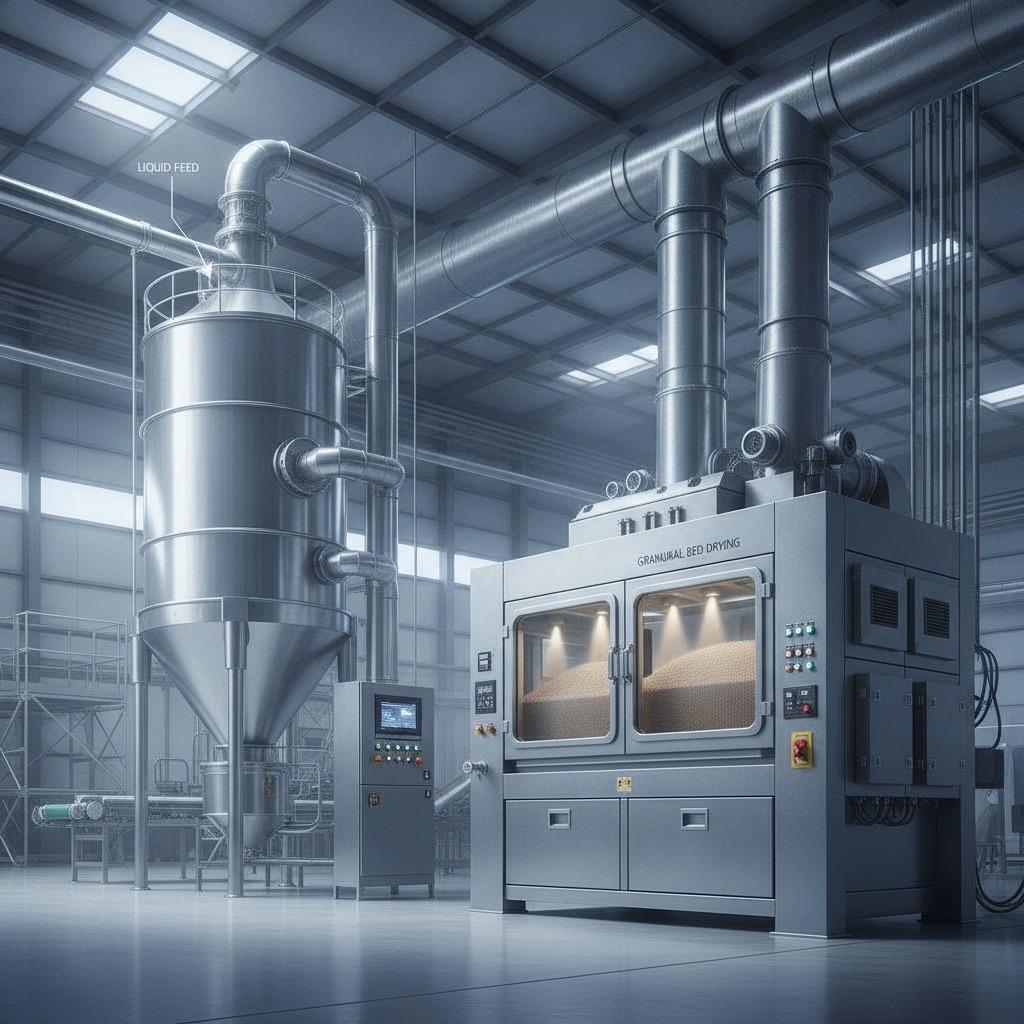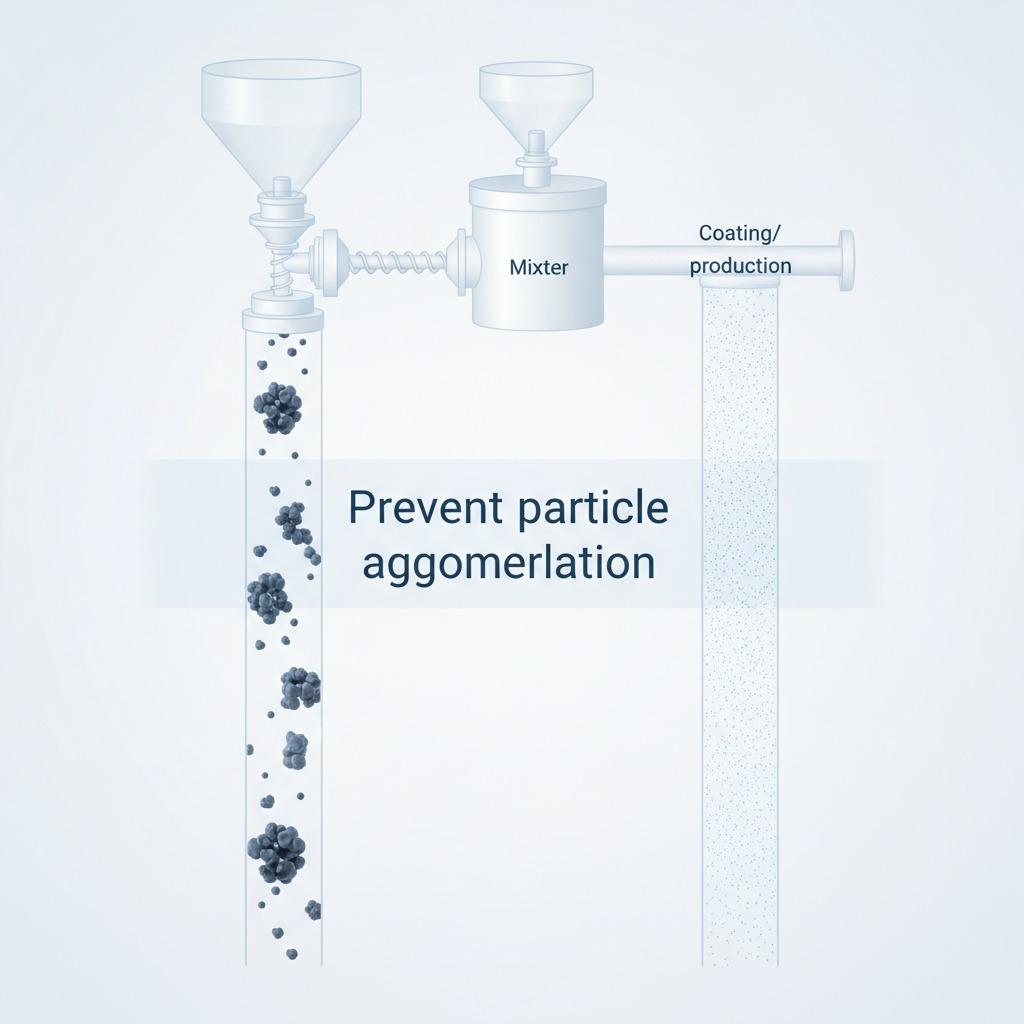
Why particle agglomeration becomes a production problem
To prevent particle agglomeration is to protect consistency, and consistency is usually what decides whether a powder process behaves or turns stubborn. In coatings, ceramics, batteries, pharmaceuticals, food powders, additives, and many other manufacturing lines, particles that cling together can change flow, affect dispersion, create weak spots in a finished part, or make a blend impossible to meter accurately. What looks like a small clump in a bag of powder often becomes a larger problem downstream: blocked feeders, poor mixing, uneven reaction rates, dusty handling, or a product that fails to meet its own internal specification.
The practical question for a buyer or process engineer is not whether agglomeration exists. It does. The better question is where it starts, how much it costs in scrap or downtime, and what control method fits the material. Some powders are naturally prone to bridging because of particle size and surface energy. Others pick up moisture, static charge, or contamination during handling. A few only agglomerate after drying, milling, or transport. The right response depends on that root cause, not just on breaking lumps after they appear.
What actually causes particles to stick together
Particle agglomeration is usually the result of several forces working at once. Fine particles have a high surface area, so they attract one another more easily than coarse materials. If the material is hygroscopic, even a little ambient moisture can form liquid bridges between particles. Electrostatic charge can make matters worse, especially in dry air or in polymer and pigment systems. In some processes, the problem starts during upstream milling when the particle surfaces become freshly exposed and highly reactive.
Temperature matters too. When powders are heated, softened, or partially dried, surfaces may become tacky enough to form clusters. Mechanical compression during transport or storage can compact a powder bed and create strong bridges that are hard to break later. Contamination is another quiet culprit: oil, binder residue, or incompatible fines can alter surface behavior and encourage clumping. In the field, these causes overlap, which is why a single cure rarely solves every case.
Quick reference: the main ways to reduce clumping
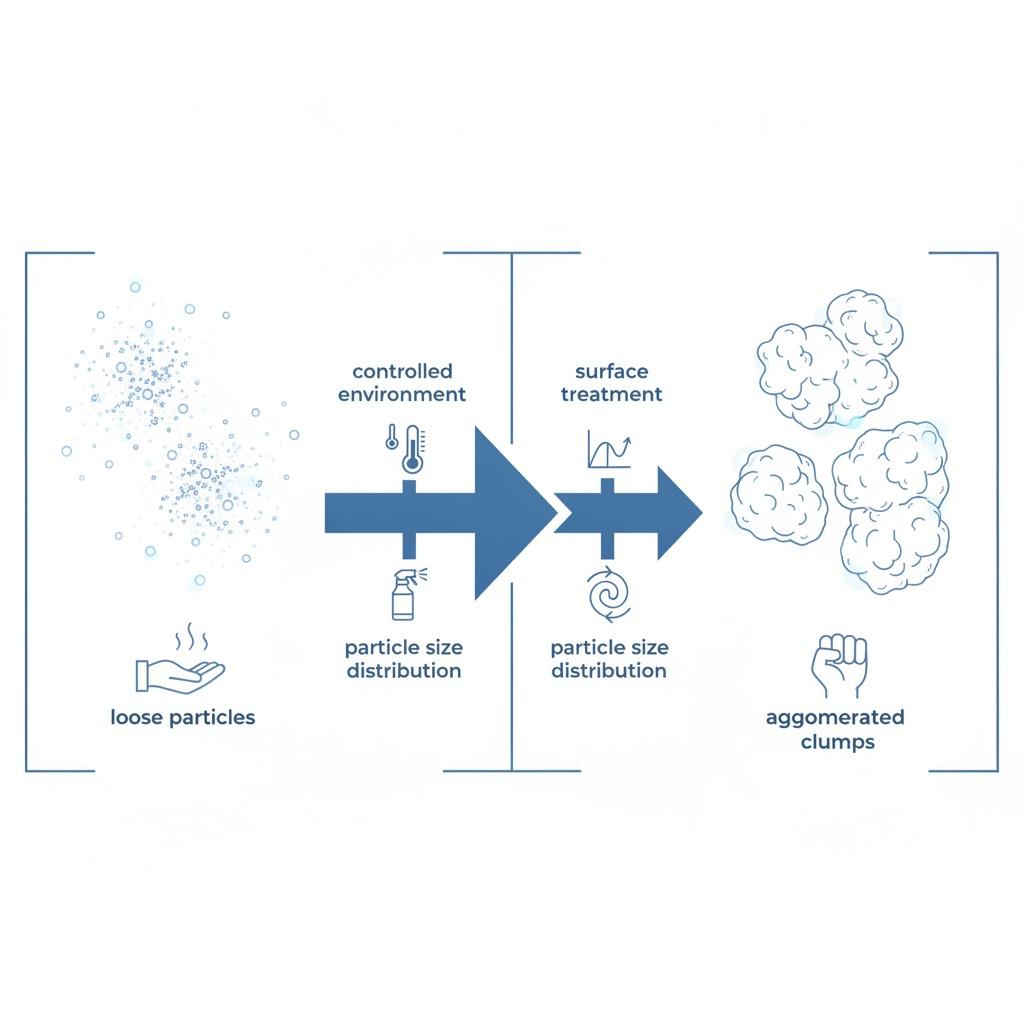
If you need a fast way to think about the problem, the control methods usually fall into four buckets. None is universal, but each one has a place.
1. Control the environment
Humidity management is often the first lever. Dry rooms, sealed transfer, desiccant packaging, and temperature control can all help reduce moisture-driven adhesion. This is especially useful for hygroscopic powders and materials that lose free-flow behavior when the weather turns damp. It is not glamorous, but it is often the most economical fix.
2. Change the particle surface
Surface treatment, coatings, and flow aids can lower interparticle attraction. In some applications, modifying the surface chemistry is more effective than changing the process. This route is common where the product must remain fine, yet still handle like a free-flowing material.
3. Adjust the particle size distribution
Fine fractions tend to agglomerate more readily than broader or slightly coarser distributions. Granulation, spray drying, controlled milling, and sieving can all shift the balance. The caveat is obvious: changing size can also change performance, dissolution, reactivity, or finish quality, so this is rarely a casual change.
4. Improve handling and mixing
Even a stable powder can clump if it is mishandled. Gentle transfer, reduced drop height, anti-static measures, and proper mixer selection all matter. A material that behaves in the lab may still fail in a full-scale silo, so the handling route deserves more attention than it sometimes gets.
How different industries approach the same problem
Manufacturing teams often use the same phrase—prevent particle agglomeration—but the target outcome varies by industry. In pharmaceuticals, the concern may be dose uniformity and reproducible flow into tablet presses or capsule fill lines. In ceramics and advanced materials, agglomerates can create weak points, nonuniform sintering, or localized defects. In battery powders and electronic materials, a few persistent clusters can affect coating quality and electrochemical performance. In paints, inks, and pigment systems, clumps show up as poor color development, rough finish, or filtering problems.
Food and nutraceutical powders bring another layer of caution. A powder may need to remain free-flowing for packaging and dosing, yet still disperse quickly in water or another medium. In that setting, one should be careful not to over-correct. A very aggressive anti-caking approach can sometimes hurt reconstitution or change mouthfeel. That tradeoff matters, and it is easy to miss when a line is under pressure to stop visible clumping as quickly as possible.
Selection criteria for buyers and process teams
When evaluating a preventive strategy, do not start with the equipment catalog. Start with the powder behavior and the business risk. A good selection process usually answers a few practical questions: Is the material moisture-sensitive? Is the agglomeration reversible with mild agitation, or is it a hard bridge? Does the clumping begin in storage, during transfer, or after drying? Does the final product allow any added excipient, coating, or processing aid?
Then look at production realities. Some lines can support humidity control but not major formula changes. Others can change the powder formulation but cannot slow throughput. A method that looks elegant at pilot scale may be too fragile for a plant running three shifts and frequent changeovers. That is where many projects go sideways: the chosen fix is scientifically sound but operationally awkward.
Compatibility is another issue that deserves more attention than it usually gets. If you add a flow aid or surface modifier, confirm that it will not interfere with downstream blending, bonding, printing, sintering, dissolution, or regulatory requirements. Even when the chemistry is acceptable, the economics may not be. Extra processing steps can protect flow, but they also add another point of variation.
Common mistakes that make agglomeration worse
One common mistake is assuming all lumps are caused by the same mechanism. A powder that cakes in storage may need moisture control, while a powder that clumps during pneumatic conveying may need anti-static measures or gentler transfer. Treating every failure like a packaging problem can waste time.
Another frequent error is over-milling. Smaller is not always better. Finer particles can increase surface attraction, raise dusting risk, and make the powder more difficult to handle. The material may look improved immediately after milling, only to become more troublesome after a few hours in ambient air.
There is also a tendency to focus on the powder and ignore the container, the mixer, or the environment. Residual buildup inside equipment can seed new agglomerates. Vibration, compression, and moisture exposure during storage may all undo otherwise good formulation work. A plant can spend a great deal of time adjusting powder chemistry while a leaky seal or poorly vented bin keeps reintroducing the same failure mode.
What practical testing should look like
Before committing to a plantwide change, it is wise to test under conditions that resemble actual production. Bench tests should not only measure whether a powder clumps, but how easily the clumps break, how the material flows after storage, and whether the treatment changes other performance attributes. For many materials, a useful test program includes humidity exposure, rest time, vibration or compaction, and a realistic transfer step. The goal is to reproduce the problem, not merely observe it in a jar.
If you are comparing two control methods, watch for secondary effects. One treatment may reduce agglomeration but worsen dusting. Another may improve flow but slow dissolution. The better choice is usually the one that preserves the broader process window rather than the one that wins a single lab metric.
Buyer advice: choose the fix that matches the failure mode
The most reliable way to prevent particle agglomeration is to match the intervention to the mechanism. Moisture-driven clumping needs environmental control or packaging changes. Static-driven clumping needs grounding, ionization, or handling adjustments. Surface-chemistry problems may require a coating, granulation step, or different raw material grade. Mechanical compaction may call for bin design changes or less aggressive transport. That may sound obvious, but in practice teams often buy the solution they already know rather than the one the material actually needs.
If you are sourcing materials or process support, ask suppliers about the powder’s sensitivity to humidity, storage time, and handling method. Ask how the material behaves after transport, not just at the point of manufacture. If possible, request sample evaluation in conditions close to your own plant. Small differences in ambient humidity, feeder design, or residence time can be enough to change a powder’s behavior completely.
FAQ: short answers to common questions
Is it always better to make particles larger?
No. Larger particles may reduce agglomeration, but they can also hurt performance, packing, or dissolution. Size change is a tool, not a default answer.
Can agglomeration ever be useful?
Yes. In some processes, controlled granulation is desirable because it improves flow, reduces dust, or helps dosing. The distinction is between intentional, manageable agglomeration and unwanted clumping.
Why does a powder that passed lab testing fail in production?
Scale changes the conditions. Residence time, humidity exposure, vibration, compaction, and transfer geometry often differ enough to reveal problems that small tests missed.
What to do next
If your line is struggling with powder flow, start by mapping when the clumps appear and what changed just before they did. That simple timeline often points to the real cause faster than a broad redesign. From there, choose the least disruptive control method that addresses the mechanism, not just the symptom. In many cases, that is enough to stabilize throughput without major product reformulation. In others, the answer may be a combination of environmental control, surface treatment, and gentler handling. Either way, the most useful fix is the one that keeps the powder predictable when the plant gets busy, the weather changes, or the process drifts a little—as it usually does.