Why buyers keep comparing spray drying vs fluid bed drying
When engineers and sourcing teams compare spray drying vs fluid bed drying, they are usually not debating a theory exercise. They are trying to solve a process problem: how to turn a liquid, slurry, granulation, or wet powder into a stable, usable solid with the right particle size, flowability, moisture content, and handling behavior. The wrong choice can create fines, caking, poor dissolution, weak agglomerates, or a product that simply does not behave well in the next step of production.
That decision matters because drying is rarely just a finishing step. In many lines, it changes the product itself. It can alter density, solubility, bulk flow, dusting, compressibility, and even how reliably the material fills a bag, feeds a press, or dissolves in a downstream process. If you are selecting equipment for food ingredients, pharmaceuticals, chemicals, or specialty powders, the drying method shapes both quality and cost.
Quick takeaway: the two processes solve different problems
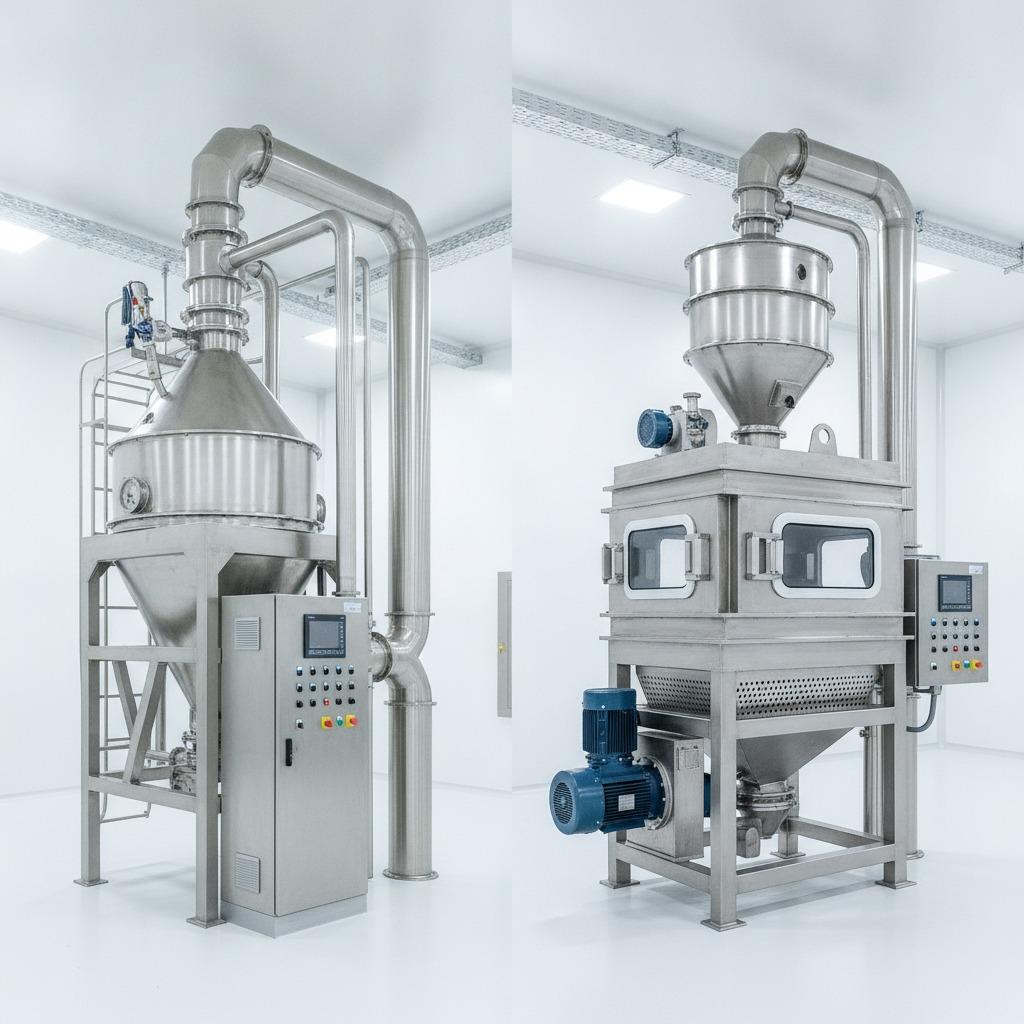
Spray drying is generally the better fit when the starting material is a pumpable liquid and the goal is to create dry powder in a single step. Fluid bed drying is usually better when you already have particles or granules that need controlled moisture removal, conditioning, agglomeration, or coating.
That sounds simple, but the overlap is where many buying mistakes happen. Some materials can be processed by either route depending on formulation, target particle behavior, and available plant space. Still, the starting point matters. Spray drying converts droplets into powder. Fluid bed drying moves hot air through a bed of solids and dries them more gently, often with more control over moisture uniformity and residence time.
How spray drying works
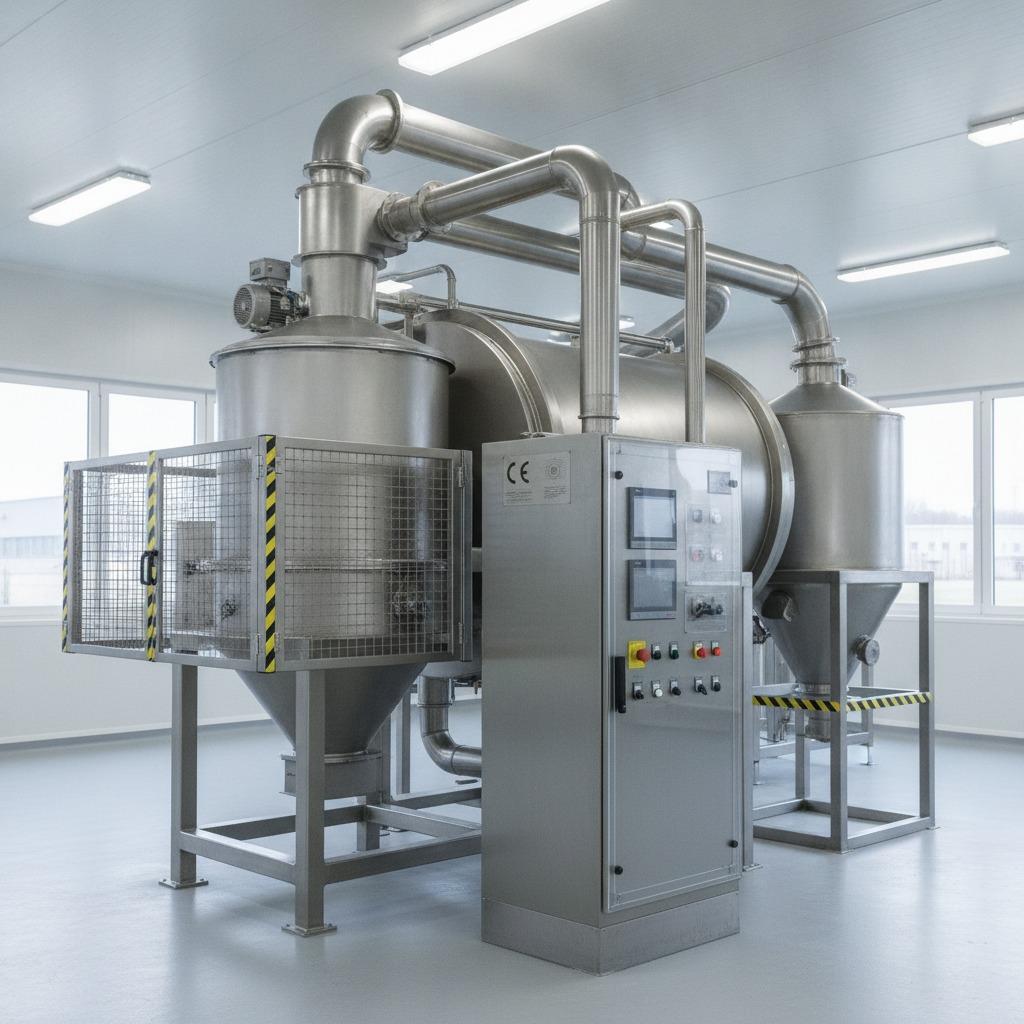
Spray drying atomizes a feed liquid into fine droplets and exposes those droplets to hot gas in a chamber. Water or solvent evaporates quickly, and dry particles are collected downstream. Because drying occurs in seconds, the process is well suited to heat-sensitive products that should not remain wet for long periods, though the inlet temperature is often high. What the material actually experiences is a much shorter thermal history than the heater setting suggests.
From a product-design perspective, spray drying is useful when you want to control particle morphology, create free-flowing powders, or convert a formulation that would be difficult to dry by tray or oven methods. It is common in dairy ingredients, instant beverages, detergents, ceramics, and certain pharmaceutical intermediates. Depending on formulation, the process can produce hollow particles, porous structures, or agglomerated powders with improved dissolution. That is an advantage, but it is not automatic; the feed solids, nozzle choice, and chamber conditions all matter.
How fluid bed drying works
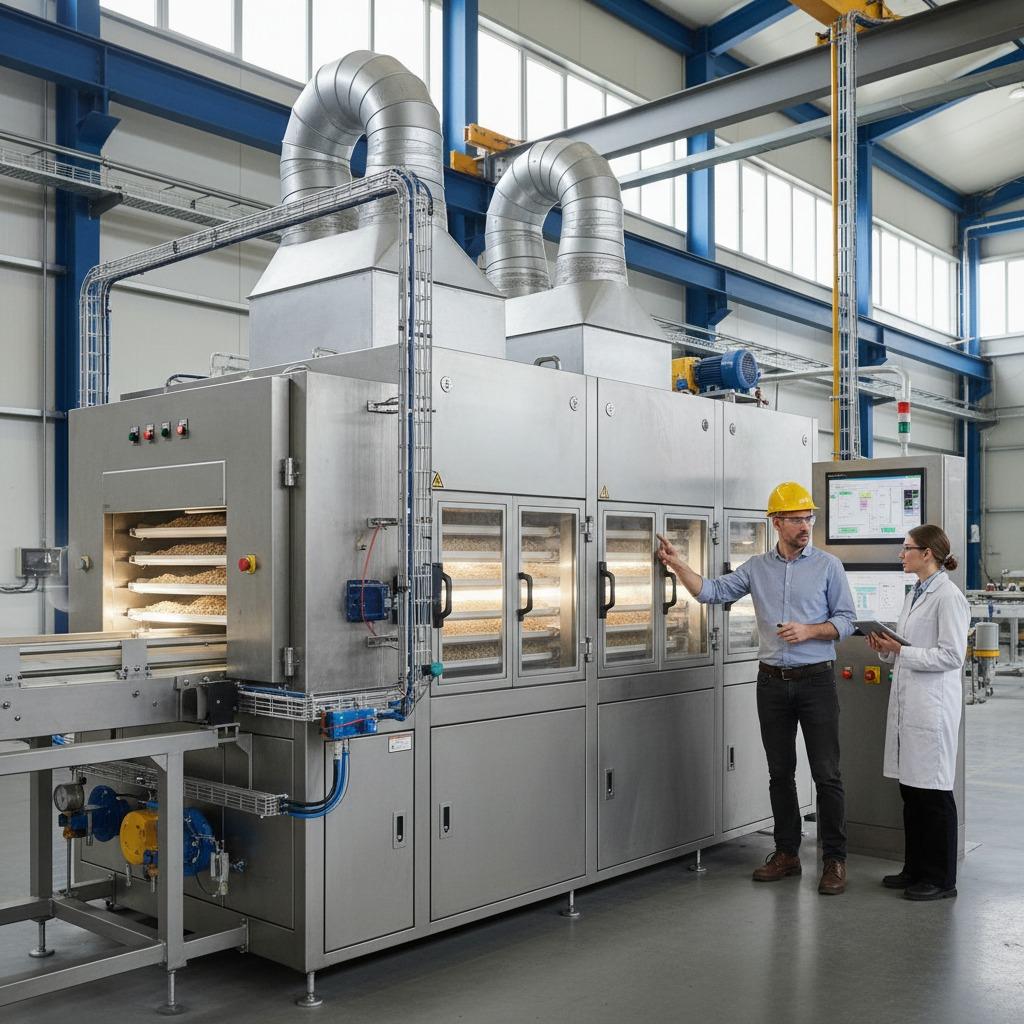
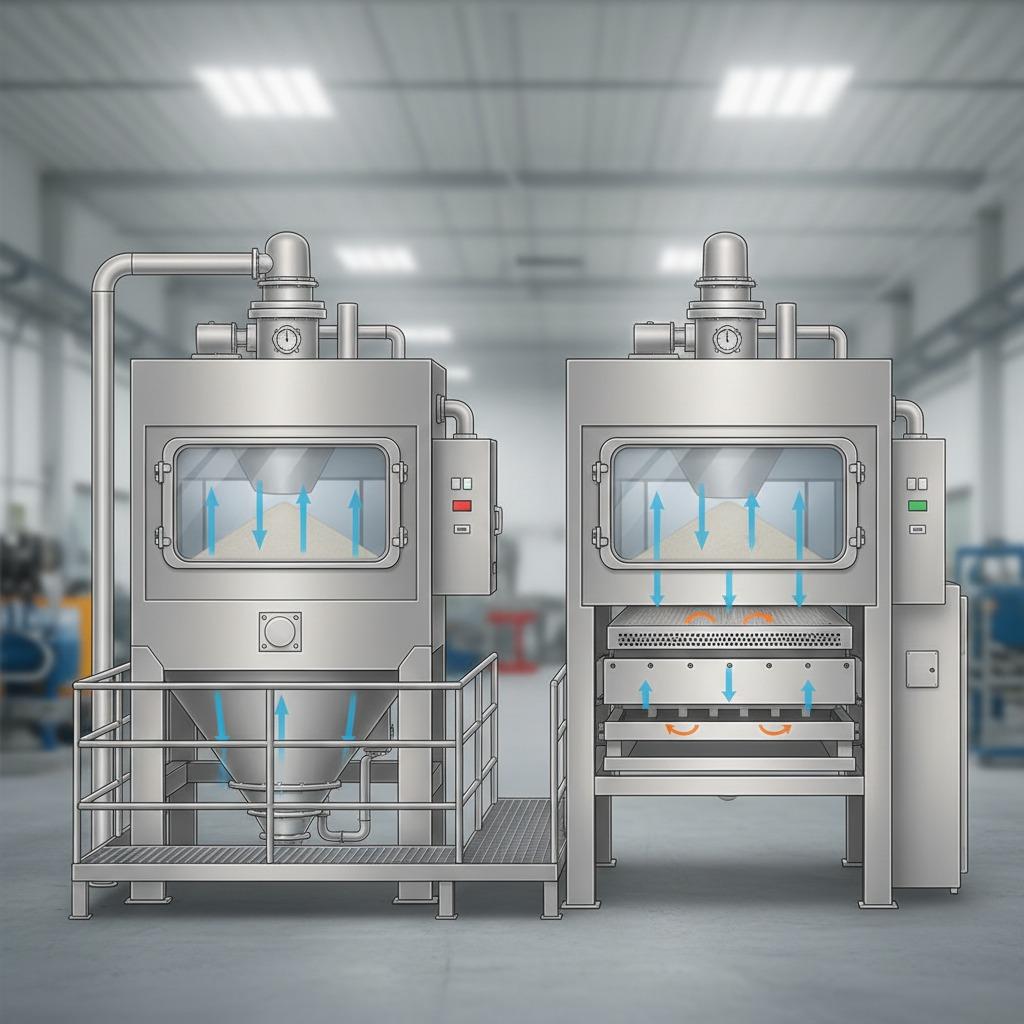
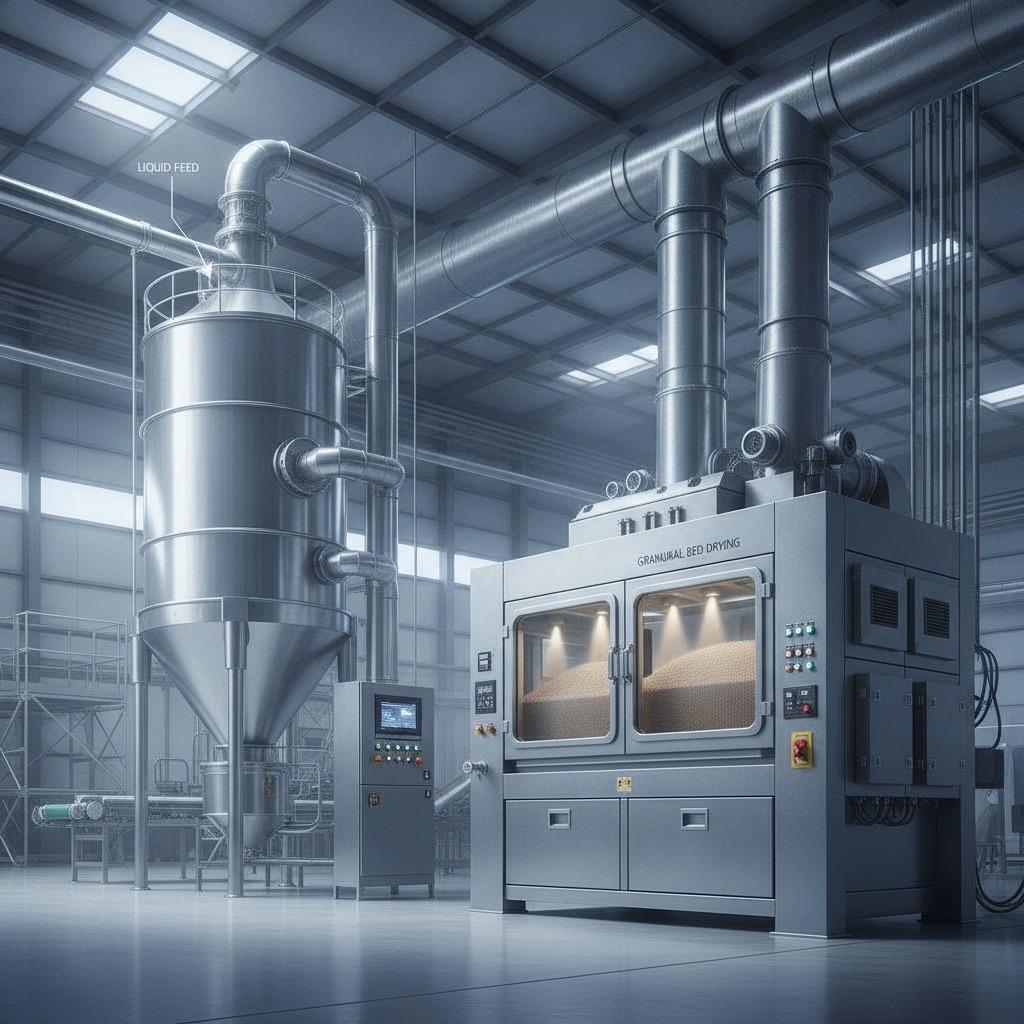
Fluid bed drying uses a stream of air to suspend and agitate particles so moisture evaporates evenly. The particles behave like a fluid, which increases surface contact and improves drying efficiency. Compared with spray drying, the process is typically gentler and is often used after a wet granulation step or after a material has already been formed into a wet cake, granule, or pellet.
In practical plant terms, fluid bed dryers are valued for uniformity and control. They can dry material without creating as much thermal stress or as many fines, and they often support additional functions such as granulation and coating. That makes them a strong choice in pharmaceutical, nutraceutical, food, and specialty chemical operations where downstream handling is sensitive to dust, segregation, or uneven moisture.
Side-by-side comparison buyers actually need
Feed form
Spray drying needs a liquid feed. If your material is already a stable powder or wet granule, forcing it into spray drying may require extra preprocessing that adds cost and complexity. Fluid bed drying starts with solids, so it fits better when the product is already partially formed.
Moisture removal style
Spray drying removes moisture almost instantly from atomized droplets. Fluid bed drying removes moisture from the particle surface and interior more gradually. The difference matters when the product is sensitive to crust formation, sticky surfaces, or nonuniform final moisture.
Particle engineering
Spray drying is often chosen for particle creation. Fluid bed drying is often chosen for particle conditioning. If your objective is new powder formation, spray drying is usually more direct. If your objective is to improve flow, reduce residual moisture, or build granules step by step, fluid bed drying is often the better tool.
Energy and footprint
Both processes use energy, but the system economics differ. Spray drying can be efficient for large volumes of liquid feed, yet it also demands atomization, air handling, and powder collection infrastructure. Fluid bed dryers may offer lower complexity for existing granules, though they can require careful control of airflow and bed loading to keep the process stable. Plant footprint, exhaust treatment, and cleaning requirements are often as important as energy draw.
Where spray drying is usually the better choice
Choose spray drying when the problem begins with a liquid or slurry and ends with a powder. It is especially useful when you need consistent powder properties from batch to batch, fast drying, or the ability to handle thermally delicate formulations with short exposure time. It is also a practical option when the target material should dissolve quickly or disperse easily in water.
Buyers should keep one caution in mind: spray drying is rarely forgiving of poor feed preparation. Viscosity, solids content, filtration, and feed stability can make or break the run. A material that looks easy in the lab may become difficult at scale if it fouls nozzles, sticks in the chamber, or produces too many fines. That is one of the reasons pilot testing is worth the time.
Where fluid bed drying usually wins
Fluid bed drying is often the better answer when the material is already in granule form and needs controlled moisture reduction without aggressive particle breakage. It is also attractive when you want tighter control over residual moisture than a conventional dryer can provide, or when the process includes granulation and coating as part of the same equipment train.
This method can be especially helpful when final product flowability and bulk handling are sensitive to even small moisture variations. In tablet manufacturing, for example, consistent drying can affect compression behavior. In food and chemical powders, it can influence caking and storage stability. If the material is fragile, though, airflow and bed motion must be set carefully; otherwise, the product can abrade and create dust.
Selection criteria that matter more than equipment brochures
For sourcing teams, the real comparison is not which machine sounds more advanced. It is which process matches the material and the business constraints. A few criteria tend to matter most:
First, look at feed state. Liquid feed points toward spray drying; existing granules point toward fluid bed drying. Second, define the product target. Are you making powder from scratch, or are you conditioning an already formed solid? Third, consider particle attributes. Flowability, density, porosity, and dispersibility all influence the answer. Fourth, review cleaning and containment needs, especially in regulated or allergen-sensitive lines. Fifth, ask what happens downstream. A drying choice that saves a few minutes but causes poor filling or packaging issues is usually a false economy.
Common mistakes in spray drying vs fluid bed drying decisions
One common mistake is assuming both processes are interchangeable because both remove water. They are not. The feed form and the desired material transformation are different. Another is underestimating how much the drying step affects the final powder’s physical behavior. Bulk density and flow angle can matter just as much as moisture content.
A second mistake is treating scale-up as a simple enlargement of lab data. Spray drying and fluid bed drying both depend heavily on airflow, residence time, particle distribution, and thermal balance. A product that dries cleanly in a small unit may behave differently in a production-scale chamber or bed. That is not a defect in the technology; it is just the nature of drying physics.
Finally, buyers sometimes focus only on throughput and ignore maintenance, dust collection, and exhaust handling. Those items can dominate operating cost over time, especially in plants that run multiple product grades or frequent changeovers.
Practical buyer advice before you issue an RFQ
If you are preparing an RFQ or equipment specification, define the product state in plain language first. State whether the feed is a solution, slurry, suspension, wet cake, or granule. Then describe the target moisture range, acceptable fines level, and any downstream requirement such as instant dissolution, tablet compression, or packaging stability. If you do not know the exact numbers yet, say so and ask vendors how they would test or narrow them down.
It also helps to separate process goals from wish-list features. A fluid bed dryer with coating capability may look attractive, but if the real need is simply to dry a spray-converted powder, that extra functionality could add cost without much return. On the other hand, if the product line regularly changes formulation, flexibility may be worth more than raw throughput.
FAQ
Can a product be made by either method?
Sometimes, yes. But the better question is which method gives the required powder properties with the least preprocessing and risk. Materials that seem flexible in theory can become difficult at scale.
Which method is better for heat-sensitive materials?
It depends on the material and the thermal profile. Spray drying exposes droplets to hot air but for a very short time. Fluid bed drying usually applies a gentler, more prolonged drying action. The right answer depends on how the formulation reacts to both heat and residence time.
Which is better for agglomeration?
Fluid bed drying is often the more natural choice if agglomeration is part of the process. Spray drying can also create agglomerated or porous powders, but it does so through formulation and atomization behavior rather than bed processing.
What to do next
If you are still deciding between spray drying vs fluid bed drying, the most efficient next step is to map your feed form, target powder behavior, and production constraints onto the process that best matches them. In many cases, the decision becomes clearer once those three things are written down side by side. If not, pilot trials and application reviews are usually worth the effort before you commit to capital equipment. Drying is one of those steps where a small mismatch can echo through the whole line, and that is better caught early than after installation.