Why a vertical boiling dryer gets attention in process plants
A vertical boiling dryer is the kind of equipment buyers start looking at when they need more than simple hot air and a tray rack. In batch processing, especially where powders, granules, or slurry-like intermediates must be handled in a contained way, the drying step can make or break the next operation. If moisture stays uneven, downstream blending, packaging, or reaction performance can drift. If the product is overheated, you may lose texture, potency, or yield. That is why a vertical boiling dryer is often judged not just on drying ability, but on how well it supports containment, inspection, discharge, and cleaning.
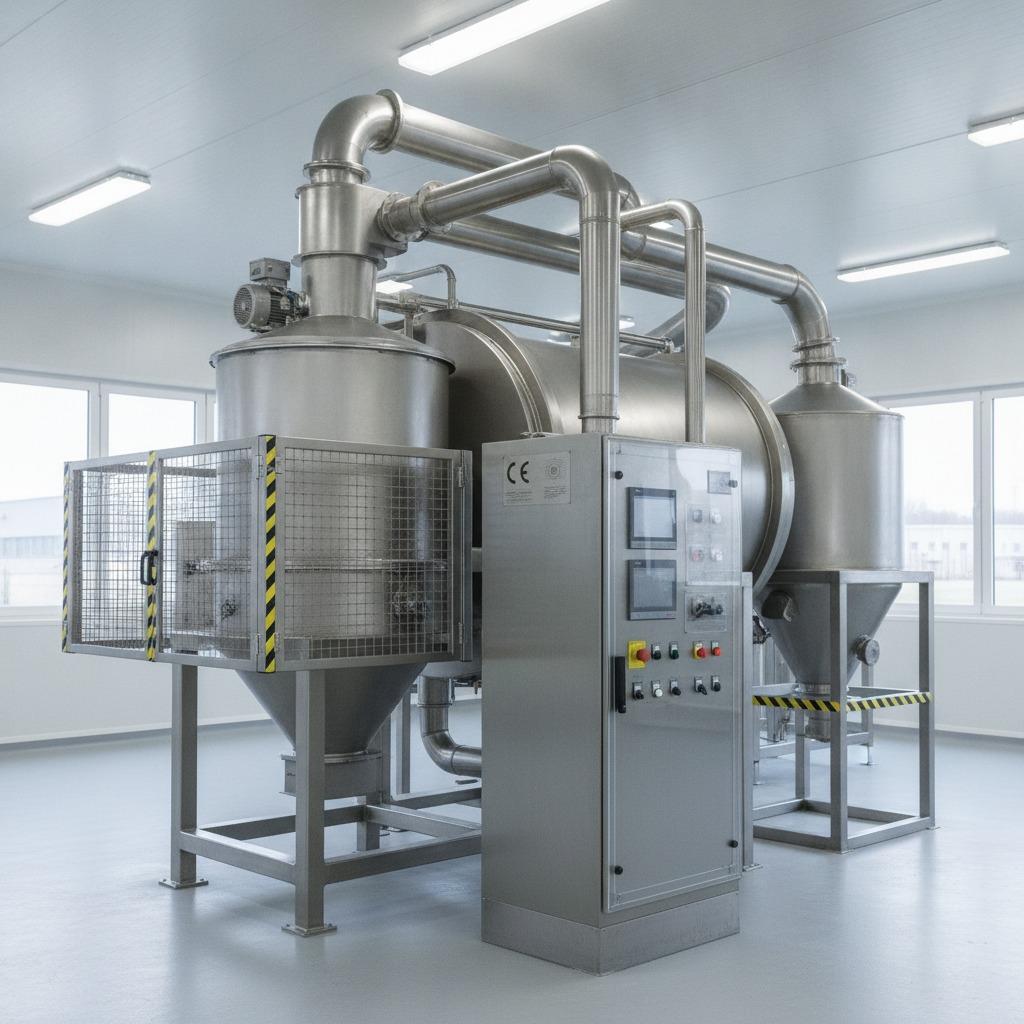
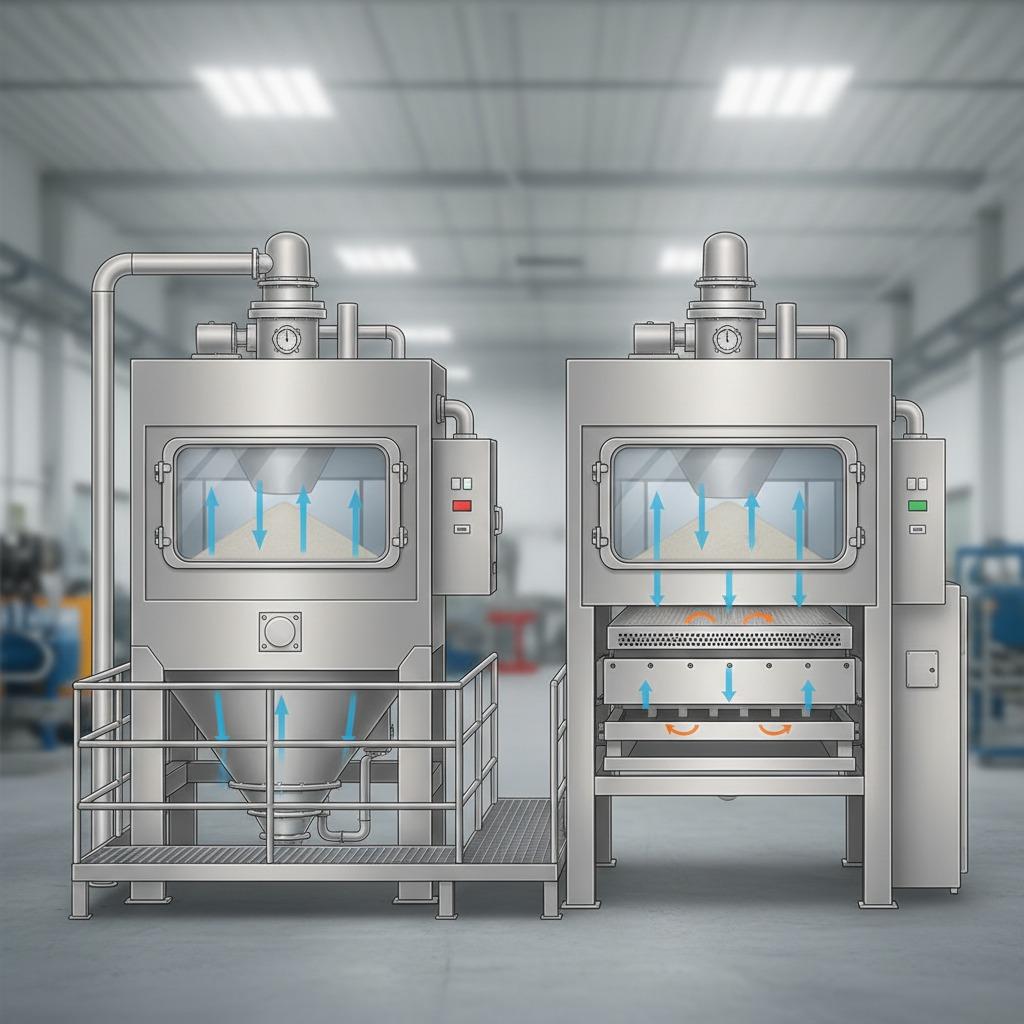
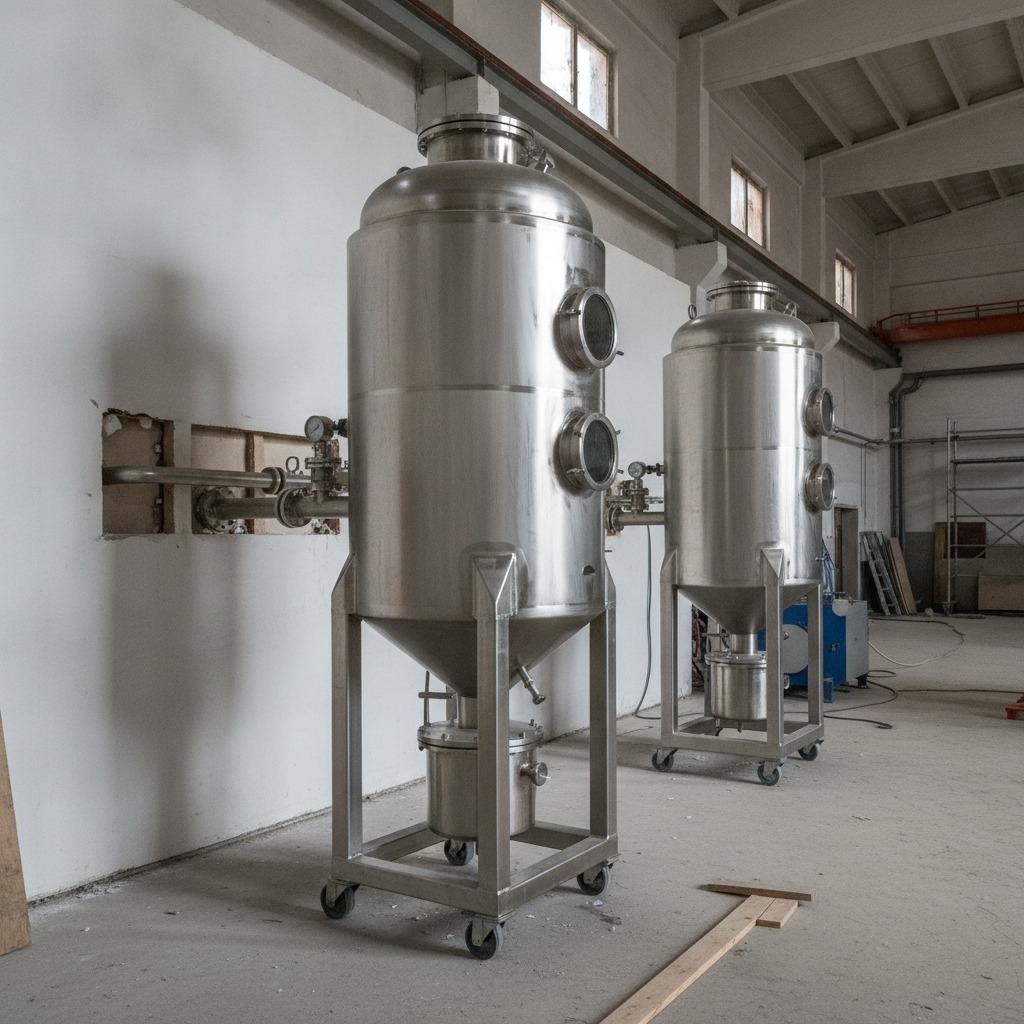
The equipment shown here suggests a tall stainless steel system with a domed top, conical lower section, round viewing ports, and a lower collection vessel. That layout points to a piece of fabricated industrial equipment built for controlled handling rather than open-air processing. The exact internal method is not provided, so it would be irresponsible to claim a specific drying mechanism. Still, the visible construction tells a useful story: this is the kind of machine chosen when the buyer cares about enclosed processing, corrosion resistance, and practical access for operators.
What buyers usually need to decide first
Before comparing suppliers, it helps to define the job the dryer must do. Many teams start with the wrong question, such as “What size do we need?” when the real question is “What material behavior are we trying to control?” A vertical boiling dryer, or any similar vertical drying vessel, is often selected for one of three reasons: to remove moisture from a solid bed, to process a wet mass in a closed environment, or to keep materials contained during transfer and recovery. Those are not small distinctions. They affect the chamber geometry, filtration needs, discharge design, and cleaning method.
In food, chemical, pharmaceutical, and material processing, the buyer also has to think about whether the machine will sit in a single-product line or serve multiple formulations. If a unit will be changed over frequently, a polished stainless steel finish and accessible ports can matter more than raw throughput. If the material is abrasive or corrosive, surface finish and fabrication quality become a bigger part of the decision than many sourcing teams expect.
What the visible construction suggests
The pictured equipment appears to be built around a tall cylindrical chamber with a conical lower section. That is a common shape in many vertical process systems because it helps gravity discharge and reduces dead zones where material can hang up. The round sight glasses or inspection ports are a useful detail. They suggest the operator is expected to monitor the condition of the batch during operation, which is often more valuable in real plants than a glossy spec sheet. A machine can look robust on paper and still be awkward to operate if no one can see inside without stopping the process.
The stainless steel finish also matters. In industrial drying and separation systems, stainless construction is usually chosen for corrosion resistance, cleanability, and durability under repeated washdown or product contact. That said, buyers should not assume all stainless grades perform the same. The exact grade is not provided here, so it would be a mistake to build a purchase case on that assumption. If the application involves aggressive chemicals, chlorides, or demanding sanitation routines, the material specification should be confirmed early.
One practical detail that is easy to overlook: the wheeled base. Mobility does not sound dramatic, but in a busy plant it can make positioning, service access, and line rearrangement much easier. Of course, casters are not always meant for frequent movement under load, so plant teams should ask whether the wheels are for final positioning only or for routine relocation. That difference can affect both safety and wear.
How this type of equipment is commonly used
Without inventing an internal mechanism, it is still reasonable to describe the common use cases for a vertical boiling dryer-style vessel. These systems are often considered for batch drying, bulk solids handling, solid-liquid separation support, or enclosed processing where product recovery matters. In practical terms, that means powders, granules, and wet intermediates can be managed in a single contained vessel rather than moved between several open pieces of equipment.
That kind of integration can reduce handling losses. It can also reduce contamination risk, which is a major issue in regulated or high-value production. For a plant manager, fewer transfers often mean fewer chances for operator error. For a sourcing manager, integrated equipment may also simplify floor layout. The trade-off is that integrated vessels tend to be more application-specific. A buyer should resist the temptation to treat them as general-purpose machines unless the supplier can demonstrate that flexibility.
Key selection criteria that matter in the field
Material compatibility
Start with the product, not the machine. If the batch is sticky, abrasive, hygroscopic, heat-sensitive, or corrosive, the equipment needs to be selected around those behaviors. A smooth polished interior helps, but it is only one piece of the picture. Discharge angle, port placement, and any internal interfaces also matter.
Inspection and access
The round viewing ports visible on the unit are not just cosmetic features. They affect how operators verify process behavior, detect buildup, and confirm discharge. In some plants, the ability to inspect without opening the vessel is a real advantage. In others, it is essential for maintaining containment.
Cleaning and changeover
When equipment is used for multiple products, cleaning time becomes a hidden cost. A sanitary-looking stainless finish is helpful, but buyers should also ask about drainability, internal corners, access to welded joints, and how easily the lower receiver can be removed or emptied. A beautiful vessel that takes too long to clean is a poor production asset.
Discharge behavior
The conical bottom section is promising, but buyers should still ask how fully the material exits the chamber. Bridging and hold-up are common headaches in vertical vessels. Even a good geometry can struggle with fine powders or cohesive wet solids. If the material does not flow consistently, the operating team ends up doing more manual intervention than they planned.
Common mistakes when buying vertical process drying equipment
One common mistake is focusing only on capacity. A large vessel that cannot handle the product’s flow behavior may underperform a smaller, better-shaped unit. Another mistake is assuming that enclosed equipment automatically solves contamination concerns. Containment is not just a closed shell; it depends on seals, ports, exhaust handling, and how the system is actually operated.
Buyers also sometimes underestimate maintenance access. Vertical machines can be compact from a footprint perspective, but compact does not always mean service-friendly. If pumps, ducts, or lower collection components are difficult to reach, routine cleaning and inspection can become a nuisance. That slows production in ways that do not always show up during supplier presentations.
There is also a tendency to skip the question of mobility. A wheeled frame is useful, but only if the plant floor, loading arrangement, and utility connections support it. If the unit will live in one place for years, the mobility feature may be a secondary benefit. If the production line changes often, it may be much more important.
Practical advice for sourcing teams
When evaluating a vertical boiling dryer or similar fabricated stainless steel vessel, ask for more than a dimensional drawing. Request details on material contact surfaces, discharge arrangement, inspection access, and the intended process environment. If the equipment is part of a larger separation or drying system, clarify which functions are built into the vessel and which depend on external utilities or companion machines.
It also helps to compare real operating priorities side by side. For example, a plant focused on hygiene may value washability above everything else. A plant handling expensive intermediates may prioritize recovery and low hold-up. A plant with frequent product changes may care most about cleanup and access. These priorities are not interchangeable, and the wrong one can distort the purchase decision.
If the supplier cannot clearly explain how the lower collection vessel interfaces with the main chamber, or how the side ducting is intended to be used, that is a warning sign. It does not necessarily mean the equipment is poor. It may simply mean the system is highly customized and requires a more careful engineering review.
Frequently asked questions
Is a vertical boiling dryer always a drying machine?
Not necessarily. The term can be used loosely in the market, and without internal design details it is safer to describe the equipment as a vertical process vessel used for drying or related bulk-material handling tasks.
Why use stainless steel?
Stainless steel is commonly chosen for corrosion resistance, cleanability, and durability in process plants. It is often the preferred material where product contact, sanitation, or washdown are concerns.
Are sight glasses really important?
Often yes. They give operators a way to monitor the batch without opening the system. In many facilities, that saves time and reduces exposure risk.
Can the same unit handle multiple materials?
Possibly, but that depends on the process, cleaning standard, and product compatibility. Multi-use is attractive, yet it should be verified carefully rather than assumed.
A sensible next step
If you are comparing a vertical boiling dryer with other enclosed drying or separation equipment, start by mapping the product behavior, not the catalog language. Then ask the supplier to explain the chamber geometry, discharge path, inspection points, and cleaning approach in plain terms. Those answers will tell you more than a polished brochure ever will.
For engineering, sourcing, and product teams, the goal is not to buy the most impressive vessel. It is to buy the one that keeps material moving, keeps operators safe, and keeps the line predictable day after day. That is where this type of stainless steel vertical equipment earns its place.