Powder blending equipment: what buyers should look for before they sign off
Powder blending sounds simple until a batch comes out streaky, segregates in transfer, or behaves differently from one run to the next. For engineers and sourcing teams, the real job is not just choosing a machine that turns, but selecting a system that gives repeatable product quality, cleans reasonably well, and fits the way material moves through the plant. That is why powder blending deserves a closer look than many purchasing conversations give it.
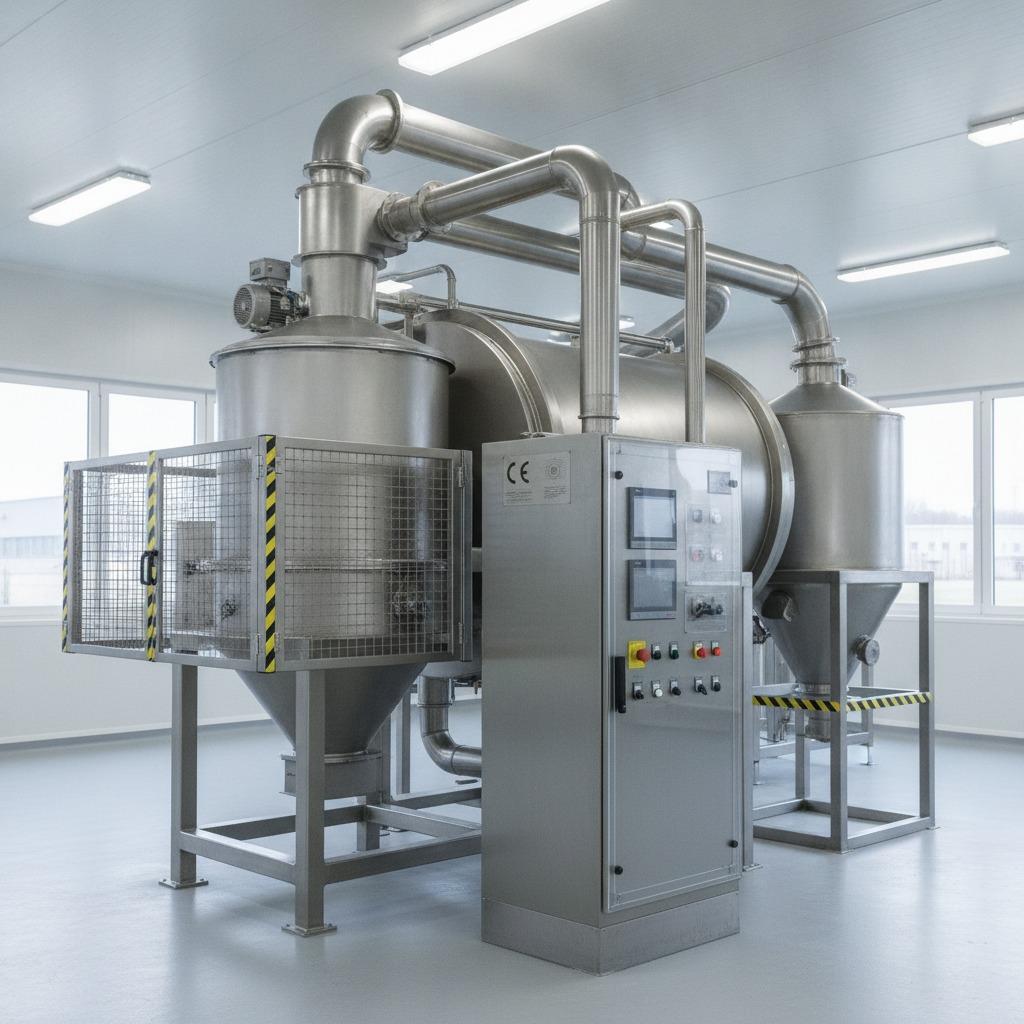
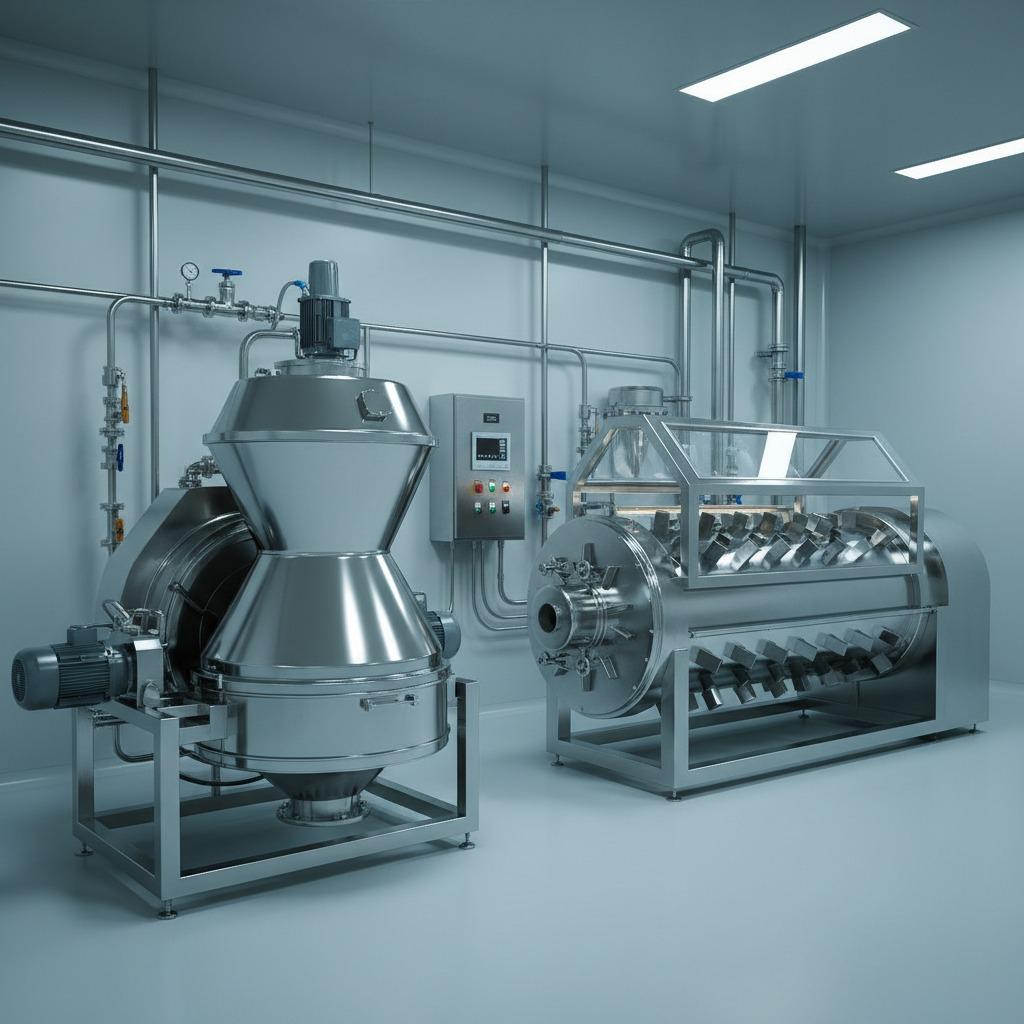
The equipment in question appears to be a stainless steel industrial rotating drum or tumble mixer, with an angled cylindrical vessel mounted on a support frame and a smaller receiving hopper or discharge unit below it. The exact model is not identifiable from the image, and it would be a mistake to claim more than that. Still, the geometry says a lot. An enclosed rotating vessel like this is usually chosen when the process calls for gentle mixing, tumbling, coating, or batch handling of powders, granules, or similar bulk materials. In a controlled production room, that can be a very practical choice.
Why powder blending matters more than it first appears
In dry processing, inconsistent blending usually shows up later than the blend step itself. A batch may look fine in the mixer, then separate during conveying, filling, or packaging. One section of a drum may carry more active ingredient than another. A lubricant or flavoring may not distribute evenly. The result is not just cosmetic; it can affect dosing consistency, taste, flow, compressibility, or downstream yield.
That is why buyers should think beyond capacity and price. The powder blending process is tied to the physical behavior of the material. Free-flowing granules behave differently from cohesive powders. Fragile particles may break down under aggressive agitation. Low-dose additives often need a machine that can distribute them without overworking the batch. A drum-style blender may be exactly right for some of these cases, but not all.
What the visible equipment suggests
From the visible construction, this looks like sanitary or process-grade equipment rather than a general-purpose shop mixer. The stainless steel finish, clamped access ports, angled vessel, and wheeled lower receiver all point toward a plant where cleanliness and controlled discharge matter. The lower hopper or tank could be used to collect blended material, move it to the next step, or receive discharge from the main vessel in a way that reduces spillage.
The angled mounting is worth noting. A rotating drum or similar tumbler can use gravity and rotation to move material through the batch without a central agitator shaft. That can be an advantage when the goal is low-shear mixing or when the material should not be beaten up. It is also common in applications where cross-contamination must be limited, because enclosed vessels are easier to manage than open-top mixers.
Quick reference: where a drum-style blender fits and where it may not
For buyers trying to narrow the field, here is the practical version.
Often a good fit
Batch blending of powders, granules, and pellets; gentle tumble mixing; product conditioning before packaging; enclosed processing where dust control matters; and operations where material is transferred by discharge rather than handled repeatedly.
May be a poor fit
Very sticky pastes; highly viscous wet masses; formulations that need intense shear; and products that demand a specific internal mixing action, such as high-speed dispersion. A drum mixer can be excellent, but it is not the universal answer some sales decks make it out to be.
Industrial powder mixing methods: why the mixing principle matters
Industrial powder mixing is not one category so much as a family of mixing principles. The right choice depends on how sensitive the product is and how the plant wants to move it.
A tumble mixer or rotating drum generally works by lifting and cascading the material through rotation. This tends to be relatively gentle and suitable for blends where preserving particle integrity matters. Other mixer types use internal paddles, screws, cones, ribbons, or high-shear motion. Those designs can produce faster mixing or handle more difficult formulations, but they may also create more heat, more wear, or more product fracture.
For a sourcing manager, the key question is not “Which mixer is best?” but “Which mixer makes the material behave the way the process needs?” That distinction sounds obvious, yet it is where many projects go wrong. A machine can be mechanically impressive and still be the wrong tool for the formulation.
Sanitary design and GMP powder blending considerations
When a machine sits in a clean process room and is built largely from stainless steel, buyers naturally start asking about hygienic use. That is reasonable, but it is also where caution is needed. The term GMP powder blending is often used broadly, sometimes too broadly. GMP expectations can vary by sector and by internal quality system. A shiny vessel alone does not establish compliance.
What matters in practice is how the machine is built, finished, sealed, cleaned, and validated in the actual production environment. Clamp-style access points, visible gaskets, and enclosed surfaces are helpful signs because they suggest a machine intended for process control and cleaning discipline. Still, the buyer should confirm the details that matter for their own line: access for inspection, drainability, dead zones, compatibility with cleaning methods, and whether the transfer path minimizes residual hold-up.
One small but important caution: if your product is sensitive to contamination, do not let a polished exterior distract from the harder question of internal cleanability. The inside of the vessel, the outlet, and any seals or fittings are where trouble usually begins.
Selection criteria that actually change performance
When comparing blending equipment, start with the product and work backward to the machine. That sounds basic, but it keeps the conversation grounded.
Material behavior: Is the powder free-flowing, cohesive, abrasive, fragile, or prone to segregation? A rotating drum may be ideal for one and frustrating for another.
Batch size and fill level: Blenders generally work within a useful fill window. Too little material can lead to poor movement; too much can reduce the tumbling action. Capacity should always be tied to the real working batch, not just the vessel volume.
Discharge method: The visible bottom outlet suggests a gravity-assisted discharge path. That can be efficient, but it should be checked against powder flow behavior. Some powders bridge, hang up, or retain pockets in the cone or outlet.
Cleaning and changeover: In multiproduct plants, time spent cleaning is real production time. Enclosed stainless steel equipment can help, but only if the geometry and access points support practical cleaning.
Mobility and layout: The wheeled lower unit indicates movement may be part of the workflow. That can help with flexible lines, but it also means operators will care about stability, locking, and how the receiving container interfaces with the rest of the process.
Common mistakes buyers make with powder blending systems
The first mistake is overspecifying capacity and underspecifying the mix mechanism. A larger machine is not necessarily a better one if the batch only occupies a small part of the vessel.
The second is assuming all stainless steel process equipment behaves the same. Surface finish, weld quality, seal design, and access geometry matter. Two machines may look similar from across a room and perform very differently in service.
The third is ignoring downstream handling. A batch that blends well but discharges poorly can create more labor and more variability than it solves. The discharge path is part of the blending system, not an afterthought.
The fourth is treating material trials as optional. For powder and granule work, real samples are often worth more than a stack of brochures. Small differences in density, moisture, or particle shape can change the result more than buyers expect.
Practical advice for sourcing and production teams
If you are evaluating a machine like the one shown, ask for a process conversation rather than a generic quotation. Bring the supplier the product family, not just the capacity target. Explain whether the batch is dry or lightly conditioned, whether segregation is a concern, and whether the discharge needs to feed downstream packaging, a tote, or another vessel.
Also ask how the machine will be supported in daily use. Who loads it? Who opens and closes the access point? How is it cleaned? What happens if the material cakes at the outlet? These are not side questions; they determine whether the equipment becomes a dependable workhorse or a maintenance headache.
If the operation involves food, pharma, nutraceuticals, cosmetics, or specialty chemicals, align engineering and quality before release. A blending system that looks right but does not fit your internal sanitary rules can delay commissioning and create expensive rework.
FAQ: a few questions buyers keep asking
Is a rotating drum always the best choice for powder blending?
No. It is often a strong choice for gentle batch mixing, but not for every material or every mixing goal.
Can the same equipment be used for mixing and discharge?
Yes, in many systems the blender and discharge function are closely linked. That is useful, but only if the outlet design supports smooth flow and easy cleaning.
Does stainless steel guarantee hygienic performance?
Not by itself. Stainless construction helps, but surface finish, seals, access, and cleanability still need review.
What should be tested first?
The material itself. Blend behavior, segregation tendency, and discharge performance are usually more informative than a simple mechanical spec sheet.
What to do next
If you are comparing powder blending equipment for a new line or a replacement project, start with your material behavior and product flow, then match the mixer type to those realities. A stainless steel rotating vessel like the one shown may be a sensible fit for controlled batch processing, especially where gentle tumbling and enclosed discharge are useful. But the decision should still be based on trial data, cleaning needs, and how the machine fits the rest of the process.
For a buying team, that is the useful question: does this blender improve consistency without adding hidden labor? If the answer is yes, you are probably looking in the right direction.