Why a double cone vacuum dryer still matters in modern processing
A double cone vacuum dryer is one of those machines that looks simple from the outside and yet solves a stubborn production problem: how to dry powders, granules, and crystalline solids evenly without overheating them or beating them up. For engineers and sourcing teams, that matters because drying is rarely just a utility step. It affects flowability, impurity risk, product appearance, downstream blending, and sometimes the difference between a clean batch and a rework headache.
In plants handling heat-sensitive or fragile materials, the appeal is straightforward. A rotating conical vessel gently tumbles the charge while reduced pressure helps remove moisture at lower temperatures than atmospheric drying. That combination is why a conical vacuum dryer is often considered when a process calls for low mechanical shear, controlled heat exposure, and a closed system. It is not the only answer, and it is not always the fastest answer, but it has a place when product quality matters more than brute throughput.
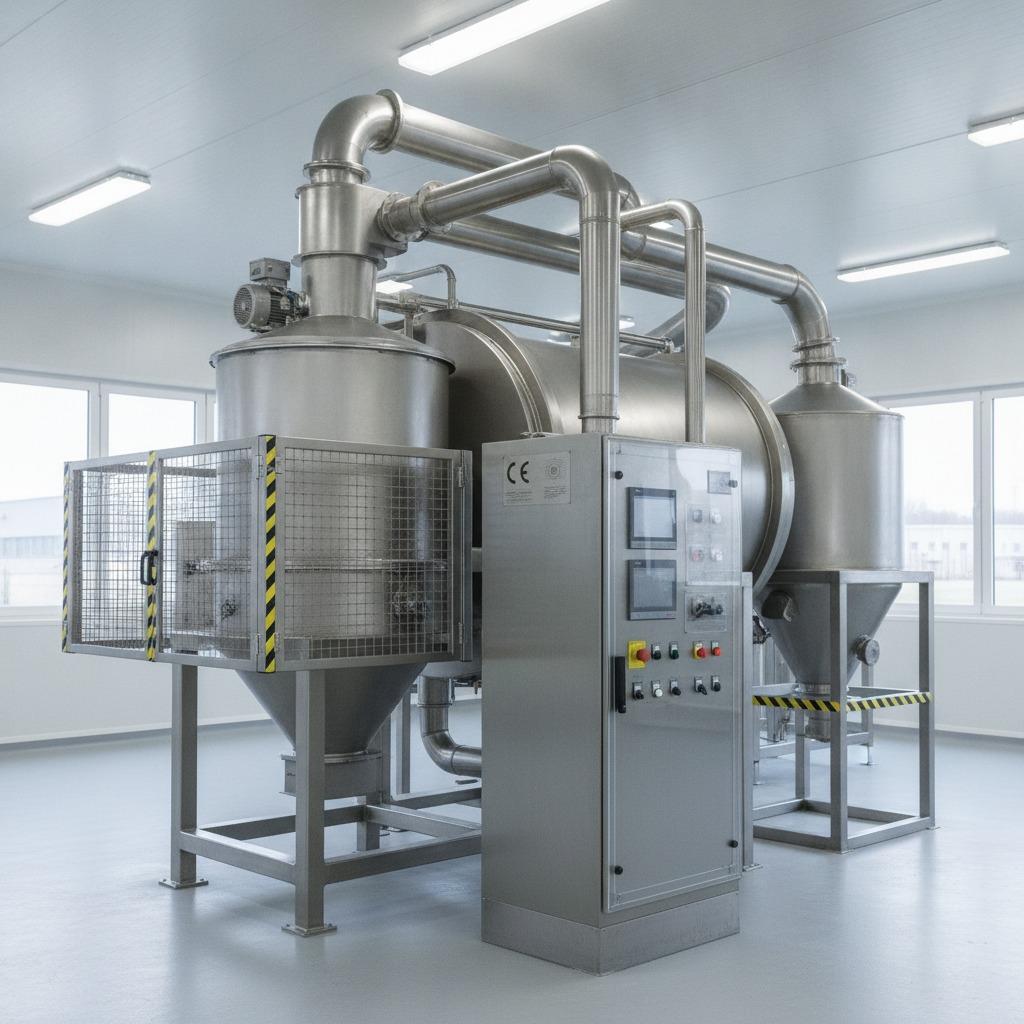
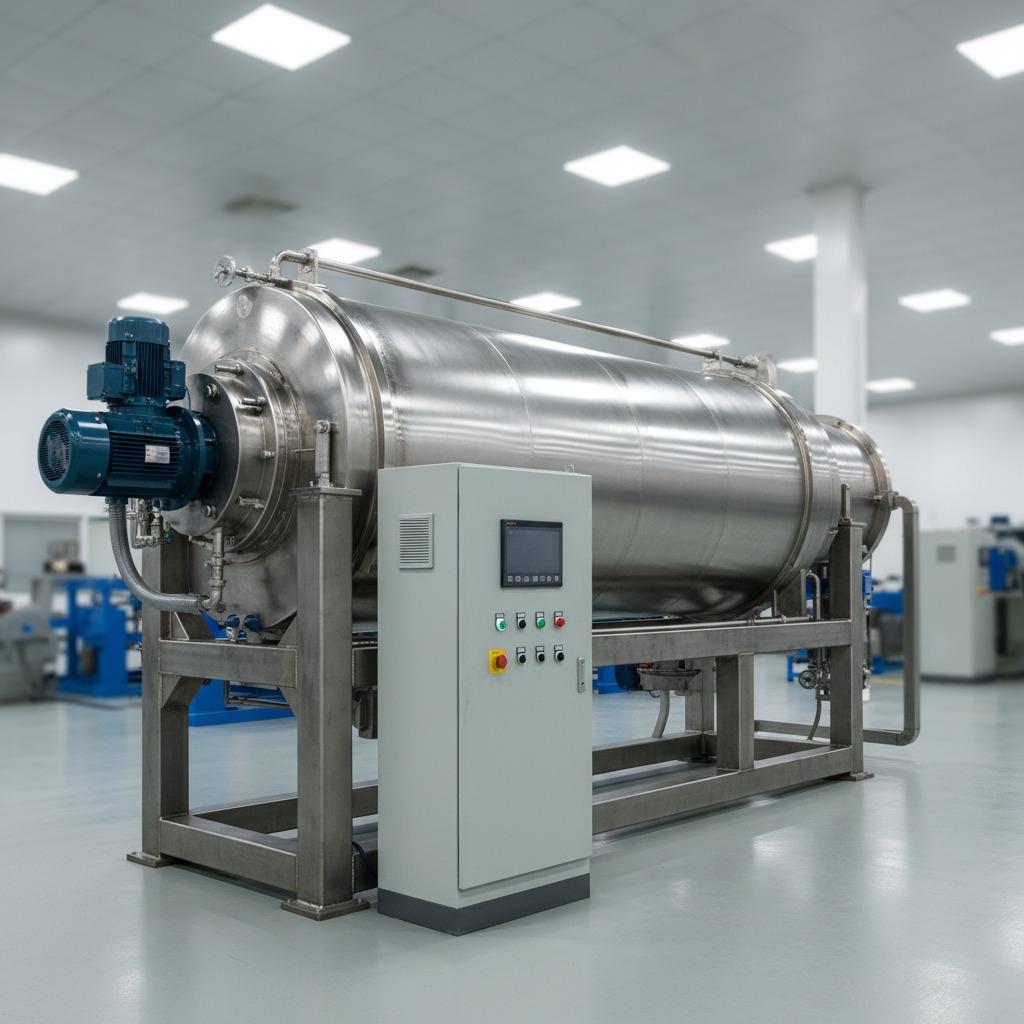
The machine shown in the preparation data appears to be a large, floor-mounted industrial unit with a double-cone rotating vessel, heavy framing, and an integrated control enclosure. I would treat that as a representative example of the category rather than proof of any exact model or specification. The useful question for buyers is not what brand it is, but whether this type of industrial vacuum dryer fits the material, the batch size, and the plant’s handling philosophy.
What the machine does, in practical terms
A double-cone vessel rotates so the batch lifts, falls, and redistributes continuously. That tumbling action is mild compared with many mixers, which is part of the point. The vessel geometry encourages solids to move and expose fresh surfaces without the intense shear associated with paddle or ribbon systems. When vacuum is applied, moisture or solvent can be removed at lower temperatures, which is especially important for products that degrade, discolor, or agglomerate when overheated.
This is why the equipment shows up in chemical, pharmaceutical, food, pigment, and fine powder processing. It is used for wet crystals, powder blends, granules, and other solids that benefit from uniform drying in a closed vessel. The enclosed design also helps contain dust and reduce exposure during processing, although actual containment performance depends on the sealing, the charging and discharge arrangement, and the plant’s operating discipline. That last point is worth stressing; too many buyers assume an enclosed machine automatically means a clean process. It does not.
Where the double-cone design has an advantage
The double-cone form gives the machine a specific operating character. It is gentle, batch-oriented, and relatively easy to understand from a maintenance and process-control standpoint. Compared with some continuous drying systems, it may be slower, but the batch approach can be an advantage when formulations vary, cleaning is important, or changeovers are frequent. A rotating conical drying mixer also tends to suit products that should not be ground down or broken apart during drying.
For a sourcing manager, this often translates into a decision between productivity and product integrity. If the plant needs continuous high-volume evaporation, another platform may be more efficient. If the product is expensive, fragile, or difficult to handle, the lower-shear batch approach can save money in ways that do not show up on the equipment quote.
Quick comparison: when this type of dryer is a good fit
It helps to think in terms of material behavior rather than machine labels.
A double cone vacuum dryer is generally a strong candidate when the material is:
• heat-sensitive and should be dried at lower temperatures
• prone to dusting or contamination in open handling
• free-flowing enough to tumble without sticking severely
• a batch product with moderate to large lot sizes
• valuable enough that gentle handling matters
It is usually less attractive when the material is:
• very sticky or pasty before drying
• highly heterogeneous and needs intense agitation
• better suited to continuous processing
• so difficult to clean that a different vessel geometry would be simpler
None of those are hard rules. Process development can change the picture. But these are the questions a competent buyer should ask early, before the purchase process gets stuck on price alone.
Selection criteria buyers should not skip
The biggest mistake with a low temperature drying machine is treating it like a commodity. It is not. The vessel may look generic, but the process details are what make or break performance.
1. Material behavior during tumbling
Some solids cascade cleanly. Others smear, bridge, or form deposits. If the product tends to cake, the double-cone geometry may still work, but only after test batches confirm that the vessel rotation produces acceptable movement. The wrong assumption here can waste weeks.
2. Heat transfer strategy
Buyers should understand how heat reaches the batch and how moisture leaves it. Vacuum alone does not dry anything. The system must still deliver heat through the jacket, internal surfaces, or another heating arrangement. Because the preparation data does not confirm the heating source, it would be unwise to assume steam, hot water, or thermal oil. Each option affects energy use, control stability, and maintenance.
3. Sealing and discharge design
Vacuum performance depends on the integrity of the vessel, ports, and rotating interfaces. Discharge also matters more than some teams expect. A clean drying cycle can be undone by a messy outlet design that leaves residue behind or slows batch turnaround.
4. Cleaning expectations
For multiproduct plants, the time needed to clean the vessel and adjacent surfaces can matter almost as much as drying time. A conical vacuum dryer with a rigid base frame and enclosed body may be robust, but buyers should still ask how access is handled and how residue is removed. Some equipment looks easy to clean until the first difficult validation or sanitation run.
5. Controls and operator visibility
The visible control panel in the supplied material suggests a fixed industrial installation, which is sensible for this kind of machine. Still, control sophistication varies widely. A sourcing team should clarify what is actually monitored: temperature, vacuum level, rotation, alarms, interlocks, batch records, or simply basic start-stop functions. That distinction affects both process consistency and operator training.
Common mistakes in specifying this equipment
One common error is overemphasizing vessel volume while ignoring the material’s fill behavior. The nominal size of a dryer is not the same as its useful operating capacity. Another is assuming that all stainless-looking machines are equally corrosion resistant. Surface finish and material grade matter, but the preparation data does not identify the exact grade, so that should be verified during RFQ and FAT discussions.
Another practical mistake is asking for “a vacuum dryer” without defining whether the process needs gentle mixing, solvent recovery compatibility, low temperature operation, or just moisture removal. Those are not interchangeable requirements. A good vendor will ask those questions back. If they do not, be cautious.
How this type of unit compares with other drying approaches
Compared with tray drying, a double cone vacuum dryer generally offers better enclosure and more consistent batch tumbling. Compared with high-shear systems, it is gentler. Compared with continuous drying lines, it is usually more flexible but less suited to relentless high-throughput service. That is the tradeoff in one sentence: control and gentleness versus speed.
For many plants, that is exactly the right compromise. Pharmaceutical and specialty chemical teams often prefer a batch vessel when product integrity, contamination control, and process visibility are key concerns. Food and pigment applications can also benefit, though the fit depends on moisture profile and cleaning requirements. The wrong use case usually shows up as clumping, long cycle times, or poor discharge behavior.
What to ask before issuing a purchase order
Before committing to a double cone vacuum dryer, buyers should ask for process-relevant data, not marketing language. Request the operating range, the materials of construction, the vacuum capability, the rotation arrangement, and the heating method. If the machine will handle solvents or sensitive compounds, ask how vapors are managed and what downstream recovery or condensation equipment is expected.
It is also sensible to ask for references from applications that are genuinely close to yours. “Chemical industry” is too broad to be helpful. A pigment powder and a wet crystalline intermediate can behave very differently inside the same vessel. One may discharge smoothly; the other may prove stubborn. That difference is why sample trials and process discussions are worth the time.
Practical buyer advice from the floor, not the brochure
If your team is evaluating a conical vacuum dryer, start with the product itself. Bring in data on particle size, moisture content, stickiness, solvent content, heat sensitivity, and expected batch size. Then map those traits against the machine’s likely strengths: enclosed operation, gentle tumbling, and low-temperature drying. That sequence is far more useful than starting with horsepower or polished metal photos.
Also, think beyond the dryer body. Loading method, discharge method, cleaning access, utility connection points, and maintenance clearance often determine whether a machine is pleasant to operate or a constant nuisance. A rigid floor-mounted installation, like the one indicated in the preparation data, can be excellent for stability and heavy batch work, but it also commits valuable floor space and usually demands careful layout planning.
FAQ
Is a double cone vacuum dryer only for vacuum service?
Not necessarily. Some units may be used in atmospheric or partially enclosed service, but the name usually implies vacuum drying capability. Always confirm the actual operating mode rather than relying on a general category label.
Can it blend as well as dry?
Many users rely on the tumbling action for gentle blending during drying, but it is not a universal mixer replacement. The blending performance depends on fill level, material properties, and rotation behavior.
Is it suitable for fragile crystals?
Often yes, because the shear is relatively low. That said, fragile does not always mean easy. Some crystal forms break down or stick under vacuum, so material testing is still important.
What should be verified from the supplier?
At minimum: capacity, heat source, vacuum rating, rotation details, material of construction, discharge arrangement, and control scope. If those are not clearly documented, the machine is not ready for serious procurement review.
Next step for buyers and engineers
If you are narrowing options for a double cone vacuum dryer, the smartest next step is a structured process review: material profile, batch goals, cleaning requirements, and utilities. That will tell you whether this machine is a fit, a maybe, or the wrong tool altogether. A good supplier should be able to discuss the process in plain language, not just the frame and finish.
For teams comparing drying equipment, treat the conical vacuum dryer as a precision batch tool. When the product and process suit it, it earns its keep. When they do not, it can be an expensive piece of stainless steel taking up space. The difference is usually in the specifications you insist on before the order is placed.