Why powder blending is harder than it looks
Powder blending sounds straightforward until a batch comes out striped, segregated, dusty, or simply inconsistent. In manufacturing, powder blending is rarely just about turning on a mixer and waiting. It is about getting the same composition, flow behavior, and downstream performance from one batch to the next, and doing it without creating contamination or handling problems along the way.
That matters because dry solids do not behave like liquids. Particle size, density, shape, electrostatic charge, moisture pickup, and flowability all influence the final mix. A formulation that looks uniform in the vessel can still separate during transfer, packaging, or filling. For engineers and sourcing teams, the practical question is not whether the machine can turn. It is whether the blending system can deliver repeatable batch quality, fit the cleaning regime, and move material safely through the plant.
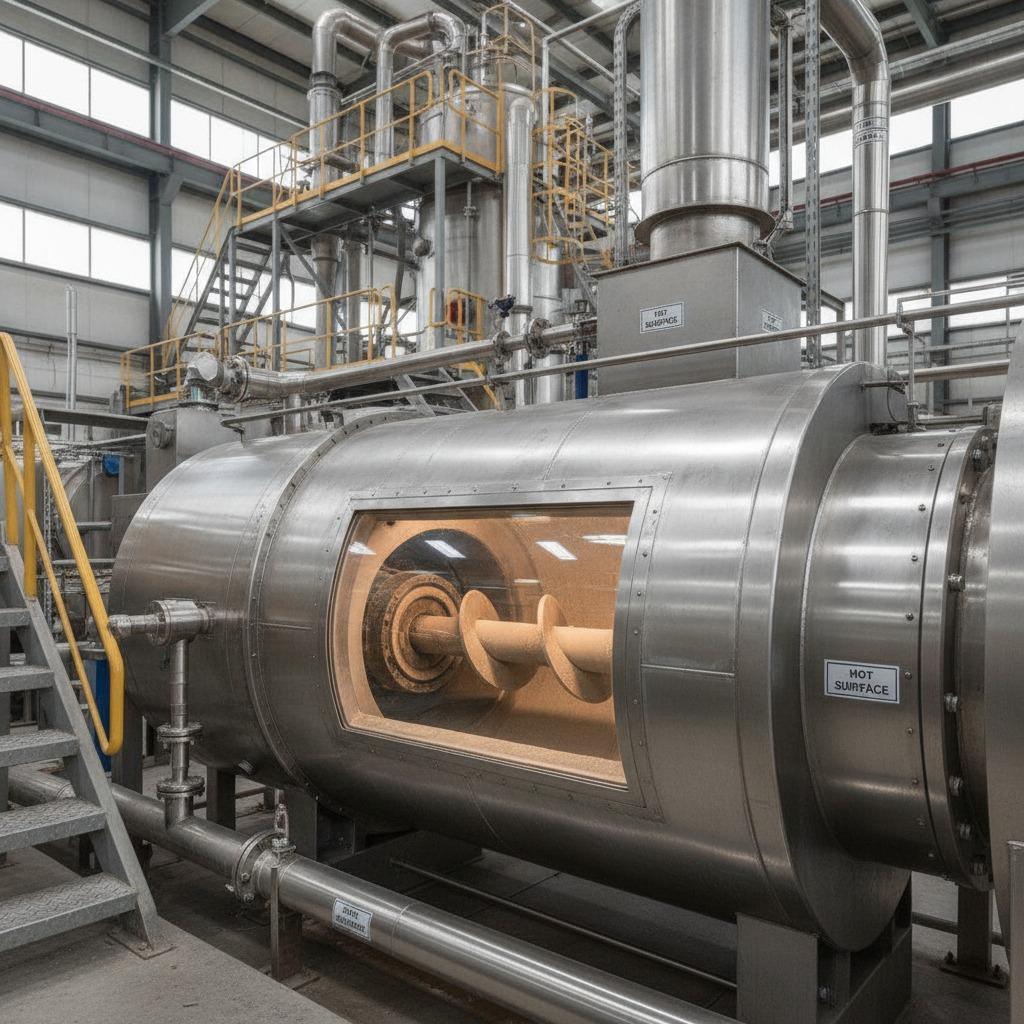
The equipment in the provided material appears to be a stainless steel rotating drum or tumble mixer arrangement, with a closed vessel mounted at an angle and material discharged into a hopper/bin through a flexible sleeve. That setup is commonly associated with controlled handling of dry powders, granules, or similar bulk solids in sanitary or process environments. The exact model and internal mechanism are not visible, so it is better to treat the machine as a representative example of a closed industrial mixing and transfer system rather than a confirmed machine type.
What the powder blending process is really trying to control
The powder blending process is about more than visual uniformity. A good process manages three things at once: distribution, containment, and transfer. Distribution means the ingredients are mixed evenly. Containment means dust and cross-contamination stay under control. Transfer means the blended material can leave the mixer and enter the next step without undoing the work.
That last point is often underestimated. Many batches blend well inside the vessel, then segregate during discharge because the outlet is too aggressive, the drop height is too high, or the receiving bin is poorly matched. In a plant, the quality problem may not show up until much later, when tablets vary, seasoning coverage looks patchy, or a filler machine starts to run inconsistently. By then, the batch is already expensive.
Closed stainless steel systems help because they limit exposure to the room, reduce cleaning burden, and support a more controlled flow path. The visible clamped ports, access lids, and flexible discharge connection in the image suggest the design is meant to keep material contained rather than open to the environment. That is a useful clue for buyers evaluating sanitary or controlled-process applications.
Common industrial powder mixing equipment types
Not every blender works the same way, and choosing the wrong geometry can create avoidable trouble. For a quick comparison, here is the practical distinction buyers usually care about.
Tumble blenders and rotating drums
These rely on the motion of the vessel rather than a high-shear impeller. They are often chosen for gentle mixing of dry solids, especially when particle integrity matters. A rotating drum can be a sensible choice for granules, pellets, or powders that need low-breakage handling. The tradeoff is that very cohesive powders may need longer blending time or a different mixer design.
Ribbon or paddle mixers
These use internal mixing elements and are often more aggressive. They can work well for many industrial blends, but they are not always the best fit for fragile particles or delicate coatings. They can also create more cleaning complexity if the product is sticky or prone to buildup.
Closed transfer and discharge systems
Sometimes the challenge is not blending itself, but moving material between steps without dusting or segregation. A lower hopper, discharge valve, and flexible sleeve, like the arrangement visible here, point toward a controlled transfer path. In many plants, that is where the real value sits: not the mixer alone, but the way the mix is emptied, collected, and fed downstream.
Where stainless steel matters
Stainless steel is the obvious material choice in a lot of powder handling applications, and not because it looks good on a brochure. It is used because it is durable, cleanable, and compatible with many sanitary or process environments. The reflective finish in the visible equipment suggests an emphasis on hygiene and easy maintenance, though the exact grade is not identifiable from the image.
For powder blending, surface condition matters nearly as much as base material. Smooth, welded, easy-to-access surfaces are easier to clean and less likely to trap residual fines. That matters in food, pharmaceutical, and chemical production where carryover can affect product quality or trigger a cleanup headache. It is worth noting, though, that shiny stainless alone does not make a system sanitary. Weld quality, gasket selection, dead-leg reduction, and cleaning access still decide whether the equipment performs well in daily use.
Selection criteria buyers should actually use
When sourcing a mixing system, it is tempting to start with capacity and price. Those matter, but they are not the first question. The first question is: what kind of powder are we handling, and what failure would be most expensive?
If the material segregates easily, gentle tumbling may be better than high-shear mixing. If dust control is critical, a closed discharge arrangement may matter more than raw throughput. If the plant changes products often, easy access and cleanability may be the deciding factor. And if the operation is part of a regulated workflow, GMP powder blending practices can push the buyer toward enclosed systems with documented cleaning and controlled transfer points.
A few practical points usually help separate strong candidates from merely adequate ones:
First, confirm whether the material needs blending, coating, deagglomeration, or simple transfer. Those are not the same job. Second, look closely at discharge behavior. A machine can be excellent at mixing and still poor at emptying. Third, consider whether the process needs batch flexibility. Rotating drum systems are often chosen for batch work because they can be straightforward and gentle, but they are not universal. Finally, check how the unit will be cleaned. The best mixer is the one maintenance can actually keep clean on a Monday morning.
Why GMP-style powder blending places extra demands on equipment
In GMP powder blending environments, buyers usually care about more than throughput. They care about traceability, repeatability, containment, and cleaning validation or at least cleaning confidence. Even when an equipment supplier does not explicitly label a machine as pharmaceutical-grade, the design cues still matter: enclosed vessel, sanitary finishes, controlled ports, and minimized exposure to ambient contamination.
The visible clamping hardware and closed vessel structure suggest a machine built with controlled access in mind. That is useful, but it is not enough to assume any specific compliance level. A cautious buyer should still verify documentation, material traceability, surface finish requirements, and the cleaning method expected by the plant. It is one thing to look sanitary; it is another to hold up under audit.
Common mistakes in industrial powder mixing
One common mistake is treating every powder as if it behaves the same. Fine cohesive powders, free-flowing granules, and fragile coated particles all respond differently to motion. Another is overfilling the mixer. Reduced headspace can change tumbling behavior and lead to poor homogeneity. A third mistake is ignoring discharge segregation. If the outlet dumps material too quickly into a tall bin, a carefully blended batch can separate before it reaches packaging.
There is also a tendency to focus on the visible vessel and forget the support equipment. Valves, sleeves, clamps, and the receiving hopper can have just as much influence on process success. In the provided equipment, the mobile base, flexible sleeve, and lower hopper/bin all suggest a system designed as a complete handling step, not just a mixer sitting in isolation. That is the right way to think about it.
Questions to ask before you buy
Before specifying a powder blending machine or a connected discharge system, ask for the answers that will actually affect production:
What material types will be processed, and what range of bulk density and particle size should the equipment handle? How is the batch loaded, blended, and discharged? Is the vessel intended for gentle tumbling or more active mixing? How is dust contained during transfer? What cleaning access is available? Can the system be moved, integrated, or reconfigured if the line changes later?
And one more, often overlooked: what happens if the batch is not perfectly free-flowing? A lot of systems look excellent in a showroom environment and become awkward when a sticky or slightly damp powder arrives on the floor. That is where practical design earns its keep.
Buyer takeaway
If you are comparing industrial powder mixing options, focus on the whole material path, not just the drum or blender. The quality of industrial powder mixing depends on the mixer geometry, the discharge method, the cleanliness of the enclosure, and how safely the batch moves to the next step. The stainless steel rotating vessel and hopper-style discharge arrangement shown here point toward a closed, controlled approach that can be useful in sanitary or process-heavy plants, but the final fit still depends on your product and your cleaning requirements.
For sourcing teams, the next step is usually to map the material behavior first and the machine second. For engineers, it is worth checking how the mixer will be charged, blended, emptied, and cleaned as one connected sequence. That is where most surprises live.
FAQ
Is powder blending the same as powder transfer?
No. Transfer moves material from one point to another. Blending aims to make the batch uniform. A system can do one well and struggle with the other.
Why choose a closed stainless steel system?
Closed stainless steel equipment can help with cleanliness, dust control, and product protection. It is common in controlled manufacturing environments, especially where material exposure needs to be limited.
What is the biggest risk in powder blending?
Segregation is one of the biggest risks. Even a well-mixed batch can separate during discharge, transport, or filling if the process is not designed carefully.
Is a rotating drum always the best option?
No. It can be a very good option for gentle batch blending, but the right choice depends on powder behavior, cleaning needs, and downstream handling.
Next step
If you are evaluating equipment for powder blending or controlled dry-material discharge, compare the mixer, the transfer path, and the cleanability as a single system. That approach usually gives a more reliable result than judging the vessel alone. If needed, request process drawings, material specs, and a layout review before committing to the final configuration.