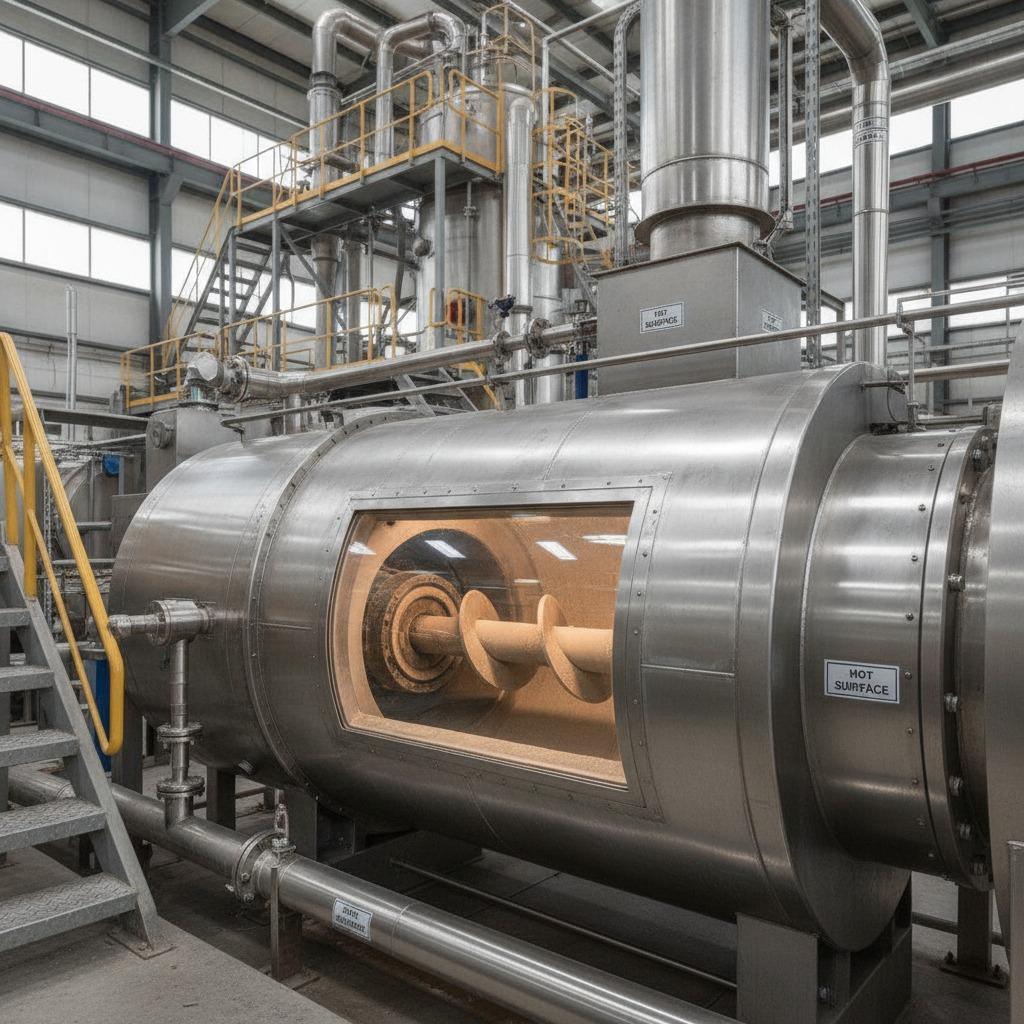
Why industrial drying technology is rarely just “drying”
In most plants, industrial drying technology is not a single machine with a single job. It sits inside a wider handling system that may store, move, separate, heat, cool, or condition bulk solids before they reach the next operation. That matters because the drying step is often blamed for problems that start elsewhere: poor feed consistency, sticky product, dust carryover, heat loss, or an awkward transfer layout that never quite worked from day one.
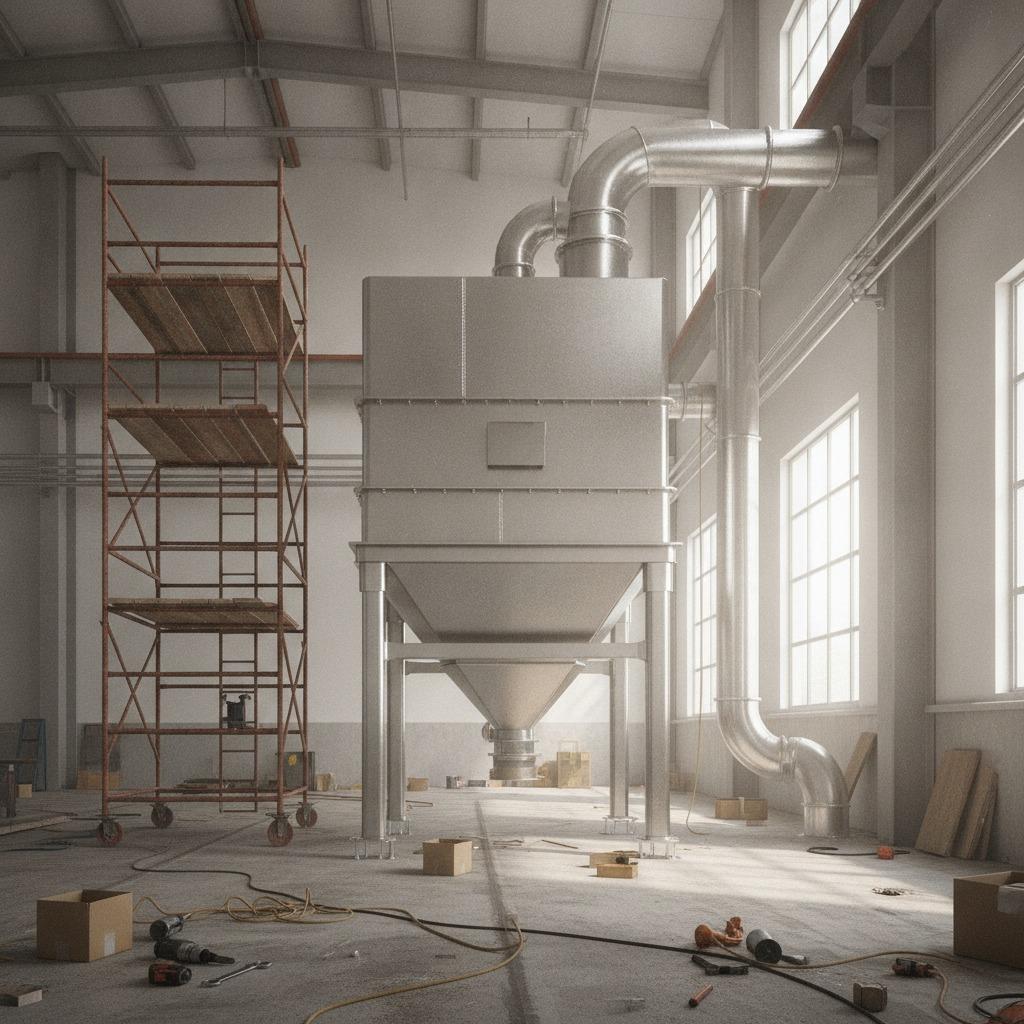
The equipment shown in the provided material fits that broader reality. What is visible is an integrated stainless-steel process line with hoppers, ducting, transfer units, valves, and support frames. It could be part of a thermal process, or it could be handling dust-sensitive powders and granules in a controlled environment. The exact function is not identifiable from the image alone, and that caution is useful in itself. Buyers often over-name a line too early and then design around the wrong assumption.
For engineers and sourcing teams, the real decision is usually not “Which dryer should we buy?” but “What combination of drying, conveying, containment, and access will let the plant run steadily without creating contamination, blockage, or maintenance headaches?”
A quick read of the equipment layout
From a buyer’s point of view, the visible layout suggests a fixed plant-installed system rather than portable equipment. The line includes a large conical hopper or silo, a cylindrical stainless-steel vessel marked “X1901,” overhead ducting, curved elbows, motorized transfer units, and a set of frames and platforms that make maintenance access possible. That usually points to a process built around continuous or semi-continuous flow.
Several features stand out:
The major vessels are stainless steel or a polished metal finish, which is often chosen where corrosion resistance, cleanability, or product protection matters. The conical bottoms support gravity discharge, while the ducting suggests either air movement, vapor handling, dust control, or pneumatic transfer. The motorized equipment indicates that material is not simply falling by gravity; it is being moved, metered, or conditioned with some care.
That combination is common in food ingredient processing, chemical powder handling, plastics additives, minerals, and similar bulk-solids applications. It is also common in hygienic or dust-sensitive service, although the image alone does not justify claiming any specific sanitary standard or performance level.
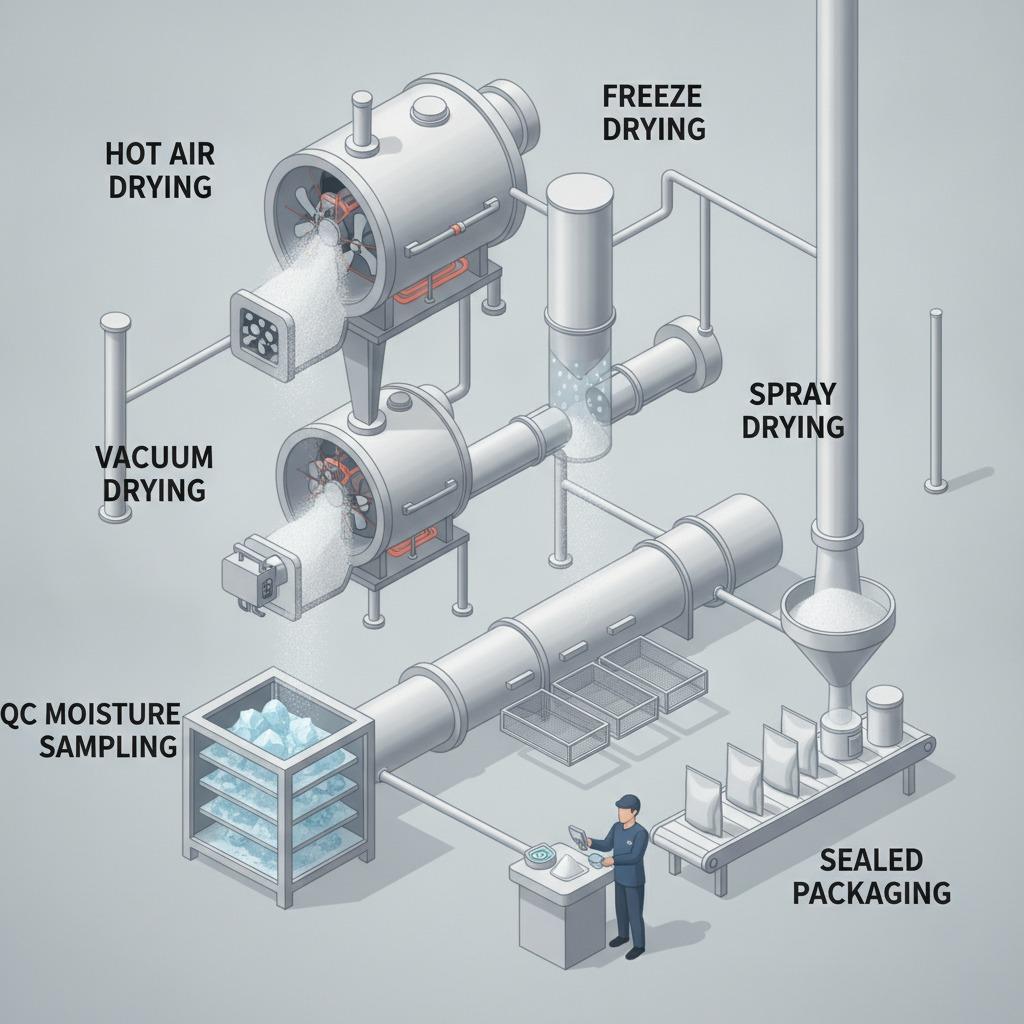
Where hot air drying systems fit into bulk solids processing
Hot air drying systems are often selected when a plant needs to remove surface moisture, improve flowability, stabilize a material before storage, or prepare it for downstream packaging and blending. In practice, those systems rarely operate as a standalone island. They are linked to feed hoppers, transfer screws, exhaust ducts, filters, and discharge bins so the product can move through the line without being exposed to open handling for long.
That integrated approach matters because moisture control is inseparable from material handling. A powder that dries unevenly can bridge in a hopper. A granule that enters too hot can stick in a conveyor dryer or create condensation when it reaches a cooler zone. A line that lacks proper ducting may also lose fine particles to the environment, which is both a yield problem and a housekeeping problem.
For buyers, the lesson is simple: evaluate the drying step together with the vessel, transfer path, and exhaust route. Looking at the dryer in isolation often leads to under-specification of the upstream and downstream equipment.
Conveyor dryer or fluidized bed dryer: choosing the process path
Two common process routes come up often in bulk-solids drying discussions: the conveyor dryer and the fluidized bed dryer. They are not interchangeable, and the better choice depends on particle behavior, heat sensitivity, residence time, and the layout of the plant.
Conveyor dryer
A conveyor dryer is a practical option when material needs a controlled travel path through a heated zone. It is often used for products that can tolerate a relatively gentle, continuous feed and discharge. The appeal is straightforward: stable flow, predictable residence time, and easier integration into a line that already uses mechanical conveying.
The downside is that a conveyor dryer can become a large piece of equipment if the product needs a long heat exposure. It also depends heavily on good feed distribution. If the feed is uneven, the discharge quality can vary more than buyers expect.
Fluidized bed dryer
A fluidized bed dryer is usually considered when the product can be suspended or agitated by process air so heat transfer becomes more efficient. These systems are valued for uniform drying and good thermal contact, especially with granular materials. But they are more sensitive to particle size distribution, dust behavior, and air handling design.
For plants with powders that are light, sticky, or irregular, a fluidized bed dryer may need more upstream conditioning than the brochure implies. This is one of those places where a practical trial or a serious material review is worth more than a polished spec sheet.
What the visible construction suggests about the design philosophy
The image shows heavy-duty welded fabrication, elevated support legs, and connected round ducting. That points to a design philosophy built around containment and serviceability. In many plants, that is more valuable than decorative compactness. A system that can be inspected, cleaned, and repaired without dismantling half the line will usually outperform a tighter layout over the long run.
The conical hopper geometry is also telling. Steep cone angles are commonly used to encourage discharge and reduce stagnant material zones, though the exact effectiveness depends on the product. Sticky or cohesive powders can still hang up even in well-made vessels, which is why discharge aids, agitation, or careful wall finish selection may matter. Buyers sometimes assume a cone solves flow problems by itself. It does not.
The overhead ducting and elbows suggest air movement and possibly dust or vapor handling. In drying and powder processing, that is not a side detail. Poor duct routing can create pressure losses, dust build-up, temperature imbalance, or maintenance access problems. A clean-looking vessel with awkward ducting can be harder to run than a more modest machine arranged with better logic.
Selection criteria that matter more than marketing language
If you are comparing industrial drying technology for a new line or retrofit, start with process behavior rather than machine type. What is the material form: powder, granule, flake, or blend? How sensitive is it to heat, shear, and exposure time? Does it bridge, cake, or create dust? What happens at discharge when it moves from hot to cooler equipment?
Then look at integration. Can the system accept material from the current hopper or feeder? Can it discharge into the next stage without extra transfer points? Is there a clear path for access, cleaning, and inspection? Those questions may sound unglamorous, but they often determine whether a line runs well after commissioning.
Materials of construction matter too. The visible stainless-steel surfaces suggest a corrosion-conscious or hygienic design choice, but the correct grade and finish must match the actual service environment. Wet product, saline residues, aggressive chemicals, or frequent washdown will each change the answer. It is wise not to assume that “stainless” is the end of the discussion.
Common mistakes buyers make
The first mistake is buying a dryer before understanding the upstream and downstream handling. The second is assuming all powders behave similarly. They do not. The third is underestimating access. A system with a hidden valve, awkward platform, or difficult inspection point can become expensive in ordinary maintenance, even if the purchase price looked reasonable.
A fourth mistake is overconfidence about throughput claims. Without confirmed test data, exact capacity figures, and real material trials, those numbers are just assumptions. The image provided does not support any capacity claim, and it would be poor practice to pretend otherwise.
Finally, some teams focus only on heat input and overlook dust control. In powder processing, that is a serious omission. Exhaust handling, filtration, and transfer sealing can affect product quality, plant cleanliness, and operator safety just as much as the drying mechanism itself.
Practical buyer advice for plant teams
When you request quotations or compare layouts, ask vendors to show the full material path, not just the main dryer. Ask where dust exits, where condensate or vapor goes, how material is discharged, and how a maintenance technician reaches the critical wear points. If the vendor cannot explain the system as a sequence of steps, that is a warning sign.
For existing plants, a retrofit review is often worth doing before replacing major equipment. Sometimes the issue is not the dryer at all but the feeder, the transfer screw, or the duct route. A modest redesign around the hopper or discharge path can improve performance more than swapping one thermal unit for another.
And if your material is sensitive, insist on a trial or at least a structured review of product characteristics. Bulk solids have a habit of behaving better in a presentation than they do in a real plant.
FAQ
Is the equipment in the image definitely a dryer?
No. The visible line could be part of drying, cooling, conveying, dust collection, or another bulk-solids process. The image supports an informed guess, not a firm identification.
Why is stainless steel common in this kind of system?
Because it is often chosen for corrosion resistance, cleanability, and durability in industrial processing environments. The right grade still depends on the product and operating conditions.
When would a fluidized bed dryer be preferred over a conveyor dryer?
Usually when the material can fluidize well and the plant wants efficient, uniform heat transfer. If the product is fragile, sticky, or highly variable, the decision needs more caution.
Next step for sourcing and engineering teams
If you are evaluating industrial drying technology for a new line, start by mapping the full material flow: feed, transfer, heating, exhaust, discharge, and maintenance access. Then compare equipment types against the actual behavior of your bulk solid, not just the catalog description.
The safest procurement decision is usually the one that respects process reality. A well-designed hopper and ducting arrangement can be as important as the dryer itself, and in many plants it is the difference between a line that runs and a line that constantly needs attention.