
Why nutrition retention in spray drying matters
Nutrition retention in spray drying is one of those topics that only gets more important the closer you get to production. On paper, spray drying looks straightforward: atomize a liquid feed, expose it to hot air, collect a dry powder. In practice, the process can change proteins, vitamins, flavors, lipids, and bioactive compounds in ways that matter to product quality, shelf life, and label claims. For engineers, sourcing managers, and product teams, the real question is not whether spray drying works. It does. The question is how much nutritional value survives the process, what losses are acceptable, and where the process window sits between efficiency and product integrity.
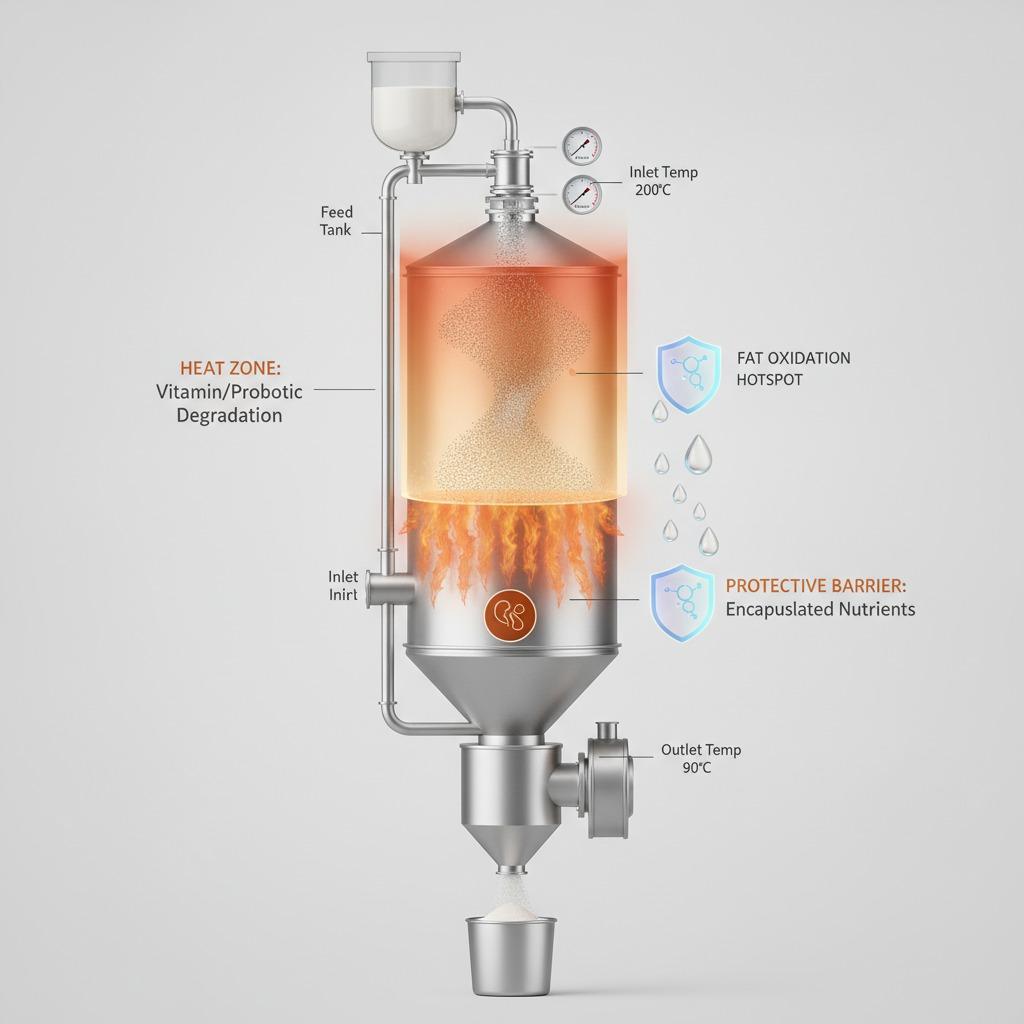
This is especially true in food and dairy applications, where powder quality is judged not only by moisture and flowability but by how well it preserves functional and nutritional properties. Milk powder spray drying is a familiar example, but the same concerns show up in infant nutrition, protein beverages, coffee creamers, probiotics, fruit powders, and fortified ingredients. If the wrong choices are made upstream, the final powder may dry beautifully and still underperform in nutrition, taste, or digestibility.
What spray drying changes in a formulation
Spray drying exposes droplets to elevated temperatures for a very short time. That short residence time is one reason the process is widely used for heat-sensitive materials. Still, “short” does not mean “neutral.” The process can affect ingredients in several ways:
First, heat-sensitive compounds such as some vitamins can degrade, especially if they are not protected by formulation design or encapsulation. Second, proteins can denature or aggregate, which may be acceptable in some products but problematic in others. Third, volatile flavor compounds may be lost, and fat oxidation can become a concern if the powder is not handled well after drying. Fourth, some biologically active ingredients, including probiotics and enzymes, may see reduced viability if the inlet, outlet, or drying profile is too aggressive.
The tricky part is that these changes do not happen in a neat, predictable way for every ingredient. A process that is too hot can be damaging, but a process that is too gentle may leave too much moisture, stickiness, or microbial risk. That is why nutrition retention in spray drying is really a process-balancing problem, not a single setting to be memorized.
The main factors that influence retention
Feed composition
The starting formulation often determines more than the dryer itself. Solids content, sugar level, protein ratio, emulsifier choice, pH, and mineral content all influence heat sensitivity and droplet behavior. For example, a high-sugar feed may dry differently from a protein-rich feed because sugars can protect or, in some cases, complicate drying through stickiness and glass transition effects. In dairy systems, the presence of milk solids and fat changes thermal behavior and powder structure, which is one reason milk powder spray drying is such a well-studied case.
Inlet and outlet conditions
Operators often focus on inlet temperature, but outlet temperature and actual particle exposure matter just as much. A high inlet temperature with a brief residence time may preserve more nutrition than a lower-temperature process that drags on and exposes the product to heat for longer. That said, the margin is narrow. Outlet temperature, air flow, and atomization quality all shape the final outcome. It is common for teams to assume a single temperature number tells the whole story; it does not.
Atomization and droplet size
The way the liquid feed is atomized affects droplet size distribution, and droplet size affects drying speed. Smaller droplets dry faster but may be more exposed to oxidative effects or losses of volatile components. Larger droplets take longer to dry and can trap moisture, creating instability or lowering powder yield. The atomizer choice—nozzle or rotary—should be evaluated alongside the ingredient’s sensitivity, not separately.
Encapsulation and protective carriers
For ingredients with fragile nutrients or aromas, protective carriers can make a meaningful difference. Maltodextrins, gums, proteins, and other wall materials are often used to reduce direct exposure and improve powder stability. This is not magic, and it can change taste, solubility, and cost, but it is one of the more practical tools available when retention matters. In many cases, the formulation strategy is as important as the dryer settings themselves.
Quick comparison: what teams usually trade off
Most spray drying projects sit on a triangle of priorities: nutrition retention, powder stability, and throughput. Improve one, and another may move in the wrong direction.
If retention is the top priority, teams often reduce thermal stress, add carriers, or adjust solids content. If powder stability is the top priority, they may accept some nutritional loss in exchange for lower moisture, better flow, or longer shelf life. If throughput is the top priority, the process may lean toward higher evaporation rates and tighter operating margins.
The best commercial process usually finds a middle ground. That is especially true for products where the powder must survive storage, transport, and reconstitution without major losses in quality. A powder that leaves the dryer with excellent nutrient data but becomes sticky, oxidized, or caked in the warehouse is not a successful product.
Milk and dairy powders: a useful reference case
Milk powder spray drying is often used as a benchmark because it combines several sensitive components in one formulation: proteins, lactose, fat, minerals, and sometimes added vitamins. It is a good reference case for nutrition retention in spray drying because it shows how process choices affect both chemical stability and physical powder properties.
In dairy powders, heat can influence protein structure, while oxidation can affect flavor and shelf life. If the formulation includes added vitamins, those compounds may need extra protection. The outcome is not just a matter of drying the milk fast enough; it is about preserving functionality through the whole process chain, including concentration, homogenization, drying, cooling, and packaging. A well-run line pays attention to the entire chain, not only the chamber.
How buyers and product teams should evaluate a spray drying setup
If you are sourcing spray drying capacity or specifying a powder product, start with the product’s real risk profile. Ask which nutrients are critical, which can tolerate some loss, and which are mainly there for label or positioning purposes. That distinction helps avoid overengineering the process. Not every formulation needs the same level of protection, and not every nutrient behaves the same way under heat.
It is also worth asking for process data in terms that matter to the product, not just the machine. Inlet temperature alone is not enough. You want to understand solids loading, outlet conditions, atomization method, residence time, carrier use, and post-drying handling. If the supplier can only discuss the dryer as a generic piece of equipment, that is a caution sign.
For buyers, a practical warning: do not compare quotes on capacity alone. A dryer that runs faster but sacrifices retention may create downstream costs in reformulation, claims risk, or customer complaints. The right comparison includes product stability, consistency batch to batch, and the ability to reproduce a target powder spec without pushing the process so hard that nutrition suffers.
Common mistakes that hurt retention
One of the most common mistakes is treating all heat-sensitive ingredients as if they respond the same way. They do not. Another is focusing only on drying temperature while ignoring oxidation, light exposure, and packaging. A third is relying on lab-scale success and assuming it will translate directly to a larger line. Scale-up can change droplet formation, residence time distribution, and wall deposition in ways that are not obvious until the powder is already in production.
There is also a tendency to chase maximum solids content because it can improve efficiency. That can work, but only within the ingredient’s stability window. Push it too far and the feed may become too viscous, atomization may suffer, and the final powder may lose quality rather than gain it. Process teams know this instinctively; commercial pressure sometimes ignores it.
Practical takeaways for better results
To improve nutrition retention in spray drying, start with the formulation, not just the dryer. Protect sensitive nutrients with carriers or encapsulation where appropriate. Match atomization to the feed and target particle size. Monitor outlet conditions and post-drying cooling carefully. And if the product is particularly sensitive, test shelf stability, not only fresh powder composition.
For milk powder spray drying and similar dairy applications, the same principle applies: the process should be designed around what the finished powder must do in the market. That may mean prioritizing reconstitution, flavor retention, and nutrient stability together rather than optimizing one metric in isolation. In real manufacturing, that balance usually separates a workable powder from one that only looks good in a trial report.
FAQ: short answers to common buyer questions
Does spray drying always reduce nutrition?
Not always, but it can reduce or alter sensitive nutrients depending on the formulation and operating conditions.
Is a lower temperature always better?
No. Lower temperatures can increase residence time or leave excess moisture, which may harm stability.
Is milk powder spray drying different from other powders?
The basic process is similar, but dairy powders are a useful benchmark because their proteins, fats, and sugars make retention and stability especially visible.
What should a buyer request from a supplier?
Ask for process parameters tied to the product, not just machine capacity, and request clarity on how sensitive nutrients are protected through drying and packaging.
What to do next
If you are evaluating a spray drying project, define the nutrients or functional compounds that matter most, then map the process risks against them. That gives your engineering team a better basis for selecting equipment, choosing carriers, and setting operating windows. The best results usually come from treating nutrition retention in spray drying as a product design issue first and a drying issue second.





