
Why forage drying matters to buyers, operators, and farm planners
Forage drying is one of those farm-process topics that looks simple from a distance and turns expensive very quickly when it is done poorly. The goal is not just to remove water. It is to preserve feed quality, reduce spoilage risk, keep harvesting moving, and make sure the stored crop still has value when it is needed months later. For hay, silage-adjacent operations, and other dry-feed workflows, the drying step often decides whether a crop becomes a sellable input or a storage problem.
That is why buyers comparing agricultural drying systems should think beyond capacity alone. A system that dries fast but damages leaf retention, wastes energy, or creates uneven moisture content can hurt more than it helps. Likewise, a system that is gentle but too slow may not keep up with weather windows. In practice, the right choice is usually a compromise between throughput, crop quality, fuel or power cost, and the labor available to run it.
This article is meant to help engineers, sourcing managers, and farm operators think through that decision in a practical way. What type of drying process fits the crop? Where do the hidden losses show up? What should be checked before purchase? And which mistakes tend to show up only after the equipment is already installed?
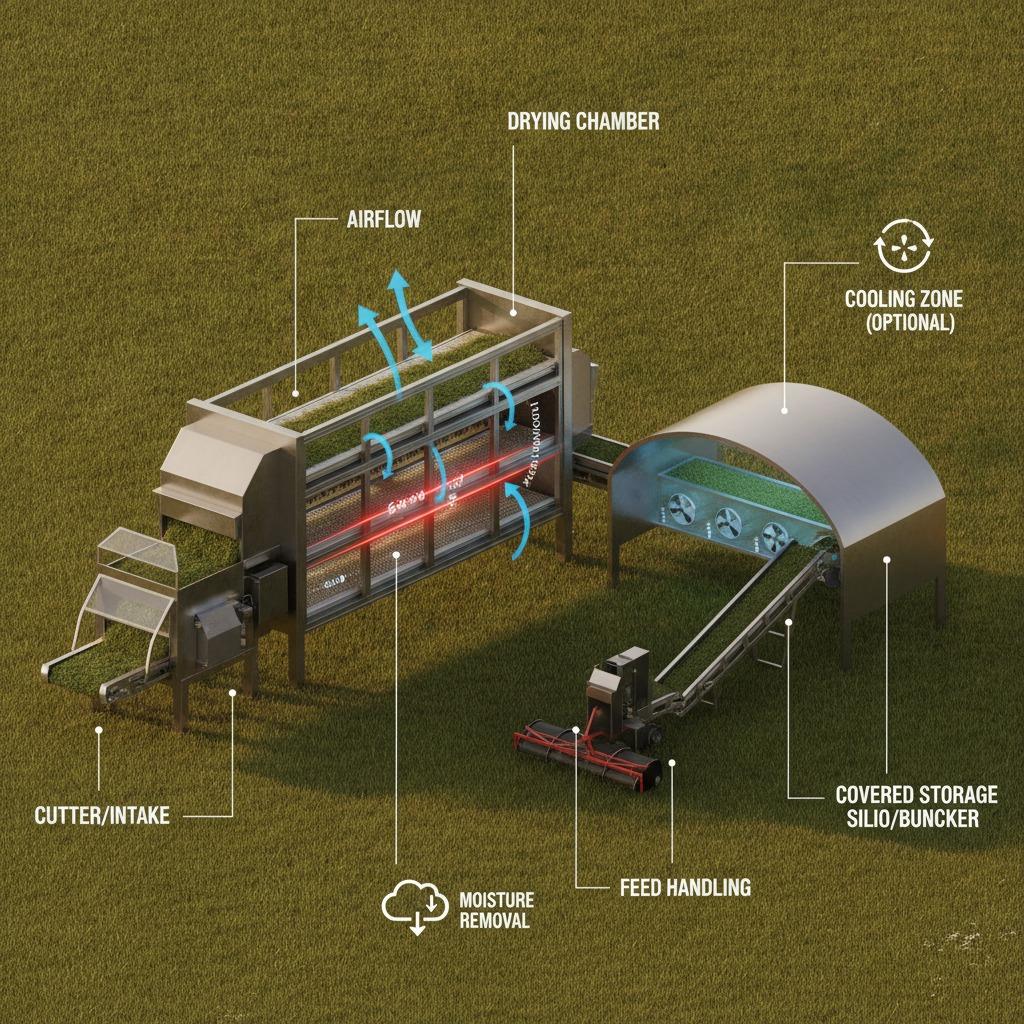
What forage drying is really trying to control
The central challenge is moisture removal without unnecessary damage. Fresh-cut forage often contains too much water for safe storage, and if that water is left in the crop, respiration continues, mold can develop, and nutrient losses can increase. Drying lowers the moisture level to a point where storage becomes more stable and handling becomes easier.
But moisture is not the only variable. Airflow, temperature, crop density, particle size, ambient humidity, and the time between cutting and drying all affect the result. A system may look adequate on paper and still fail in a wet climate because the air exchange rate is too low. In another setting, the same system may over-dry the outer layer while the core remains damp. That kind of unevenness matters because it creates storage hot spots and makes feed consistency harder to manage.
Quick reference: the main process trade-offs
Different drying approaches are used depending on crop type, climate, and scale. The practical choice usually comes down to these trade-offs:
Fast drying can improve weather protection and reduce field losses, but it may increase energy use and risk over-processing delicate material. Slower drying can be gentler and cheaper to run, but it demands better scheduling and can expose the crop to rain, dew, and spoilage. Higher-capacity systems help with harvest windows, yet they may require stronger infrastructure, more maintenance, and more careful loading control.
For many operations, the best answer is not the largest system available. It is the system that can handle local conditions without turning the operation into a full-time troubleshooting job.
How agricultural drying systems are typically evaluated
Buyers looking at agricultural drying systems usually start with throughput, but that is only the first filter. The more useful questions are operational ones. How much material can the system process at the crop condition you actually harvest, not the best-case condition in a brochure? How stable is moisture reduction across the batch? What are the energy inputs per ton, and how sensitive are those inputs to weather?
Uniformity is especially important. A drying line or storage-based system that leaves some portions too wet creates a recurring quality issue. Operators may compensate by running longer cycles or lowering the loading rate, but both of those choices can reduce the effective return on the equipment. If the system depends on perfect loading discipline, that should be treated as a risk, not a feature.
Another practical point: maintenance access matters more than many first-time buyers expect. Fans, ducts, heat exchangers, sensors, belts, screens, and transfer points all need cleaning or inspection. If any of those parts are hard to reach, the system may perform well for the first season and become a nuisance later.
Crop characteristics change the drying strategy
Leafy forage behaves differently than stem-heavy material
Leafy crops tend to dry quickly and can lose value if handled too aggressively. Mechanical action during turning, conveying, or transfer can break leaves, and the nutrient-rich portion of the crop is often the most fragile. Stem-heavy material may tolerate more handling, but it can also trap moisture longer in the core. That is one reason a generic drying setup often disappoints when it is asked to serve multiple crop types without adjustment.
Batch size affects more than throughput
Large batches are efficient only if the system can move air evenly through the load. Deep beds or dense layers can create resistance that slows drying in the center. Smaller batches reduce that risk, but they increase labor or handling frequency. The right batch size is therefore a balance between labor efficiency and airflow physics, which is not always obvious until the system has been running for a few weeks.
Selection criteria that usually matter most
If you are comparing equipment or process layouts, start with these buyer-facing criteria rather than marketing language.
First, define the crop and the moisture range at intake. A system sized for partially field-dried forage may not be suitable for wetter incoming material after weather delays. Second, estimate peak-season demand, not annual average demand. Drying equipment is often judged by its worst week, not its slow months. Third, look at energy availability. Electrical supply, fuel access, and ventilation capacity can each become a limiting factor even when the machine itself is adequate.
Fourth, ask how the system handles control. Good sensors and straightforward operator interfaces reduce the chance of inconsistent output. That matters in real farms and feed operations, where staff skill levels can change seasonally. Finally, think about integration with upstream and downstream equipment. Cutting, conveying, storage, and unloading should work as one chain. A drying unit that creates bottlenecks elsewhere may not improve the operation overall.
Common mistakes that create expensive surprises
One common mistake is buying for maximum nameplate capacity without checking actual crop conditions. Capacity ratings are often tied to ideal inputs, and ideal inputs are rare during harvest. Another mistake is ignoring ambient climate. In humid regions, drying performance can swing sharply, and a system that works well in dry weather may underperform for long stretches.
Operators also underestimate the cost of inconsistent loading. Uneven feed distribution, poor bed formation, or frequent interruptions can all reduce drying quality. The issue is not always the equipment. Sometimes it is the operating pattern around the equipment. Still, if the process depends on expert attention every hour, the design may be too fragile for a commercial setting.
There is also a tendency to focus on fuel use while overlooking product loss. A slightly more expensive drying cycle may still be the cheaper option if it preserves quality and reduces spoilage. That is especially true where feed value is high or where storage losses have been a recurring issue.
Practical advice before you buy or specify a system
Before issuing an RFQ or approving a purchase, ask for operating assumptions in plain language. What moisture range was used for sizing? What crop type? What ambient conditions? If the supplier cannot explain those assumptions clearly, the proposal may be too generic to trust.
It also helps to walk through a real harvest scenario. Start with crop arrival, then follow the material through unloading, drying, cooling if applicable, and storage. Check where the crop waits, where it is transferred, and which step requires the most labor. A drying system that fits the brochure but not the workflow will become a scheduling headache very quickly.
For larger operations, pilot testing or side-by-side comparison can be worthwhile. Even a short trial can reveal issues with airflow, moisture uniformity, or handling losses that are hard to predict from specification sheets alone. That is not a luxury; it is often the cheapest way to avoid a poor capital decision.
FAQ: a few questions buyers ask repeatedly
Is faster always better?
No. Faster drying can protect crop quality in a narrow weather window, but only if the process remains even and gentle enough for the material.
What matters more: heat or airflow?
Both matter, but airflow is often underappreciated. Without good air movement, added heat may simply create a hot surface and a damp core.
Can one system handle different forage types?
Sometimes, but only if it is designed with adjustable controls and enough flexibility in loading and airflow management. Otherwise, performance usually drops when crop conditions change.
A sensible next step
If you are evaluating forage drying for a new line, a retrofit, or a capacity upgrade, begin with the crop conditions you actually see in the field, not the ideal case. Then compare agricultural drying systems on moisture uniformity, energy demand, maintenance access, and how well they fit the harvest workflow. That combination usually tells you more than any single capacity number.
When the process is specified well, drying stops being a bottleneck and becomes a reliable part of feed quality control. When it is specified poorly, it becomes one more place where weather, labor, and equipment all decide to disagree at the worst possible moment.





