
Integrated Fluid Bed Granulation: what it solves and why it keeps coming up in process design
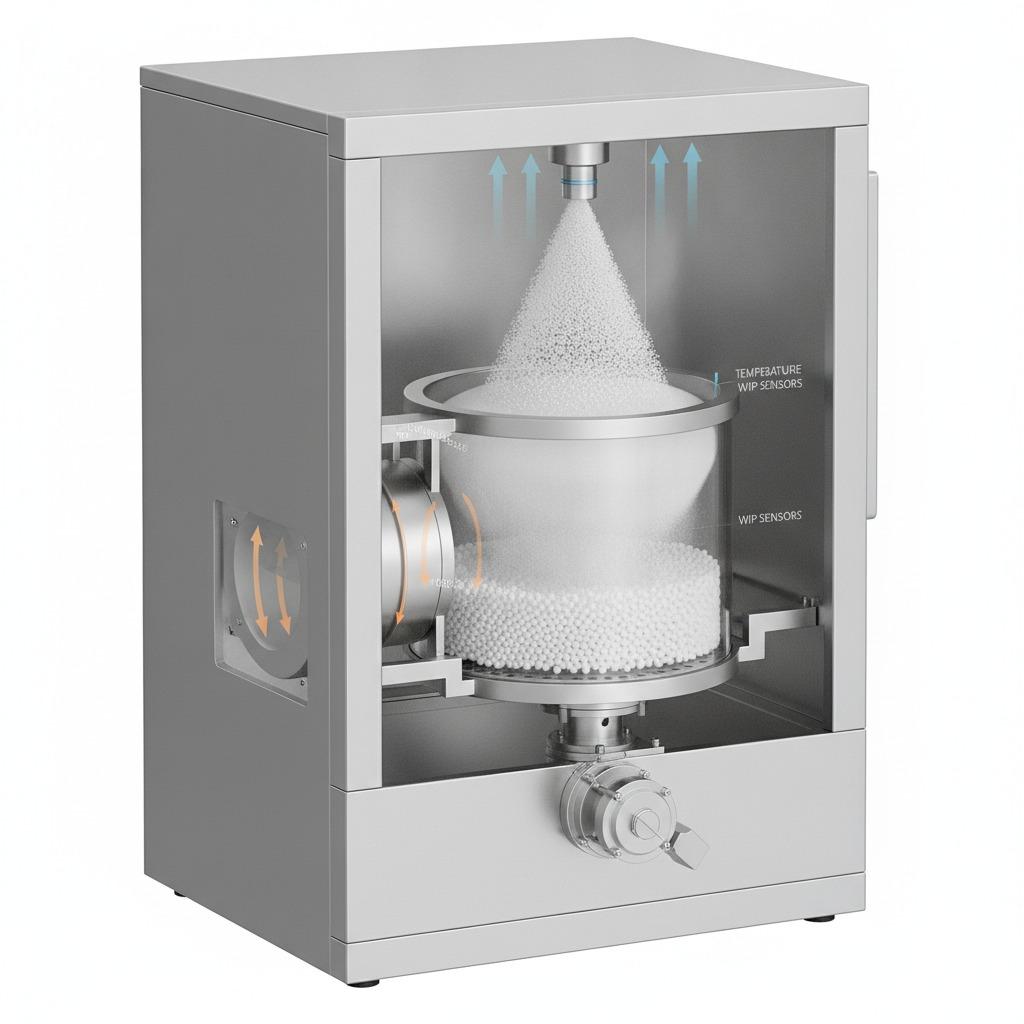
Integrated fluid bed granulation sits at the point where formulation science, equipment layout, and production practicality meet. For teams making tablets, pellets, or other solid dosage forms, the appeal is straightforward: combine drying, granulation, and often coating-related handling in a single controlled environment. That reduces material transfers, shortens workflow steps, and can make batch handling easier to defend from both a quality and a contamination standpoint.
But the interest in integrated fluid bed granulation is not only about convenience. It is also about process control. When a wet mass is formed and dried in the same system, the operator can influence particle growth, moisture removal, and final flow behavior without moving the product between separate machines. In pharma and adjacent sectors, that matters because each transfer can introduce variability. It can also create more opportunities for dust exposure, segregation, or cross-contamination if the line is not well designed.
For sourcing managers and engineers, the real question is not whether the technology is attractive. It is where it fits, what it replaces, and what tradeoffs come with combining steps.
Quick takeaways for buyers evaluating the technology
If you are comparing integrated fluid bed granulation against a more traditional sequence of mixing, wet granulation, tray drying, and milling, these are the practical points worth keeping in view:
The system can simplify material flow, but the control philosophy has to be strong enough to manage multiple phases in one unit.
It may reduce handling and floor-space demands, though the equipment itself can be more sophisticated than a basic dryer.
Product performance depends heavily on formulation behavior. Not every powder responds well to fluidization.
Cleaning, access, and containment need attention early in the project. Those issues are easy to underestimate when the main focus is throughput.
The technology often rewards teams that already have process discipline. It is less forgiving when upstream weighing, dispensing, or binder addition is inconsistent.
How integrated fluid bed granulation works in plain terms
Fluid bed systems use a stream of conditioned air to suspend particles in a fluid-like state. In granulation mode, a binder solution or other liquid is sprayed into the moving powder bed. The droplets wet the particles, bridge them, and encourage agglomeration. As the process continues, the same airflow helps remove moisture and stabilize the granules.
In an integrated setup, the machine is arranged so that these stages happen within one enclosed unit, rather than moving the batch through separate granulation and drying equipment. Depending on the configuration, the same platform may also support top spray, bottom spray, or other process-specific functions. The exact sequence varies, but the design goal is consistent: reduce manual intervention and keep the process inside a controlled chamber.
That sounds simple on paper. In practice, the success of the run depends on balancing air volume, inlet temperature, spray rate, bed expansion, and final endpoint. Too much liquid too quickly can drive overwetting and lumping. Too aggressive drying can create fragile granules or nonuniform moisture profiles. A good system gives operators enough control to steer between those extremes.
Why manufacturers use it instead of separate unit operations
The biggest reason is usually process efficiency, but “efficiency” means different things to different plants.
For a high-volume pharmaceutical operation, it may mean fewer transfers, better batch repeatability, and a cleaner pathway from raw blend to dry granule. For a contract manufacturer, it may mean the ability to switch products with less downtime and less floor congestion. For a development team, it may mean a faster route from formulation trial to scalable process data.
There is also a quality argument. Each time material is transferred by bin, drum, or manual handling, the risk of segregation increases. Fine particles can separate from coarse ones. Moisture can redistribute. Operators can also introduce human variation, even in a disciplined plant. Integrated fluid bed granulation limits some of those effects by keeping the batch in one vessel for more of its life cycle.
That said, the technology is not automatically superior. Some products granulate well in a high-shear mixer and dry more predictably in a dedicated dryer. Others need a slower, more segmented approach. A plant should adopt the integrated route because it fits the product and the business model, not because it sounds modern.
Selection criteria that matter more than brochure features
When buyers compare equipment, the glossy specifications are rarely the decisive factor. The more meaningful questions are usually operational.
1. Does the formulation fluidize cleanly?
Poor fluidization is the classic trouble spot. Very fine, cohesive, or unusually dense powders may channel, clump, or dead-zone in the bed. That can undermine both granulation uniformity and drying efficiency.
2. Can the system control the spray and drying balance?
Integrated fluid bed granulation depends on repeatable control of atomization and thermal conditions. If the spray pattern is unstable or the temperature recovery is sluggish, endpoint consistency will suffer.
3. How easy is it to clean and inspect?
A system that combines several operations in one enclosure can also combine several cleaning headaches. Access doors, removable product-contact parts, surface finish, and drainability all deserve scrutiny. This is one of those areas where a buyer should ask to see the actual maintenance routine, not just a sales drawing.
4. What level of containment is needed?
Powder handling often requires dust control, and some applications demand more stringent containment than others. The integrated unit should be evaluated as part of the wider room and HVAC strategy, not in isolation.
5. Is the process meant for development, commercial production, or both?
A lab or pilot system can be valuable for formulation work, but commercial operations care more about scale-up behavior, uptime, and batch-to-batch consistency. The machine should match the stage of the program.
Where integrated systems deliver the most value
This approach tends to make the most sense when the product benefits from controlled agglomeration and efficient drying in the same vessel. Solid dosage forms are the obvious example, but the broader lesson is that the process must tolerate a fluidized environment.
It is also useful when the plant wants to limit handling steps. That can support leaner production flow, especially in constrained facilities where every square meter matters. In older buildings, floor space and utility routing can be as decisive as the process itself.
Another strong use case is product families with similar handling characteristics. If one line can run multiple formulations without major mechanical reconfiguration, the business case improves. Even so, a plant should be careful not to assume that “similar” powders behave the same way. In granulation, small differences in particle size distribution, binder chemistry, or moisture sensitivity can change the outcome more than expected.
Common mistakes buyers make
The first mistake is treating the technology as a universal replacement for all granulation routes. It is not.
The second is focusing on capacity alone. Throughput numbers matter, but so does endpoint control, cleaning time, and changeover practicality. A machine that looks efficient on a line sheet can become less attractive once operators start using it every day.
The third mistake is underestimating process development. Integrated systems still require methodical work on airflow, binder addition, and drying parameters. The control system may be sophisticated, but it cannot rescue a poorly understood formulation.
A more subtle mistake is ignoring downstream consequences. Granule size, porosity, and residual moisture influence compression behavior, dissolution, and even packaging performance. The drying step does not end the discussion; it just moves the product into the next set of constraints.
Practical buyer advice for engineering and sourcing teams
If you are preparing an equipment shortlist, ask vendors to explain the process window in operational language. How does the system behave when the formulation runs a little wet? How does it recover from a marginal spray condition? What signals tell the operator the batch is approaching endpoint? Those are the questions that expose whether the platform is genuinely controllable.
It is also worth reviewing the installation footprint early. Integrated systems may reduce process steps, but they can still need serious utilities, access clearances, and exhaust arrangements. A compact process train is not the same thing as a simple facility fit.
For sourcing teams, after-sales support matters more than a polished demonstration run. The system’s long-term value will depend on spare parts availability, service response, documentation quality, and how well the vendor supports validation or qualification work. None of that is glamorous, but it decides whether the line stays productive.
FAQ: a few questions that come up often
Is integrated fluid bed granulation always better than separate granulation and drying?
No. It is better when the formulation, batch size, and plant layout support it. Separate unit operations can still be the smarter option for difficult materials or specialized production flows.
Does it improve product consistency?
It can, mainly by reducing handling and keeping the process under tighter control. But consistency still depends on formulation design, operator discipline, and robust equipment settings.
Is scale-up straightforward?
Usually not completely straightforward. Like most particle-processing technologies, scale-up needs real data, not assumptions. Airflow behavior, bed dynamics, and moisture removal can shift with scale.
What should a buyer test first?
Start with fluidization behavior, spray response, and drying endpoint repeatability. If those three are not stable, the rest of the discussion is premature.
What decision this article should help you make
Integrated fluid bed granulation is worth serious consideration when a plant wants fewer transfers, tighter process control, and a more compact granulation workflow. It is especially relevant where powder handling risk, floor-space pressure, or batch variability are already issues.
The decision is not simply whether the technology works. It is whether it works for your material, your production model, and your quality expectations. That is the useful lens. A system that looks elegant on paper can be a poor fit if the powder resists fluidization or the plant cannot support the cleaning and control discipline it requires.
For teams at the evaluation stage, the next step is to map formulation behavior against equipment capability, then pressure-test the cleaning, utility, and scale-up assumptions before committing to a purchase.





