
Why buyers keep comparing vibrating fluid bed dryer systems
A vibrating fluid bed dryer is one of those pieces of process equipment that looks straightforward on paper and still manages to cause plenty of debate in plant rooms and procurement meetings. The basic question is simple: how do you dry a bulk solid evenly, without damaging fragile particles, while keeping throughput sensible and energy use under control? In practice, that question touches product quality, line stability, hygiene, dust control, footprint, and downstream handling.
For engineers and sourcing teams, the real decision is not whether vibration is clever. It is whether this dryer suits the material, the moisture target, and the way the line runs day after day. Some products need gentle movement and short residence times. Others bridge, stick, or compact if a standard fluid bed is pushed too hard. That is where a vibrating design earns attention. It combines controlled gas flow with mechanical movement, helping materials advance through the bed without relying only on airflow to shift them.
This article looks at how the equipment works, where it fits, where it struggles, and what buyers should ask before they sign off on a specification. If you are comparing dryer types, the aim here is to help you decide whether this is the right machine for your material—or whether another drying route would be safer.
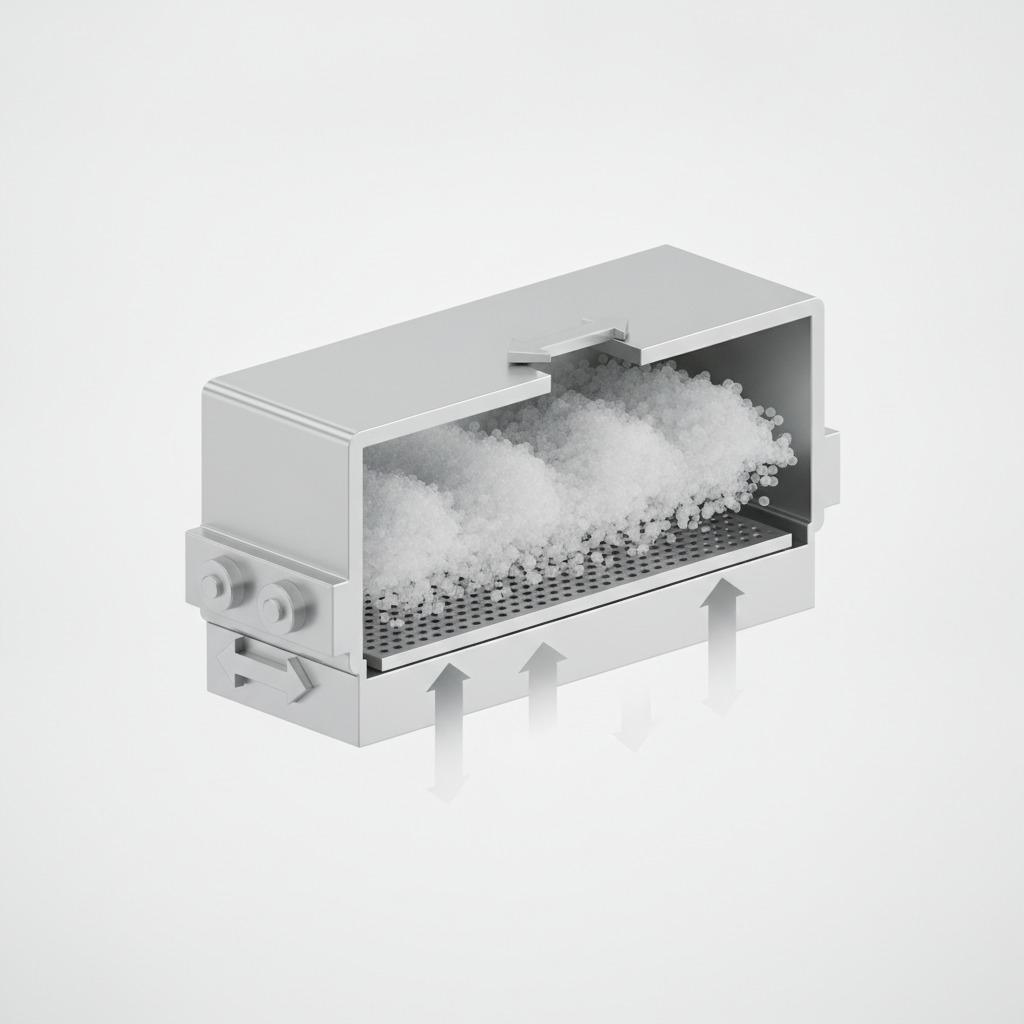
What a vibrating fluid bed dryer does
At its core, the machine uses heated air passing upward through a porous or perforated distribution surface. That air suspends and agitates the product, promoting heat and mass transfer. The vibration adds a second motion: it helps move the solids through the bed and reduces the risk of dead zones, ratholing, or sticky build-up. The result is a dryer that can handle a continuous flow of particulate material with a fairly uniform exposure to drying conditions.
Compared with purely static systems, the vibrating action can help with products that do not fluidize cleanly on their own. That matters for powders and granules with awkward size distributions, moderate cohesiveness, or a tendency to clump after washing, crystallization, extrusion, or wet processing. The machine is often discussed alongside conventional fluidized beds, rotary dryers, tray dryers, and conveyor-style drying systems, because the choice usually comes down to handling characteristics as much as thermal performance.
Where the equipment tends to fit best
Buyers often consider this dryer for food ingredients, chemicals, minerals, and some pharmaceutical intermediates, though the exact fit depends on the material and the regulatory environment. As a general rule, the technology is strongest when the product is particulate, needs a relatively uniform final moisture level, and benefits from gentle but consistent conveyance through the drying zone.
It is also attractive where a process line needs continuous operation. Batch systems can work perfectly well, but once throughput grows and upstream/downstream integration matters, continuous drying usually simplifies scheduling. A vibrating fluid bed dryer can sit between a dewatering step and a cooling or screening stage, which makes it easier to design a stable, repeatable line.
That said, not every material is a good candidate. Very wet slurries, pasty masses, and products that melt, smear, or become overly sticky at temperature can create real headaches. A buyer should be cautious if the material softens before it dries or if particle attrition is already a quality problem.
How it compares with other dryer types
A quick comparison helps clarify the choice.
Versus a conventional fluid bed dryer
A standard fluid bed depends heavily on airflow to suspend and mix the solids. That works well for many free-flowing materials, but it can become less forgiving when particles vary in size or cohesion. The vibrating fluid bed dryer adds mechanical assist, which can improve movement and reduce bed stagnation. On the flip side, the added mechanical system introduces more components to maintain and potentially more noise or vibration isolation requirements.
Versus a rotary dryer
Rotary dryers are robust and familiar, especially for minerals and other rugged bulk solids. They can tolerate variable feed conditions, but they are usually less precise in temperature control and may be harsher on the product. If the material is delicate or the target moisture is tight, a vibrating fluid bed approach may offer better control. If the feed is coarse, abrasive, or highly variable, rotary equipment may still be the tougher choice.
Versus tray or batch ovens
Tray dryers and ovens are often easier to understand but harder to scale efficiently. They require loading, unloading, and more floor space per unit of output. For high-volume continuous production, they are usually not the most economical route. A vibrating fluid bed dryer can offer a cleaner production rhythm, though only if the material handles vibration and pneumatic drying well.
Key design factors that affect performance
When teams evaluate this kind of equipment, they sometimes focus too quickly on headline throughput. Throughput matters, of course, but several other variables decide whether the machine will actually perform on the line.
Particle size and cohesion
The dryer works best when the feed has a reasonably narrow size range and a flow behavior that supports even movement. If the material contains fines, oversized pieces, or sticky agglomerates, the bed may segregate. That can produce uneven residence time and uneven drying. A pre-screening or deagglomeration step may be worth considering, even if it adds a unit operation.
Moisture profile
There is a difference between removing surface moisture and driving off bound moisture. The first is usually easier and faster. The second may require longer residence time, more careful temperature control, or a staged drying approach. Buyers should ask how the dryer handles the moisture curve rather than only the inlet and outlet values.
Temperature sensitivity
Some products tolerate heat poorly. In those cases, the value of a vibrating fluid bed dryer lies in better heat transfer efficiency and shorter residence times, not in simply turning the temperature up. The practical question is whether the material can be dried without discoloration, degradation, loss of active content, or changes in texture.
Cleaning and access
For food and pharmaceutical applications, cleanability is not a side issue. It is a design constraint. Even in industrial chemical service, access for inspection, maintenance, and dust removal affects uptime. Buyers should look closely at how the distributor, chamber, discharge points, and seals are arranged. A design that is technically sound but awkward to clean can become a production nuisance.
Common buying mistakes
One common mistake is to assume that the dryer will “fix” a difficult feed. It will not. If the incoming material is highly inconsistent, the dryer may simply reveal those inconsistencies more clearly. Another mistake is underestimating dust handling. Drying often changes particle behavior, and fines generated in the process can create housekeeping and filtration demands that were not obvious at the start.
A second pitfall is choosing equipment based only on nominal capacity. Real-world capacity depends on product properties, ambient conditions, feed variability, and the acceptable final moisture range. A line that looks adequate in a brochure can struggle once production shifts from pilot material to full-scale batches.
There is also the temptation to overlook downstream handling. If the dried material is fragile, the discharge, cooling, and transfer systems matter just as much as the dryer itself. A poorly handled product can pick up moisture again, attrite, or compact before it reaches packaging.
Practical questions to ask suppliers
When talking with equipment vendors, it helps to move beyond general claims and ask how the machine behaves with your material class. Useful questions include: What particle sizes have been tested? How is the airflow distributed across the bed? What vibration method is used, and how is it isolated from surrounding equipment? How is residence time controlled? What happens if the feed moisture rises unexpectedly? How is dust captured and managed? Can the dryer be integrated with upstream dewatering or downstream cooling?
If you already have pilot data, bring it. If you do not, ask for test work or a staged trial that reflects your actual material, not a substitute that only looks similar on paper. Even a small difference in granulation or moisture can change the drying behavior enough to matter.
When a vibrating fluid bed dryer is worth the investment
The equipment earns its place when a plant needs continuous drying, fairly tight process control, and gentle handling in one package. It is especially appealing for particulate products that do not behave well in ordinary fluid beds but still need more precision than a rotary dryer typically provides. In many projects, the answer is not that it is the universal best choice. It is that it solves a specific combination of problems better than the alternatives.
If your material flows reasonably well, tolerates vibration, and benefits from a consistent thermal profile, the design can be very effective. If the product is sticky, unstable, or extremely broad in particle size, the wiser move may be to spend more time on testing before committing. That caution can save a lot of commissioning trouble later.
Final buyer takeaway
A vibrating fluid bed dryer is not just another drying box. It is a process solution for materials that need controlled heat transfer, continuous movement, and a more forgiving drying path than a purely fluidized system can offer. The best decisions come from matching the machine to the material behavior, not from chasing the highest throughput number or the smallest footprint alone.
For sourcing teams, the next step should be to define the product characteristics that matter most: moisture range, particle size, stickiness, heat sensitivity, dust behavior, and required line speed. With those points clear, supplier discussions become much more practical and much less speculative. And that is usually where the good projects start.





