
Spray Drying vs Fluid Bed Processing: how buyers should think about the choice
When people compare spray drying vs fluid bed processing, they are usually not choosing between two interchangeable machines. They are deciding how a powder will be formed, dried, handled, and sometimes finished to a marketable state. That distinction matters. A formulation team may care about flowability and particle size, while a plant manager may be looking at throughput, energy use, and how often the equipment needs to be cleaned. The right answer depends on what the product is supposed to do after it leaves the dryer, not just what it looks like in the hopper.
Both technologies are central to modern powder manufacturing, but they solve different problems. Spray drying is widely used to turn liquids, slurries, and emulsions into powders. Fluid bed processing, by contrast, is commonly used to dry, agglomerate, coat, or cool particulate material that already exists. Some plants use both. Others only need one. The hard part is knowing where the line is.
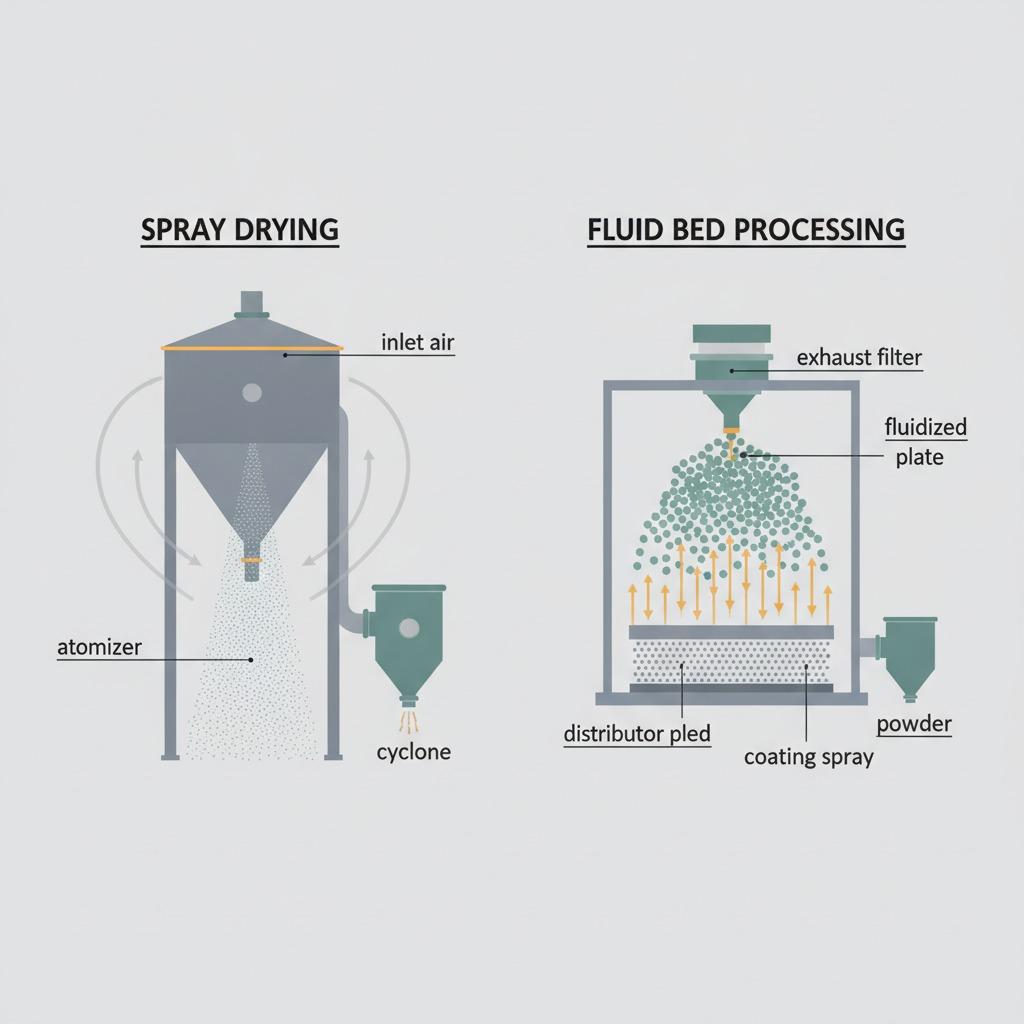
Quick comparison: what each process is good at
As a shortcut, spray drying is often the better fit when the starting material is a pumpable liquid and the goal is a controlled powder from that liquid. Fluid bed processing tends to fit better when the material is already in granular or powder form and needs further treatment such as moisture removal, layering, or surface modification.
That sounds simple, but the practical differences are worth spelling out. Spray drying creates particles from droplets in a hot gas stream, which gives the operator a lot of control over particle formation. Fluid bed processing keeps particles suspended or moving in a controlled airflow, which is useful for uniform drying and finishing operations. One is a particle-making step; the other is often a particle-finishing step.
At a glance
Spray drying is commonly selected for milk powders, functional ingredients, flavors, ceramics, and many specialty chemicals. Fluid bed systems are commonly used for pharmaceuticals, food ingredients, chemicals, and granules that need drying, coating, or agglomeration. In practice, the application matters more than the industry label. A food ingredient plant and a pharma plant may both use the same type of principle, but with very different quality expectations and regulatory controls.
How spray drying works
Spray drying starts with a liquid feed. That feed is atomized into fine droplets, usually through a nozzle or rotary atomizer, and those droplets meet heated air in a drying chamber. Moisture evaporates quickly, leaving behind dry particles that are separated from the exhaust air and collected. The speed of this process is one of its main advantages. It can convert heat-sensitive liquids into powders quickly enough to limit thermal damage, provided the process is set up correctly.
There is a catch, of course. Spray drying only behaves well when the feed formulation is stable enough to atomize consistently. Viscosity, solids content, emulsification quality, and thermal sensitivity all influence the final powder. Buyers sometimes underestimate how much upstream formulation work is required. If the liquid is not suited to atomization, the dryer is not the place to fix it.
Where spray drying creates value
The process is especially useful when a powder needs to be produced with a fairly specific combination of particle size, bulk density, solubility, and moisture content. It can also support encapsulation or controlled release in some applications. That is one reason the process has become so important in flavors, nutraceuticals, and specialty food ingredients. The powder is not merely dry; it is engineered for downstream handling and performance.
How fluid bed processing works
Fluid bed processing uses airflow to suspend or move particles so heat and mass transfer happen efficiently across the material bed. Depending on the system, the material may be fluidized for drying, agglomerated by spraying a binder or liquid onto the moving particles, coated for functional reasons, or cooled after another process stage. The key point is that the material is already particulate. The equipment is taking those particles and changing their condition or surface characteristics.
Fluid beds are valued for their relatively uniform treatment of particles. Because the material moves and mixes in the air stream, drying can be more even than in static systems. They can also be gentler than some mechanical handling methods, though that depends on particle fragility and operating settings. Fine powders can be tricky, and sticky materials can make fluidization uneven. Anyone specifying the system should ask how the equipment behaves at the edges of the operating window, not just at the ideal point on a brochure.
Where fluid bed processing is strongest
Fluid bed systems are often chosen when a plant wants to improve the handling properties of a powder or granule rather than create the particles from scratch. Agglomeration is a major use case because it can improve instant properties, flow, and dust reduction. Coating is another, especially when moisture protection or controlled release is needed. In short, fluid bed equipment is often about finishing, not just drying.
Selection criteria that matter in real plants
Engineers and sourcing teams usually need to compare these systems on a few practical grounds: feed form, target particle properties, thermal sensitivity, throughput, hygiene requirements, and maintenance burden. Those are the questions that separate a sensible capital purchase from a costly compromise.
1. Start with the feed
If the starting material is a liquid, slurry, or emulsion, spray drying is usually the more direct path. If the material is already a wet granule or powder, fluid bed processing may be the more appropriate choice. This sounds obvious, but sourcing conversations sometimes drift toward equipment preference before the product form is fully defined.
2. Decide what the powder must do
Do you need a free-flowing powder? A soluble instant product? A coated particle with improved shelf life? A granule with reduced dust? The intended function of the powder often determines the process more than the chemistry does. A good procurement team will ask how the powder performs in packaging, transport, dosing, and final use, not only how it looks in the lab.
3. Consider thermal exposure
Both technologies involve air movement and heat, but they expose material differently. Spray drying uses a very brief thermal event on droplets, while fluid bed systems may expose particles to warm air for longer periods. Depending on the product, one may be more forgiving than the other. There is no universal answer here. Heat-sensitive ingredients can still be damaged if the process is poorly balanced.
4. Look beyond the dryer itself
Dust collection, exhaust handling, cleaning access, product recovery, and control systems often matter as much as the process chamber. A machine that looks efficient in isolation can become awkward once you factor in sanitation or changeover time. This is especially true in plants that make multiple SKUs or operate under tighter cleanliness expectations.
Common mistakes buyers make
One frequent mistake is treating spray drying and fluid bed processing as competing versions of the same service. They are related, yes, but the product architecture is different. Another mistake is underestimating how much particle engineering is taking place in a spray dryer. The process is not simply “drying”; it is shaping the powder from the beginning.
Another practical problem is overspecifying the equipment before the formulation is stable. That can lead to a machine purchase that is technically impressive but difficult to run. Pilot work matters because it reveals how the material behaves under real process conditions. Buyers should be cautious about assuming a lab result will scale without surprises. It often does not.
When both technologies are used together
In some production lines, the answer is not spray drying or fluid bed processing, but both. A spray dryer may create a base powder or agglomerate from liquid feed, and a fluid bed unit may then dry, cool, or coat the particles further. This combination can make sense when a product needs both formation and finishing. It also gives plants more control over final moisture, flow, and stability.
That said, combining steps adds complexity. More process stages mean more transfer points, more cleaning, and more opportunities for material loss. It can be worth it, but only if the finished powder justifies the extra handling.
Buyer-facing questions to ask before choosing
If you are comparing suppliers or setting a process direction, ask these questions early: What is the initial feed form? What particle properties matter most? Is the main goal drying, agglomeration, coating, or particle creation? How sensitive is the product to heat and residence time? What level of cleaning and changeover will the plant require? And what does the powder need to do after packaging?
Those questions are more useful than asking which technology is “better.” Better for what, exactly? A facility making instant beverage powders will think differently from a plant producing pharmaceutical granules or chemical intermediates. The target application should drive the decision.
FAQ: a few practical points
Is spray drying always more energy intensive?
Not always in a simple sense. Energy use depends on feed solids, evaporation load, system design, heat recovery, and operating conditions. A quick comparison based only on nameplate power can be misleading.
Does fluid bed processing only dry powders?
No. It is also used for agglomeration, coating, and cooling. That versatility is part of its appeal.
Which process is better for sensitive ingredients?
It depends on the ingredient and the performance target. Sensitivity to heat, oxygen, and mechanical stress all play a role. In some cases, spray drying is the better fit because exposure is brief; in others, a fluid bed system is gentler or more controllable.
What a sensible next step looks like
If your team is debating spray drying vs fluid bed processing, the useful next step is not a broader search for “the best machine.” It is a short technical review of the material, the desired powder characteristics, and the downstream handling requirements. Once those are clear, the process choice usually becomes much easier to defend.
For buyers, that means documenting the feed form, target spec, and constraints before asking vendors for proposals. For engineers, it means testing the process under conditions that resemble production, not just ideal lab settings. And for product teams, it means remembering that a powder is a functional material, not just a dry one. The process has to serve that function all the way to the end user.





