
Spray Dryer Working Principle: What It Does and Why It Matters
The spray dryer working principle is straightforward in theory and a little more demanding in practice: turn a liquid feed into dry powder by atomizing it into fine droplets and exposing those droplets to a controlled stream of hot air. For engineers and sourcing teams, that simple description hides a lot of the real decisions that affect product quality, throughput, cleaning effort, and operating cost.
In industries such as food, pharmaceuticals, ceramics, detergents, and specialty chemicals, spray drying is not just a dehydration method. It is a particle-engineering step. The dryer can influence particle size, bulk density, flowability, solubility, and even how a powder behaves in downstream blending or packaging. If you are evaluating equipment, the key question is rarely “Does spray drying work?” It is “Will this dryer produce the powder form we need, consistently, without creating avoidable losses or headaches?”
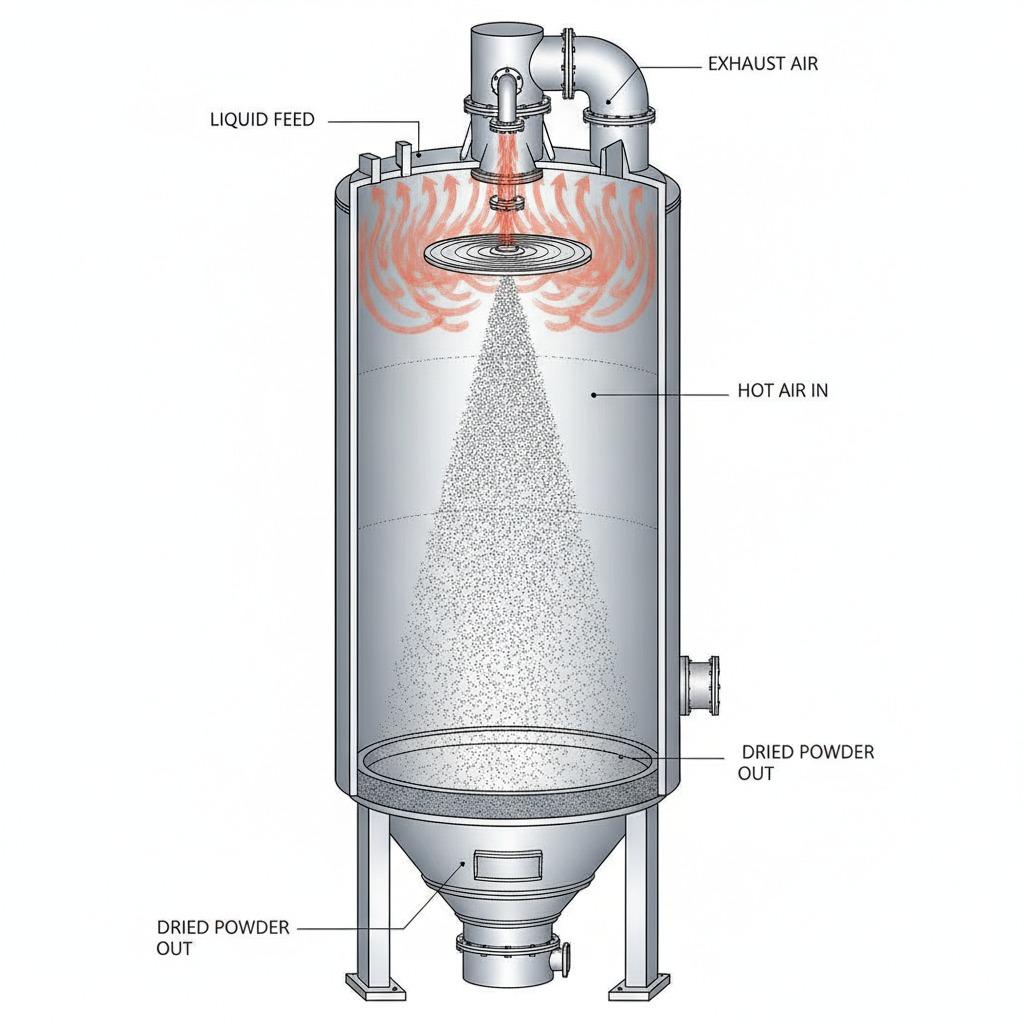
Quick View: What Happens Inside a Spray Dryer
At a high level, the process has four stages: feed preparation, atomization, drying, and powder collection. The feed, which may be a solution, suspension, or emulsion, is pumped to an atomizer. The atomizer breaks the liquid into droplets. Those droplets enter a drying chamber where hot air removes moisture almost immediately from the droplet surface. The dried particles are then separated from the exhaust air, usually by a cyclone, bag filter, or both.
The important point is that drying happens very fast. In many applications, the droplet spends only seconds in the chamber. That short residence time is one reason spray drying is so widely used for heat-sensitive materials. It is also why feed consistency matters so much. Small changes in solids content or viscosity can alter droplet formation and, in turn, the powder you get at the end.
The Spray Dryer Working Principle in Practical Terms
The basic physics are not complicated, but the operational details deserve attention. A liquid with enough solids content to form a usable powder is pumped under pressure or fed by a rotary wheel system. The atomizer creates a large surface area by dispersing the liquid into many fine droplets. Once these droplets contact hot drying gas, moisture begins evaporating from the outer layer first. As the droplet shrinks, solid material concentrates, and a particle forms.
By the time the particle reaches the lower part of the chamber, it should be dry enough to separate cleanly from the air stream. The outlet temperature, not just the inlet temperature, becomes a useful indicator because it reflects how much heat remains after evaporation. That is one reason operators often focus on thermal balance rather than a single temperature setpoint.
There is a practical caution here: hotter air does not automatically mean better drying. If the product is sensitive, excessive inlet heat can cause surface hardening, stickiness, loss of functionality, or degraded flavor and color. The right operating window depends on the material, droplet size, and desired powder structure.
Main Components and What Each One Controls
Feed system
The feed system moves the liquid into the dryer at a controlled rate. Stable flow is critical. Pulsation or settling in the feed tank can show up as uneven powder properties later. For slurries and suspensions, agitation or recirculation may be needed to keep solids from separating.
Atomizer
The atomizer is central to the spray dryer working principle because droplet size largely shapes particle size. Common atomization methods include pressure nozzles, two-fluid nozzles, and rotary atomizers. Each has trade-offs in droplet uniformity, energy use, and suitability for viscous or abrasive feeds. A fine droplet dries faster, but it can also increase dusting or losses if the powder is too lightweight.
Drying chamber
This is where heat and mass transfer happen. Chamber geometry affects residence time, wall deposition, and product recovery. Tall-form chambers are often used when longer residence time is needed, while some products benefit from a wider configuration that reduces the risk of sticking. Chamber design also influences how the drying air meets the spray pattern, which is not a small detail in practice.
Powder recovery system
After drying, the powder must be separated from the exhaust air. Cyclones are common for coarse recovery, while filters can capture finer particles. In many installations, the collection setup is as important as the dryer itself, especially when yield and cleanliness matter. If the powder is expensive or the fines are valuable, recovery efficiency becomes a direct cost issue.
Why Spray Drying Is Chosen Over Other Drying Methods
Compared with tray drying, vacuum drying, or drum drying, spray drying offers a combination of speed, control, and powder formation. It is especially useful when the final product must be free-flowing, easy to reconstitute, or uniform enough for automated filling lines.
That said, it is not the answer for every material. Very sticky formulations can cause wall buildup. Heat-sensitive compounds may still need lower-temperature strategies or protective formulation changes. Slurries with very low solids content may dry well, but the energy cost per kilogram of powder can become hard to justify. So while the method is versatile, it is best viewed as a controlled tradeoff, not a universal upgrade.
Selection Criteria Buyers Should Not Skip
If you are comparing equipment, start with the product, not the machine brochure. The most important question is how the feed behaves. Is it a true solution, a suspension, or an emulsion? What is the solids loading? Does it shear easily? Does it foam? These answers affect atomizer choice, pump selection, chamber sizing, and cleaning strategy.
Next, think about the target powder. Do you need fine, light particles for fast dissolution, or denser granules that flow better into packaging equipment? Do you need narrow particle size distribution, or is a broader range acceptable? Different applications tolerate different levels of variability, and that tolerance should guide your spec sheet.
Thermal sensitivity comes next. Some products can handle higher inlet temperatures because evaporative cooling protects the material early in the process. Others cannot. A safe approach is to evaluate both inlet and outlet conditions, plus residence time, rather than assuming a single “temperature rating” tells the full story.
Finally, look at cleanliness and maintenance. If the product is food-grade or pharmaceutical-related, access for cleaning, residue control, and changeover time can matter as much as raw output. An efficient dryer that is miserable to clean is usually a poor bargain in a real plant.
Common Mistakes in Spray Dryer Projects
One common mistake is treating feed formulation as if it were separate from equipment design. In reality, solids content, binders, emulsifiers, and viscosity all shape the result. Another is underestimating wall deposition. Sticky powders do not only reduce yield; they can disrupt airflow and create cleaning problems that shorten run time.
A second mistake is focusing too much on capacity numbers without checking the assumptions behind them. Nominal throughput often depends on product type, moisture removal demand, and acceptable outlet conditions. A dryer rated for a certain amount of water evaporation under one formulation may behave very differently with another.
It is also easy to overlook downstream handling. A powder that sprays and dries beautifully may still bridge in bins, dust excessively, or pack poorly in bags. Those problems are not always obvious during the first equipment trial, but they show up quickly in production.
Process Control: The Variables That Actually Move the Needle
Operators typically watch feed rate, inlet air temperature, outlet air temperature, airflow, atomization energy, and chamber pressure. Among these, outlet temperature often gives the clearest signal about process balance. If outlet temperature drifts, the product may be carrying more or less moisture than intended.
Airflow matters because it drives heat transfer and particle transport. Too little airflow can lengthen drying time or increase deposition. Too much can carry fines out of the chamber and reduce recovery. Atomization energy is another lever, especially for nozzle and rotary systems. It helps determine droplet size, and droplet size strongly affects moisture removal and final particle morphology.
This is why spray dryers are rarely “set and forget” machines. The process can be highly repeatable, but only when the feed and operating conditions stay within a well-understood window.
FAQ for Buyers and Engineers
Is spray drying only for liquids?
It is mainly used for liquid feeds, but those liquids may contain dissolved solids, suspended particles, or emulsified components. The key is that the material must be pumpable and atomizable.
Can spray drying improve powder quality?
Yes, in many cases. It can produce more uniform particles, better flow, and improved solubility behavior compared with some alternative drying methods. Results depend on the formulation and operating setup.
What causes sticking inside the chamber?
High moisture, sticky formulations, poor temperature balance, and unsuitable droplet size are common causes. Chamber design and airflow pattern also play a part.
What should I ask a supplier?
Ask how the dryer handles your specific feed type, what atomization method is recommended, how powder recovery is achieved, and how cleaning or changeover is managed. If the supplier cannot discuss your material in practical terms, that is a warning sign.
What to Do Next
If you are early in the project, map the feed properties and the powder requirements before comparing equipment. That simple step saves time later. For teams already working on a specification, the next move is usually a pilot or trial run with representative material, because the spray dryer working principle only becomes fully useful when it is matched to your real formulation.
A good selection decision comes from connecting process behavior, powder targets, and maintenance reality. The dryer that looks strongest on paper is not always the one that will run cleanly, recover product efficiently, and hold spec week after week.





