Why spray dryer atomizer comparison matters before you buy
If you are evaluating a spray dryer atomizer comparison, you are usually trying to solve a practical problem, not win a technical argument. The atomizer sits at the center of the drying process. It influences droplet size, residence time, powder morphology, energy use, fouling behavior, and, in many plants, whether the dryer runs steadily or turns into a maintenance headache.
That is why the choice between a rotary atomizer spray dryer, a pressure nozzle atomizer, and a two-fluid nozzle atomizer should not be treated as a simple component preference. Each design pushes the process in a different direction. Some favor throughput and broad operating flexibility. Others are better suited to finer droplets, lower batch sizes, or tighter control over certain product attributes. The right decision depends on the feed, the target powder, and the realities of cleaning, uptime, and downstream handling.
For sourcing managers and product teams, the decision usually comes down to a few questions: What kind of powder are we trying to make? How viscous is the feed? Do we need a narrow particle-size band or just reliable drying? What utilities are available? Those questions matter more than a glossy brochure, and they are where a good comparison starts.
Quick takeaways from the main atomizer types
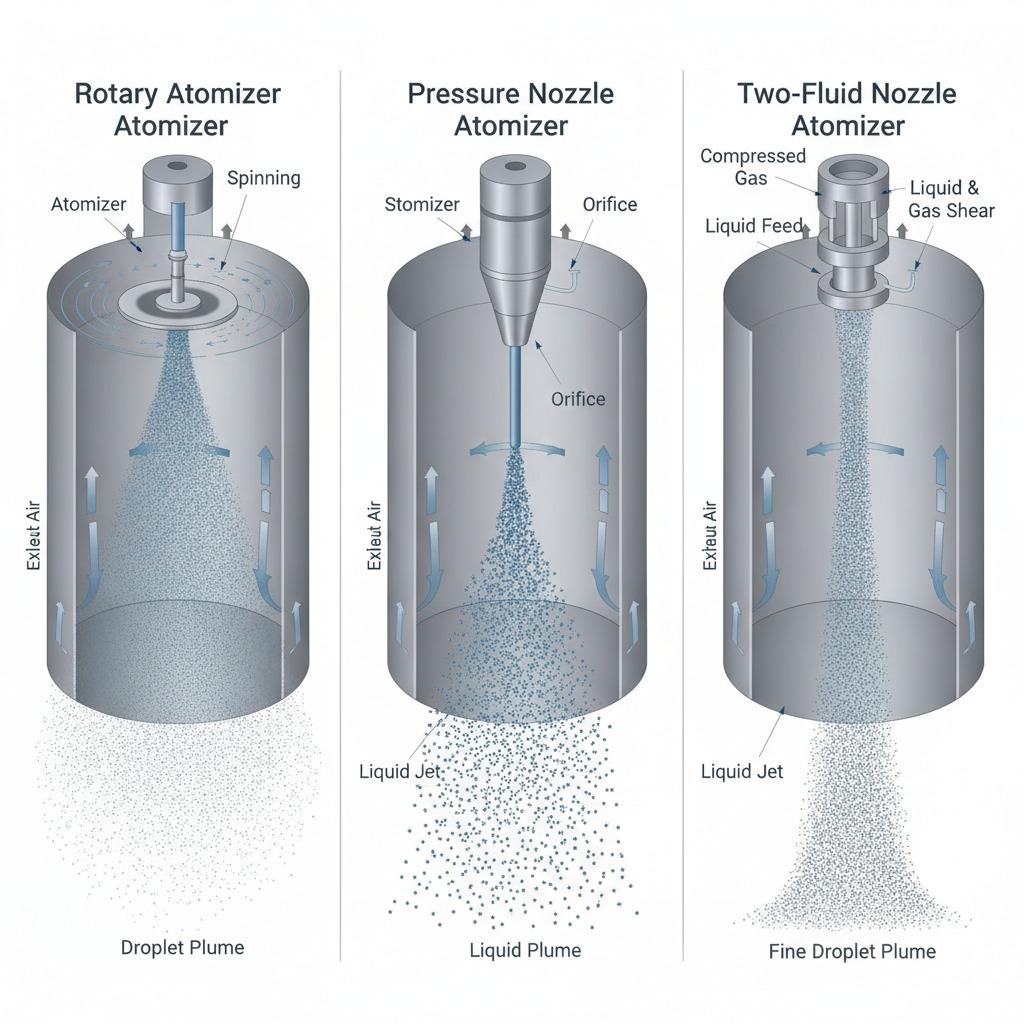
In practical terms, a rotary atomizer spray dryer is often chosen when production needs are high and the process has to tolerate a wider range of feed conditions. A pressure nozzle atomizer can be a strong fit when the process can handle higher feed pressures and the plant wants relatively simple mechanical operation at the nozzle itself. A two-fluid nozzle atomizer is commonly used when finer atomization is needed, especially at smaller throughputs or with more demanding control of droplet formation.
That sounds neat on paper, but the real picture is less tidy. Atomization is only one part of the equation. Feed solids, viscosity, temperature sensitivity, wall deposition risk, and the desired powder bulk density can all shift the answer. A plant that values energy efficiency at large scale may choose differently from a specialty manufacturer chasing uniform fine powder in smaller lots.
How the three atomizer styles differ in real production
Rotary atomizer spray dryer
The rotary atomizer spray dryer uses a rapidly spinning disc, wheel, or similar rotating element to break the liquid feed into droplets. That mechanical action gives it broad operating flexibility and makes it a familiar option in many large-scale drying lines. It is often associated with stable production of powders from a wide range of liquid feeds, including products where throughput matters and the dryer must stay productive over long runs.
One reason engineers like this route is that the atomization mechanism is not dependent on a very high-pressure pump at the feed point. Another reason is scale. Rotary units are often discussed in larger industrial spray drying installations where consistent operation and droplet distribution are more important than ultra-fine atomization. That said, the rotating assembly adds its own maintenance considerations. Wear parts, balance, and cleaning access deserve real attention, not just a line item on a capital request.
Pressure nozzle atomizer
A pressure nozzle atomizer forces liquid through a small orifice at high pressure, creating a spray that breaks up into droplets. The setup is mechanically simpler at the atomizing point than a rotary disc system, which can appeal to plants that prefer a compact nozzle arrangement. The tradeoff is that this approach can be more sensitive to feed cleanliness, viscosity shifts, and plugging risk.
For some formulations, pressure nozzles give good control and a predictable spray pattern. For others, the process window can be narrower than expected. A small change in solids content or a bit of particulate contamination may alter performance enough to affect dryer stability. That makes filtration, upstream pump control, and maintenance discipline more important than teams sometimes assume during early concept work.
Two-fluid nozzle atomizer
The two-fluid nozzle atomizer uses compressed gas, usually air or steam depending on the system design, to shear the liquid into fine droplets. This configuration is often selected when the application calls for smaller droplets, lower feed rates, or flexible operation with more challenging atomization demands. It can be a practical choice in specialty manufacturing, pilot work, and some fine powder applications.
The caution is utility demand. Two-fluid systems can use more gas than buyers expect, and that utility load can matter more than the initial equipment price. If the plant already has a stable compressed gas or steam system, the case may be easier to make. If not, the operating cost picture needs a careful look. A nice small footprint does not cancel out utility consumption.
Selection criteria that matter more than the sales pitch
A serious spray dryer atomizer comparison should start with product requirements, then move to plant constraints. That order is important because atomizer choice is often made backward. Teams fall in love with a device type and then try to fit the process around it. The better approach is to define the powder target first.
Feed properties
Viscosity, solids loading, temperature sensitivity, and any tendency to crystallize or foul can all affect atomizer performance. Higher viscosity may reduce the effectiveness of some nozzle systems. Suspended solids can raise plugging risk in pressure and two-fluid nozzles. Rotary atomizers may handle a wider range of feed behavior, though they are not immune to buildup or poor cleaning practices.
Particle and powder goals
Not every plant wants the same powder. Some need free-flowing granules for bulk handling. Others need finer particles for fast reconstitution or downstream blending. Atomizer type strongly affects droplet size, which then influences final powder characteristics. It is not the only factor, but it is one of the first.
Scale and operating mode
Throughput matters. Continuous large-scale lines often lean toward rotary atomization because of its production capacity and flexibility. Smaller batch or specialty operations may favor nozzle systems, especially when process changes are frequent. If the line must switch between products, cleaning access and changeover time should be treated as core selection criteria, not afterthoughts.
Utilities and maintenance
Utilities can change the economics of the decision. Pressure nozzles depend on pump pressure. Two-fluid nozzles depend on gas supply. Rotary systems depend on mechanical drive integrity and the condition of the rotating assembly. Each path carries different maintenance tasks, spare-part needs, and downtime risks. Buyers should ask how often wear parts are replaced, how easy inspection is, and what happens when the atomizer drifts out of spec during a long run.
Where buyers commonly get tripped up
One common mistake is assuming finer atomization automatically means a better powder. That is not always true. Too fine a droplet can increase wall deposition, shift yield, or create powder that is difficult to collect and handle. Another mistake is ignoring feed preparation. A well-designed atomizer will still struggle if the feed is poorly filtered, unstable, or outside the intended operating range.
There is also a tendency to underestimate the role of maintenance access. In a plant environment, the best atomizer is often the one operators can inspect, clean, and return to service without a long delay. A technically elegant option that is awkward to maintain can become the least attractive choice after six months of production.
Finally, some teams compare atomizers in isolation and forget the dryer as a system. Chamber geometry, airflow, inlet temperature, exhaust handling, and product collection all interact with atomization. A spray dryer atomizer comparison only becomes useful when it is tied to the whole line.
A practical way to shortlist the right option
If you are narrowing choices, start with a simple matrix. Put feed properties in one column, product targets in another, and plant constraints in a third. Then test each atomizer concept against those realities. A rotary atomizer spray dryer may score well for throughput and robustness. A pressure nozzle atomizer may win where compactness and straightforward liquid atomization matter. A two-fluid nozzle atomizer may be the strongest candidate when fine droplet generation is the priority and utility support is available.
For many teams, the next best step is pilot validation or a vendor-supported process trial. That is where theory meets drying behavior, and where the small mismatches show up: unstable spray pattern, deposit formation, sensitivity to solids changes, or a powder that does not flow the way the spec sheet promised. If a supplier cannot explain how the atomizer behaves under realistic process variation, that is worth treating as a warning sign.
Buyer-facing questions worth asking early
Before you commit, ask how the atomizer handles feed variation, what maintenance tasks are expected, how the system responds to higher solids or viscosity drift, and what spare parts are likely to be consumed over time. Ask whether the proposed design has been used on similar products, not identical ones. Similarity matters more than sales language.
It also helps to ask what happens during start-up and shut-down. Some atomizers are forgiving during transitions. Others are happiest only once the line is fully stabilized. Those details affect scrap, labor, and operator confidence, and they rarely show up in a short product summary.
FAQ: common questions from engineering and sourcing teams
Which atomizer is best for high-volume production?
Often a rotary atomizer spray dryer is considered for larger-scale, continuous production because of its flexibility and capacity. But the final answer still depends on the powder target and feed behavior.
Which atomizer gives the finest droplets?
In many cases, a two-fluid nozzle atomizer is used when finer atomization is needed. Still, droplet size is influenced by operating conditions, not just hardware type.
Which one is easiest to maintain?
That depends on the plant. Pressure nozzles may be mechanically simpler at the tip, but they can be sensitive to plugging. Rotary systems have moving parts that need proper care. The easiest option is usually the one that fits the feed cleanly and is accessible for routine service.
Can one atomizer type solve every spray drying job?
No. That is the short answer, and it is the one worth remembering. Spray drying is too sensitive to formulation and operating conditions for a universal answer.
What to do next
If you are preparing an equipment request or evaluating suppliers, build the comparison around your actual process data: feed composition, viscosity range, solids content, target particle size, utility limits, and maintenance expectations. Then ask vendors to map their atomizer recommendation to those conditions in plain language. A good supplier should be able to explain why the suggested design fits the job and where the limits are.
The most useful spray dryer atomizer comparison is not the one that ranks technologies in the abstract. It is the one that helps your team choose a system that runs steadily, produces the powder you need, and does not turn routine maintenance into an operating problem later on.