
Why protecting API bioactivity during spray drying matters
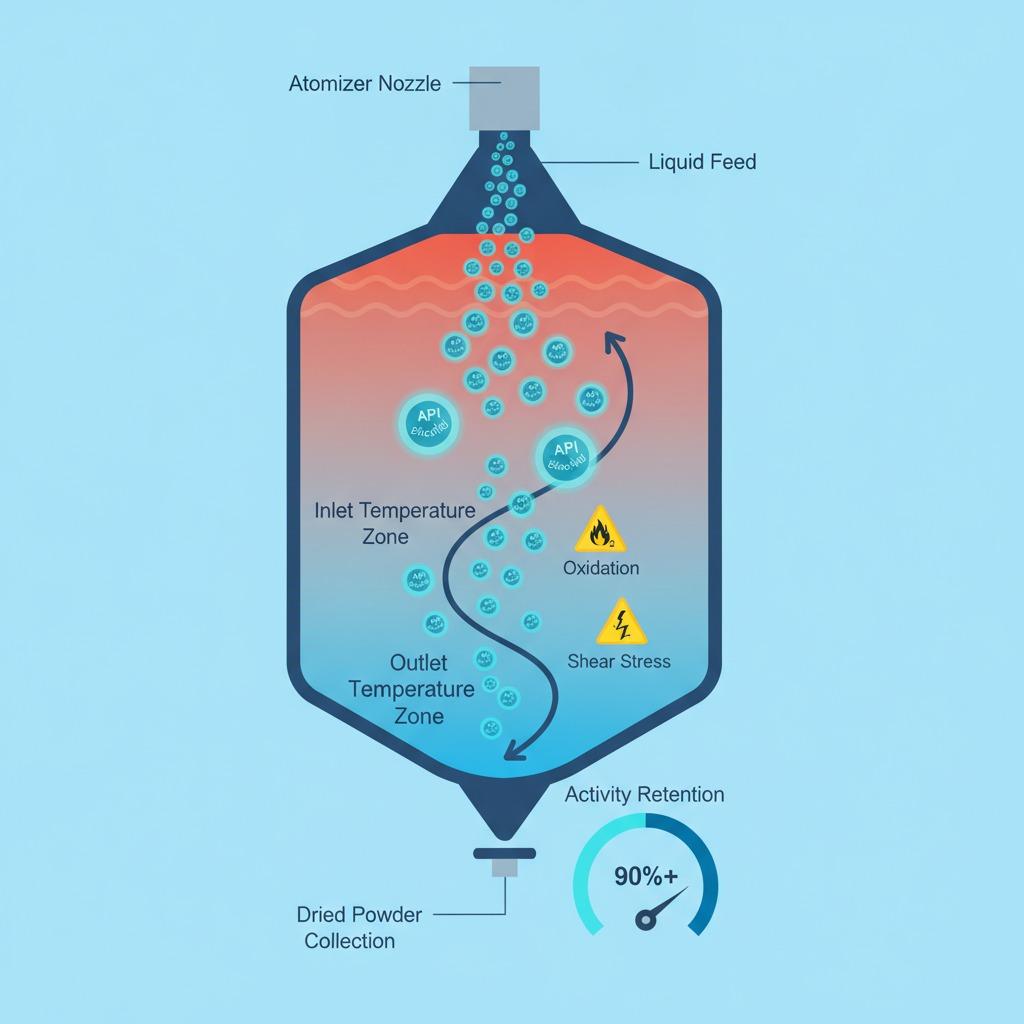
Protecting API bioactivity during spray drying is one of those formulation problems that looks straightforward from a distance and then gets complicated fast once the process is on the line. You want a dry, stable powder. You also need the active pharmaceutical ingredient to keep enough of its biological function to do the job after drying, storage, and reconstitution. That sounds simple until heat, shear, atomization, residence time, moisture loss, and oxidation all start pulling in different directions.
For engineers, sourcing teams, and product developers, the real question is not whether spray drying can be used. It is whether the process window is broad enough to preserve activity without compromising manufacturability. That decision affects everything from excipient selection to equipment choice, batch yield, and how much downstream rework you can tolerate. In biologics and other sensitive formulations, a small loss in activity can become an expensive one.
The basic tradeoff: dry powder performance versus molecular survival
Spray drying is attractive because it converts a liquid feed into a powder in a single continuous step. It can improve handling, support inhalation or oral delivery formats, and help with stability by removing water. But the same conditions that make it efficient can stress the API.
The main risks are well known: thermal exposure, interface stress during atomization, oxidation, aggregation, and residual moisture that is either too high or too low for stability. A lot depends on the type of active. Small molecules usually behave differently from peptides, proteins, enzymes, or other biologically active compounds. The more structurally complex the API, the more careful the process development needs to be.
A useful way to think about the problem is this: spray drying is not just a drying step. It is a short, intense formulation event. If the feed is not designed to protect the API before the droplet even enters the chamber, there is only so much the equipment can do afterward.
What actually damages bioactivity in spray drying
Heat is only part of the story
Many teams focus on inlet temperature because it is the most visible parameter, but outlet temperature and droplet history often matter more. The droplet may cool by evaporation, which helps, yet the surface can still experience localized stress. In other words, the powder may never see the full inlet temperature in the same way the process sheet suggests. That is why two runs with the same nominal settings can produce different activity retention if the feed solids, viscosity, or atomization pattern changes.
Air-liquid interfaces can be harsh
Atomization creates a large surface area very quickly. Sensitive APIs can unfold or adsorb at interfaces, especially if the formulation lacks a protective matrix. This is one reason excipients are not decorative. They often determine whether the API remains folded, active, and dispersible after drying.
Moisture management cuts both ways
A powder that is too wet may cake, stick to the chamber, or degrade during storage. A powder that is too dry can become brittle or less protective against conformational stress, depending on the system. There is usually a practical moisture window, but it is formulation-specific and should be treated as such.
Oxidation and residence time are easy to underestimate
Long residence times, oxygen exposure, and repeated handling can all erode bioactivity. This is especially relevant in development work, where samples may be recirculated or collected under less controlled conditions than production batches. It is a small detail until it becomes a pattern in the assay data.
Formulation choices that help preserve activity
The most reliable protection usually comes from the formulation rather than the machine setting. That does not mean process controls are unimportant. It means the feed has to do some of the work.
Protective excipients are often chosen to create a glassy matrix around the API, reduce surface adsorption, and improve shelf stability. Sugars and polymers are common examples in general industry practice, but the best option depends on the molecule and the final dosage form. Some APIs prefer a rigid matrix that immobilizes them. Others need a gentler environment with less interfacial stress. There is no universal recipe.
Buffer strength, ionic conditions, and pH also matter. A formulation that is chemically stable in solution may still fail after drying if pH shifts during solvent removal or if salt concentration rises beyond what the API can tolerate. This is one reason short development cycles can be misleading. A powder that looks fine on day one may not stay that way after a few weeks of storage.
For biologics, it is often wise to test multiple excipient ratios instead of assuming one stabilizer will solve everything. The formulation space may be broader than expected, but the performance window can also be narrow.
Process variables that deserve real attention
Inlet and outlet temperature
Lower temperatures sound safer, but going too low can create a wet, sticky powder and reduce throughput. The goal is usually not the lowest possible temperature. It is the best balance between droplet drying and biological stability.
Atomization method
Nozzle design influences droplet size, shear, and powder morphology. Smaller droplets dry faster but may expose the API to more interfacial area. Larger droplets can reduce that stress but may create drying or agglomeration issues. The right setup depends on powder target, not just drying speed.
Feed concentration and viscosity
Higher solids content can improve yield and reduce the thermal burden per unit of powder, but only if the feed remains pumpable and atomizable. Viscosity changes can alter droplet formation in ways that are not obvious at the bench.
Gas flow and chamber conditions
Airflow affects both drying efficiency and particle collection. Chamber design, cyclone performance, and powder recovery all shape the final outcome. In practice, the equipment does not just dry the material; it also influences how much of the powder survives as a usable batch.
Quick reference: what to prioritize first
If the goal is protecting API bioactivity during spray drying, the first pass should usually focus on these questions:
Does the API need a stabilizing matrix or a surface-protective excipient system?
Can the feed remain stable during the full run, not just during mixing?
Are inlet and outlet temperatures being evaluated together, not separately?
Is atomization creating unnecessary shear or excessive interfacial stress?
Will the dried powder remain stable during storage, transport, and reconstitution?
That short checklist sounds basic, but it prevents a common mistake: optimizing the dryer before the formulation is ready.
Common mistakes buyers and product teams make
One recurring issue is assuming that a successful lab sample automatically scales. Spray drying often behaves well at small scale, then starts revealing yield loss, sticking, or activity drop when the feed rate and airflow change. Another mistake is treating residual activity as the only metric. Bioactivity is essential, but so are powder flow, bulk density, particle size, and how the powder redistributes in the final device or dosage form.
A more subtle problem is overreliance on a single assay. If the test measures only one aspect of function, it may miss partial unfolding or slow degradation that appears later. Practical development usually needs a mix of potency, physical characterization, and storage stability data. That may sound obvious, yet it is still easy to cut corners when project timelines tighten.
There is also a purchasing-side warning worth stating plainly: equipment capability and formulation capability are not the same thing. A well-specified spray dryer cannot rescue a feed that is chemically unstable or a process that has never been mapped against the API’s sensitivity profile.
How to evaluate a spray drying program
A strong development program should be able to answer three questions before scale-up:
What conditions preserve the most activity without causing collection or handling problems?
What excipient system supports both stability and downstream manufacturability?
Which process parameters are sensitive enough that they need tight control in production?
If those answers are still vague, the program is probably not ready for large-scale procurement or commercial planning. That does not mean the project is at risk. It means more screening is needed before committing to a process route.
For sourcing managers, the practical issue is risk allocation. Ask whether the supplier can demonstrate process understanding, not just equipment access. For engineers, the issue is reproducibility. For product teams, it is whether the powder will behave the same way in the device, capsule, blister, or reconstitution step that follows.
FAQ
Is spray drying always too harsh for sensitive APIs?
No. Many sensitive compounds can be spray dried successfully if the formulation and process are developed carefully. The challenge is finding the right combination of protective excipients and operating conditions.
Which matters more, temperature or formulation?
Usually formulation, at least at the start. Temperature matters, but a weak formulation can fail even under relatively mild conditions. A strong formulation gives the process more room to work.
Can you rely on small-scale results?
Only cautiously. Small-scale results are useful for screening, but scale-up can change droplet behavior, drying rate, and powder recovery. That is where hidden losses often appear.
What should be tested after drying?
At minimum, bioactivity or potency, moisture content, particle characteristics, and stability over time. Depending on the product, reconstitution behavior or aerosol performance may also be important.
Practical next step
If you are evaluating spray drying for a sensitive API, the best next move is to map the formulation and process risks before you lock the equipment strategy. Start with small-screen studies on excipients, then check how inlet temperature, outlet temperature, atomization, and feed solids affect both activity retention and powder quality. That approach takes more discipline upfront, but it usually saves time later, especially when the product has to survive more than one stage of manufacturing and storage.





