
Pigment Drying: Why It Matters More Than It Sounds
Pigment drying is one of those manufacturing steps that tends to disappear into the background until something goes wrong. A powder bridges in a hopper, a wet colorant cakes during storage, a batch loses flow, or the final dispersion picks up moisture and behaves differently in processing. For engineers, sourcing managers, and product teams, the issue is not just whether a pigment looks dry enough. The real question is whether it is dry enough to handle, blend, store, and perform consistently in the next stage of production.
That matters because pigments are rarely used alone. They move into coatings, plastics, inks, masterbatch, construction materials, and specialty formulations where moisture can affect everything from dispersibility to shelf stability. Even when the chemistry is unchanged, excess water can alter bulk density, storage behavior, clumping tendency, and the way a material feeds into downstream equipment. If you are deciding on a drying method, you are really deciding how much risk you want to carry into the rest of the process.
What Proper Drying Is Trying to Solve
At a practical level, pigment drying is about removing free moisture and, in some cases, reducing bound water enough to make the material usable in production. The target is not always zero moisture. In fact, chasing the driest possible product can create other problems such as dusting, static issues, thermal degradation, or unnecessary energy use. That is why the right endpoint depends on the pigment type, its intended use, and the material’s sensitivity to heat or shear.
For buyers, this creates a familiar manufacturing trade-off. A pigment that is slightly wetter may be cheaper to dry, but it can cost more later if it causes caking, inconsistent metering, or poor dispersion. A more aggressive drying approach may improve storage stability, yet it may also change particle behavior or require more careful handling. The process choice should be evaluated in the same breath as packaging, transport, and end-use performance.
Common Drying Approaches Used in Production
There is no single standard route for pigment drying, because pigments arrive in different forms. Some are filter cakes, some are wet precipitates, and some are already in granular or agglomerated form. The drying method usually follows the physical state of the material more than the color family itself.
Thermal drying
Thermal drying is the broadest category and can include tray drying, belt drying, rotary drying, and fluid bed drying. These methods use controlled heat and airflow to remove moisture from wet solids. Fluid bed systems are often attractive when particle movement and uniform heat transfer matter, while belt and tray systems may suit more delicate materials or smaller-volume operations. Rotary dryers can handle higher throughput, but they may be too aggressive for some pigments if attrition or dust generation becomes a concern.
Spray drying
Spray drying is often used when the pigment is part of a slurry or suspension and the goal is to produce a free-flowing powder. It can deliver a uniform particle form and good handling characteristics, though it is energy-intensive and not ideal for every formulation. For colorant drying, spray drying can be especially useful when a controlled particle shape or low residual moisture is important for downstream blending.
Vacuum drying
Vacuum drying lowers the boiling point of water and can help when temperature-sensitive pigments or additives cannot tolerate higher heat. It may be slower and more equipment-intensive, but it is often worth considering for sensitive specialty materials. The lower-temperature environment can reduce the risk of color change, surface damage, or unwanted side reactions.
Mechanical dewatering before drying
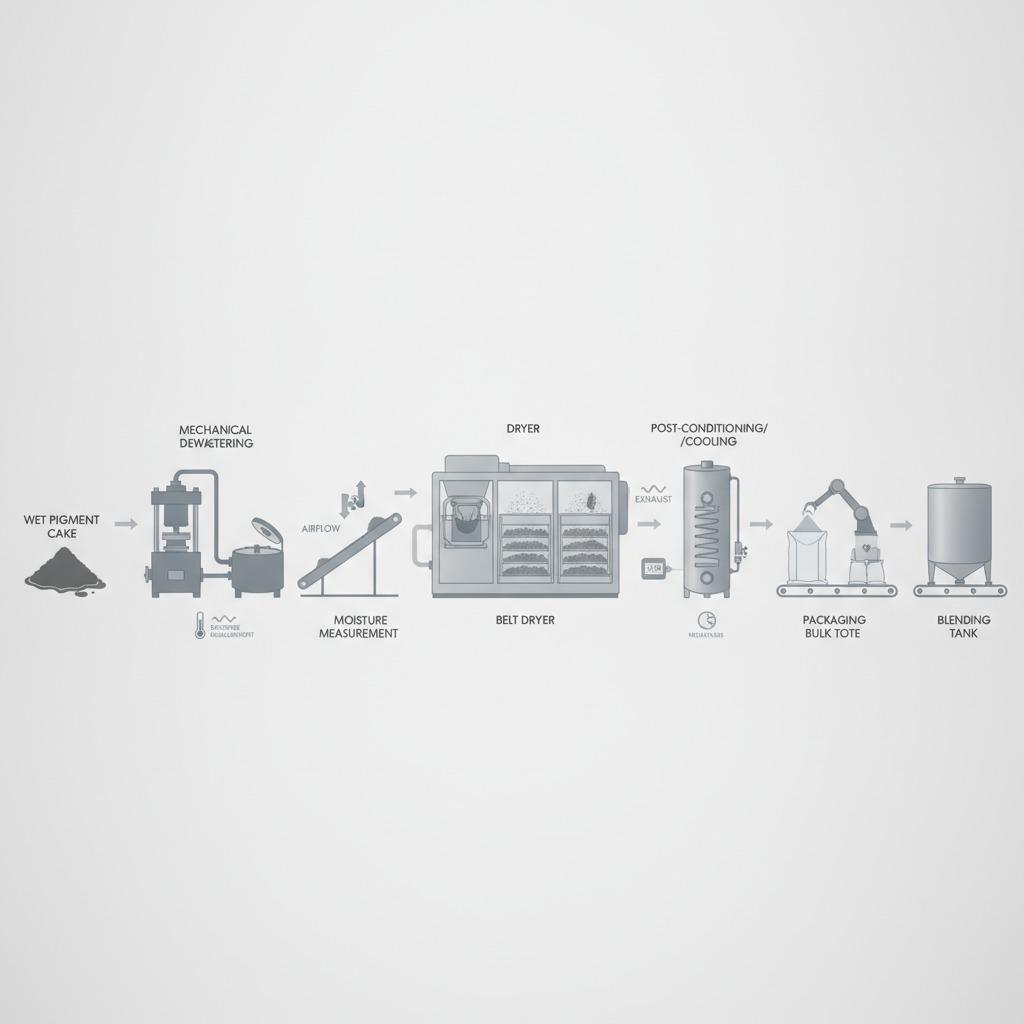
Many plants try to remove as much water as possible before the thermal step. Filtration, centrifugation, and pressing do not replace drying, but they can shorten cycle times and reduce energy consumption. For wet pigment cakes, this pre-step can be the difference between a manageable drying load and an expensive bottleneck.
How Material Form Changes the Drying Decision
Not all pigments behave the same way under heat. Particle size, surface area, agglomeration tendency, and residual process chemicals all affect how a material dries. Fine particles often hold moisture more stubbornly because of their greater surface area. Highly porous structures may trap water in ways that are not obvious from a quick visual check. Some pigments also carry residual salts or dispersants that influence caking after drying.
That is why a process that works well for one pigment family may fail for another. A seemingly minor shift in particle morphology can change drying time, flowability, and post-dry handling. If the downstream customer is blending the pigment into a sensitive formulation, even small changes in moisture profile can show up as inconsistency in color strength or dispersion quality. This is especially important in batch production, where a slight variation can echo through the entire run.
Selection Criteria Buyers Should Look At
When evaluating pigment drying options, the first question should be what the product needs to do after it leaves the dryer. That sounds obvious, but it is often where projects drift off course. The drying method should be judged against downstream handling, packaging, and shelf-life requirements, not just against moisture removal alone.
Useful selection criteria include thermal sensitivity, required residual moisture, throughput, energy use, footprint, dust control, cleaning needs, and how often the plant changes over between grades. If the material is part of a broader formulation, then compatibility with other ingredients matters too. A dryer that looks efficient on paper may become a maintenance headache if it is difficult to clean between color changes or prone to build-up on internal surfaces.
For sourcing teams, it is also worth asking for more than a generic equipment description. The useful detail is often in the operating window: what feed form the system expects, whether it can tolerate variable inlet moisture, how it manages fines, and what kind of post-dry conditioning is needed before packaging. These questions can expose practical constraints early, before a plant commits to a system that looks fine in a brochure but awkward on the floor.
Typical Problems That Show Up After Drying
One common issue is over-drying. That can make some pigments dusty, harder to dose, or more prone to static cling. Another is uneven drying, which leaves pockets of moisture inside the batch and creates inconsistency during storage. Caking is another familiar complaint, especially when moisture, pressure, and time combine in bags or bulk containers.
There is also the matter of contamination. Dryers that are not cleaned effectively can transfer residue from one batch to the next, which is a real concern in color-sensitive applications. And while it is tempting to focus only on moisture content, process residues can matter just as much. A pigment may meet a moisture target but still underperform if the drying step changes its surface characteristics or leaves it difficult to disperse.
Practical Advice for Engineers and Product Teams
If you are specifying pigment drying for a new line or evaluating an existing process, start with the least glamorous part of the problem: define the material in its wet state. Too many decisions are made from a dry powder spec that does not tell you how the wet cake behaves, how much water it actually holds, or whether it breaks apart cleanly.
Next, map the journey after drying. Where will the material sit, for how long, and in what kind of packaging? Will it go straight to a blender, or spend a week in storage before use? Those details determine whether you should favor speed, gentleness, low residual moisture, or better flow. It is also smart to run small validation lots before scaling up, because the behavior of colorant drying can change in a larger system where airflow, residence time, and loading are no longer idealized.
One caution that gets missed: the “best” dryer can still be a poor fit if the plant lacks the controls to run it consistently. Moisture measurement, temperature control, and proper conditioning after drying matter as much as the machine itself. In a tight production environment, the operator’s ability to keep those parameters steady can make the difference between a stable product and a recurring quality complaint.
Frequently Asked Questions
Is lower moisture always better for pigments?
Not necessarily. Lower moisture can improve storage stability and flow, but excessive drying may create dust, static, or handling problems. The right moisture target depends on the pigment and how it will be used.
Can the same drying process work for every pigment?
Usually not. Different pigments vary in particle size, sensitivity to heat, and tendency to agglomerate. A process that suits one material can be too aggressive or too slow for another.
Why does dried pigment still cake in storage?
Caking can happen even after drying if residual moisture remains, packaging is poor, or the material picks up humidity during storage. Temperature swings and pressure in bulk packs can make it worse.
What to Ask Before You Commit to a Process
Before you approve a drying route or talk to a supplier, ask for evidence that the process matches your actual feed material and not just a general class of pigment. Ask how it handles moisture variation, how the product is discharged, and what cleaning looks like between batches. If the answer is vague, that is usually a warning sign, not a minor omission.
For teams buying equipment or contract processing services, the most useful next step is often a pilot or trial run with your own material. That is where process assumptions usually get tested. It may not be the fastest path, but it is often the cheapest way to avoid a line full of dry, clumpy, difficult-to-use pigment later.
When the process is chosen well, pigment drying becomes almost invisible. The material feeds cleanly, stores predictably, and behaves the way the formulator expects. That is the real outcome worth aiming for: not simply a drier powder, but a pigment that is ready for the next manufacturing step without surprises.





