
Paddle Dryer Applications: Where This Indirect Drying Method Actually Makes Sense
Paddle dryer applications tend to come up when a process team is stuck between too much moisture, too little floor space, and a product that does not behave nicely in a rotary dryer or fluid bed. That is usually the real story. A paddle dryer is not the first answer to every drying problem, but for sticky cakes, slurries, filter press solids, and heat-sensitive materials, it can be one of the more practical tools in the plant.
For engineers and sourcing managers, the decision is rarely about whether a paddle dryer can remove water. It can. The real question is whether the material, throughput, maintenance profile, and downstream handling all line up. A machine that looks simple on paper may solve several problems at once: controlled heating, low off-gas volume, compact footprint, and better containment. It may also create a new problem if the solids are abrasive, the product fouls heavily, or the feed condition varies too much. That is why a closer look at paddle dryer applications matters before capital is committed.
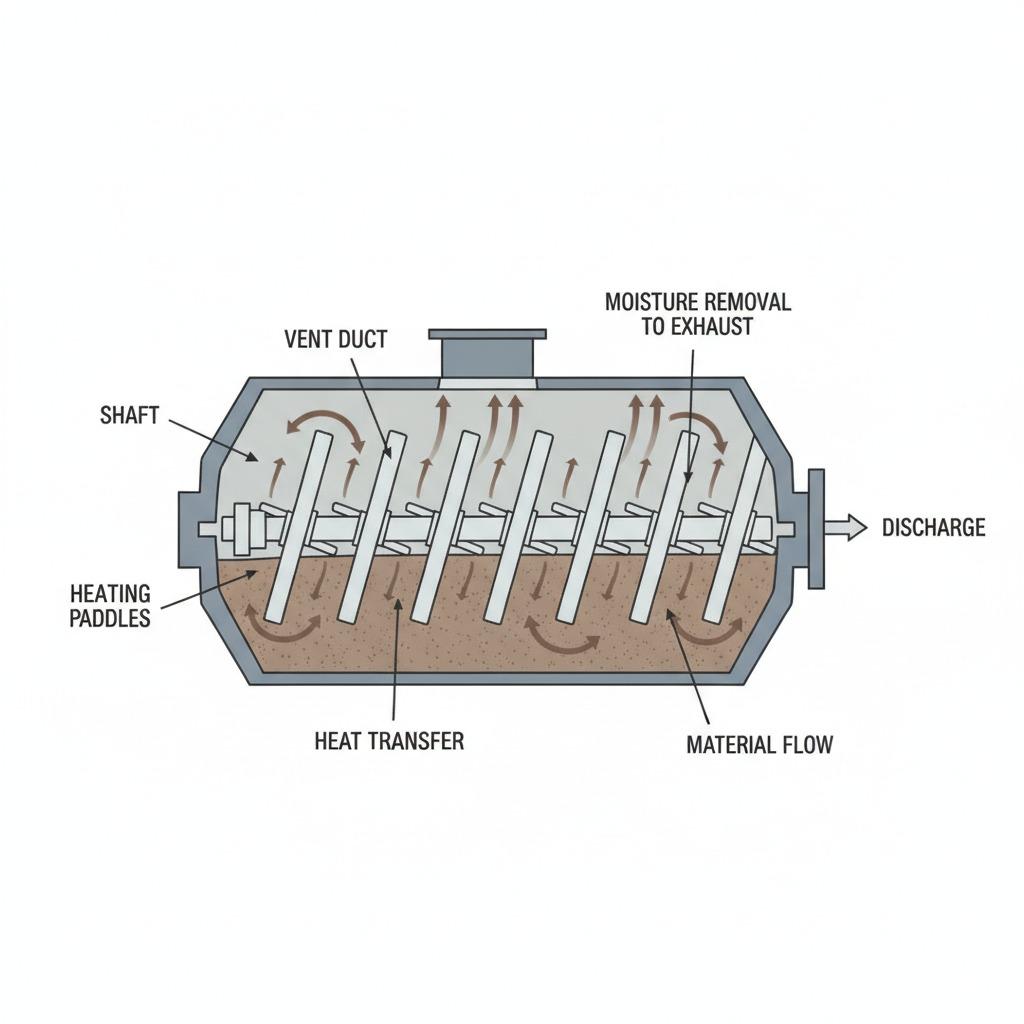
What a Paddle Dryer Is Good At
A paddle dryer is an indirect heat transfer dryer with a jacketed trough and rotating heated paddles or blades that continuously mix the material. Heat moves through metal surfaces rather than by direct contact with hot air. That distinction matters. It means the process can be gentler, the exhaust load is often lower, and the unit is better suited to materials that do not want to be blown around, oxidized, or overheated.
In practical terms, the machine is often selected for pastes, cakes, filter solids, and sludges. It is also used when a plant wants to recover solvent, reduce waste volume, or prepare a material for downstream blending, packaging, or combustion. If a product is semi-solid and sticky enough to bridge in conventional dryers, a paddle dryer can sometimes handle it with far less drama.
Common Paddle Dryer Applications by Industry
Wastewater and Environmental Processing
One of the most familiar paddle dryer applications is sludge drying. Municipal and industrial treatment plants use these systems to reduce moisture in biosolids and related waste streams. Lower moisture content usually means less transport cost, easier disposal, and in some cases improved suitability for further energy recovery. The appeal here is not glamorous, but it is easy to understand: moving water is expensive.
Environmental applications often favor enclosed equipment because odors, dust, and contamination need to be controlled. A paddle dryer can fit that requirement better than more open drying methods. That said, sludge composition can vary from site to site, so the feed characteristics should be checked carefully. A system that works on one plant’s cake may need adjustments for another plant’s ash content, grit load, or polymer dosing.
Chemicals and Specialty Materials
Chemical producers use paddle dryers for crystallized materials, salts, pigments, intermediates, and process residues that are too sticky or too fragile for aggressive handling. The indirect heating approach supports tighter temperature control, which is helpful when a product starts to discolor, decompose, or lose value if overheated. This is especially important when the product is not just being dried, but also needs to be conditioned for reuse or further processing.
In chemical service, the main concern is often fouling and cleaning. Some materials dry cleanly; others form deposits on heat transfer surfaces and paddles. That can affect performance and maintenance intervals. A buyer should ask for examples of similar materials, not just broad promises about “versatile drying.” That phrase means very little unless it is tied to actual process behavior.
Food and Agricultural Processing
Food and agricultural paddle dryer applications are usually more selective. The equipment can be useful for byproducts, protein-rich cakes, fibers, spent grains, or other semi-wet solids that need a controlled drying step. Because the process is indirect, it can help reduce exposure to excess air and limit product loss from entrainment. This is not a universal answer for food drying, but it can make sense where batch or semi-continuous solids handling is the issue rather than the final appearance of a free-flowing granular product.
For food-adjacent use, sanitation, access for cleaning, and material compatibility matter more than many first-time buyers expect. A unit that performs well mechanically may still be awkward in a hygienic plant if inspection and washdown are difficult. That is one of those unglamorous details that becomes very expensive later.
Pharmaceutical and Fine-Chemical Processing
In regulated or high-value processing, the appeal of paddle dryers is usually containment and control. The equipment is not chosen because it is the prettiest option; it is chosen because some products need low shear, controlled residence time, and a closed system. Fine chemicals, intermediates, and certain specialty powders may be handled this way when drying needs to be integrated into a broader controlled process train.
Here, the conversation often shifts toward cleaning validation, traceability, and material of construction. Those topics are highly application-specific, so the design should be evaluated against the actual product, solvent system, and cleaning strategy rather than against a generic equipment brochure.
Why Plants Choose Paddle Dryers Over Other Dryer Types
When comparing dryer options, the reasons are usually practical. A paddle dryer can handle wet cakes without requiring preconditioning into a free-flowing feed. It can offer better thermal efficiency than systems that waste heat moving a large amount of air. It can also reduce dusting and emissions because less gas is needed to carry moisture away.
Compared with rotary dryers, the paddle style is generally more compact and more controlled. Compared with fluid bed dryers, it is better suited to sticky solids and less dependent on particle fluidization. Compared with some vacuum systems, it may offer a simpler operating profile for materials that do not require deep vacuum conditions. None of these are absolute rules, of course. The right choice depends on product behavior, utility costs, and plant layout.
Selection Criteria That Actually Matter
Buyers sometimes start with capacity alone, but that is only one part of the picture. The better questions are about feed consistency, final moisture target, temperature sensitivity, and how the product behaves as it dries. A material that starts as a sticky cake may become brittle, dusty, or hard to discharge near the end of the cycle. That change in behavior can affect paddle design, residence time, and discharge arrangement.
Heat transfer area, shaft speed, torque margin, and cleaning access are also worth close attention. If the product tends to smear, the scraper and paddle geometry can matter as much as the heating surface itself. For abrasive materials, wear resistance becomes a maintenance issue almost immediately. And if the downstream line depends on consistent particle size or bulk density, the dryer’s mixing intensity should be reviewed carefully rather than assumed.
Questions to Ask Vendors
Ask what type of feed has been handled before, not just what industries they serve. Ask whether the unit has performed well with similar moisture ranges. Ask how fouling is managed, how the machine is cleaned, and whether the design supports inspection of internal surfaces. If the vendor cannot explain those points in plain language, that is worth noting.
Common Mistakes in Paddle Dryer Projects
One common mistake is treating the dryer as a standalone purchase instead of a process step. Feed preparation, discharge handling, and dust or vapor treatment all need to be considered together. Another mistake is assuming that indirect drying automatically means lower operating complexity. It often reduces some problems, but it does not eliminate the need for good controls and maintenance discipline.
It is also easy to underestimate how much product testing matters. Bench data, pilot runs, or even a careful trial on a closely related material can reveal whether the solids move properly, whether the dryer fouls, and how much residence time is realistic. A capital project can be derailed by one unpleasant surprise in the last third of the drying curve, when the material stops behaving like a simple wet cake.
Practical Buyer Advice
If you are evaluating paddle dryer applications for a new line or retrofit, start with the material, not the machine. Document the feed moisture range, particle or cake structure, thermal sensitivity, and any contaminants that could affect heat transfer or wear. Then map the full process: upstream dewatering, dryer feed, vapors, discharge, and final handling. That sequence often reveals whether a paddle dryer is the best fit or simply one workable option among several.
It also helps to think beyond nameplate capacity. A dryer that can process the nominal load may still be a poor fit if it struggles during feed variation or needs frequent cleaning. Plants usually regret underspecifying torque, access, or discharge design before they regret overspecifying a little extra robustness. That is not always true, but it is true often enough to be a useful caution.
FAQ: Short Answers for Fast Screening
Are paddle dryers only for sludge?
No. Sludge is common, but the equipment also appears in chemicals, specialty materials, food byproducts, and fine processing applications where sticky or heat-sensitive solids need controlled drying.
Do paddle dryer applications always need vacuum?
No. Some do, especially when temperature sensitivity or solvent recovery is central. Others operate without vacuum depending on the material and process goals.
What is the biggest risk in choosing one?
Assuming a generic drying solution will work without testing the actual feed behavior. Material handling issues are often the real limiting factor.
Choosing the Next Step
The best way to judge paddle dryer applications is to compare them against the actual product and operating conditions, not a brochure headline. If the material is sticky, enclosed drying is desirable, and the plant needs controlled moisture reduction in a compact footprint, a paddle dryer may be a strong candidate. If the feed is abrasive, highly variable, or requires very specific particle formation, the design needs a more cautious review.
For engineering teams, the next step is usually a process review with representative material data and a discussion of cleaning, discharge, and vapor handling. That conversation tends to separate the practical solutions from the attractive ones. In manufacturing, that difference is often the one that matters.





