Double Conical vs Paddle Dryer: how to choose the right mixer-dryer for your process
When buyers compare Double Conical vs Paddle Dryer, they are usually trying to solve a practical production problem, not settle a technical debate. The question is simple enough on the surface: which dryer will remove moisture or solvent more reliably, protect the product, and fit the plant’s way of working? The answer is less simple, because these two machines handle heat transfer, mixing, discharge, and scale-up in very different ways.
That matters because a dryer choice can affect batch time, energy use, residue build-up, cleaning effort, and even downstream quality. For powders, granules, pastes, filter cakes, and heat-sensitive materials, the wrong dryer can create clumps, over-dry outer layers while leaving a wet core, or demand more operator attention than the line can spare. The right one, on the other hand, can reduce handling steps and make a stubborn process look easy.
Quick comparison: the practical differences that matter
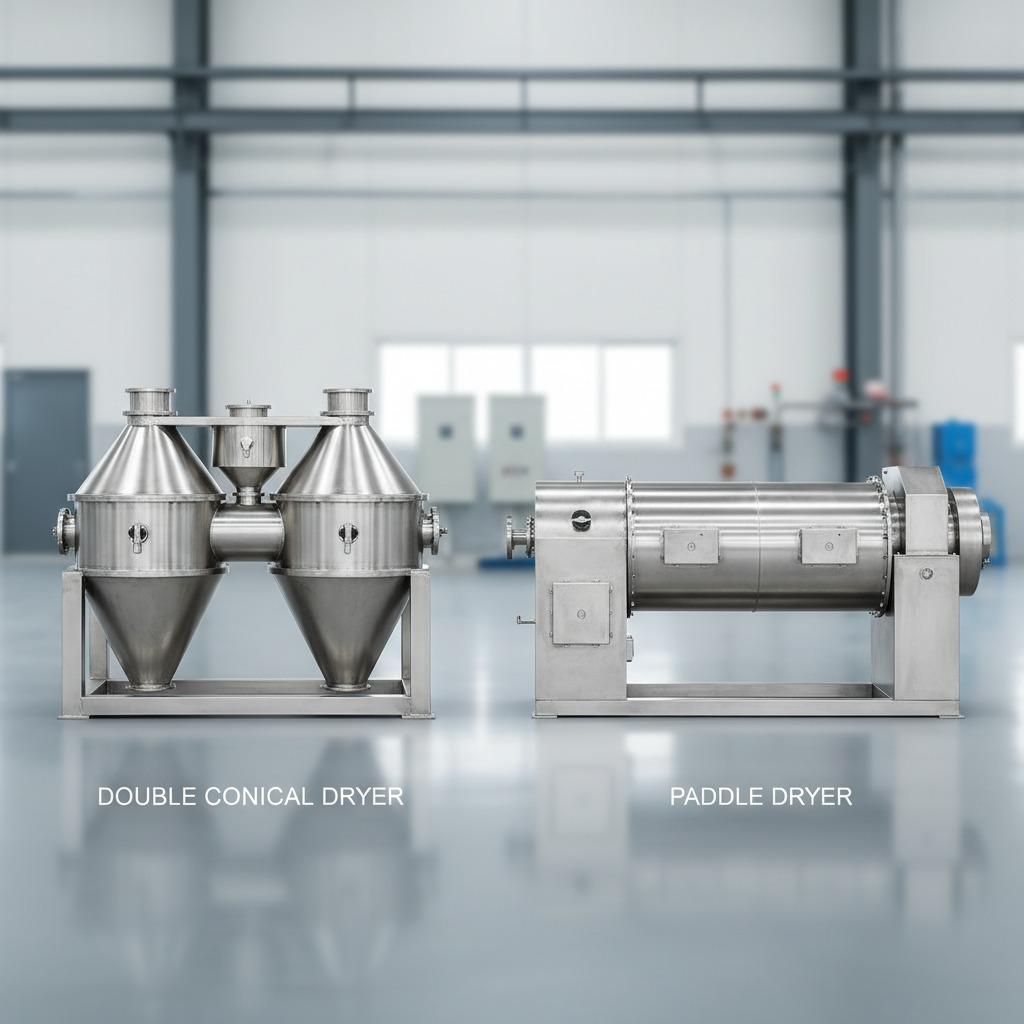
In broad terms, a double conical dryer is a rotating vessel that tumbles the batch gently while applying heat through the jacketed shell. A paddle dryer, by contrast, uses rotating shafts with paddles or blades to stir and expose the material continuously against heated surfaces. Both are widely used as batch drying equipment, but they behave differently under load.
At a glance
The double conical design tends to suit free-flowing solids, fragile crystals, and materials that benefit from gentle tumbling and low shear. The paddle dryer is often chosen for sticky, pasty, or more difficult materials that need active mixing to prevent agglomeration and improve heat transfer.
That is the simple version. In real production, the choice depends on moisture form, viscosity, discharge behavior, cleanliness requirements, and how much mechanical action the product can tolerate without damage.
How a double conical dryer works
A double conical dryer uses a vessel shaped like two cones joined at the center. The whole drum rotates around a horizontal axis, lifting and cascading the material as it turns. Heat is usually supplied through the jacket, and sometimes through internal surfaces depending on the design. Vacuum operation is common when low-temperature drying is needed.
The appeal is obvious to anyone who has dealt with delicate solids: the action is mild. There are no fast-moving paddles breaking up crystals or smashing attrition-sensitive particles. For many chemical, pharmaceutical, and fine-material batches, that gentler motion helps preserve particle integrity and reduce dust generation. It also keeps the internal geometry relatively simple, which can be a plus for cleaning and maintenance.
Still, the same simplicity creates limits. If the batch is sticky, forms wall deposits, or changes from a mobile powder to a tacky mass during drying, the tumbling action may not be enough. The material can ride with the shell instead of redistributing well, and heat transfer may become uneven. In that case, the process looks elegant on paper and disappointing on the floor.
How a paddle dryer works
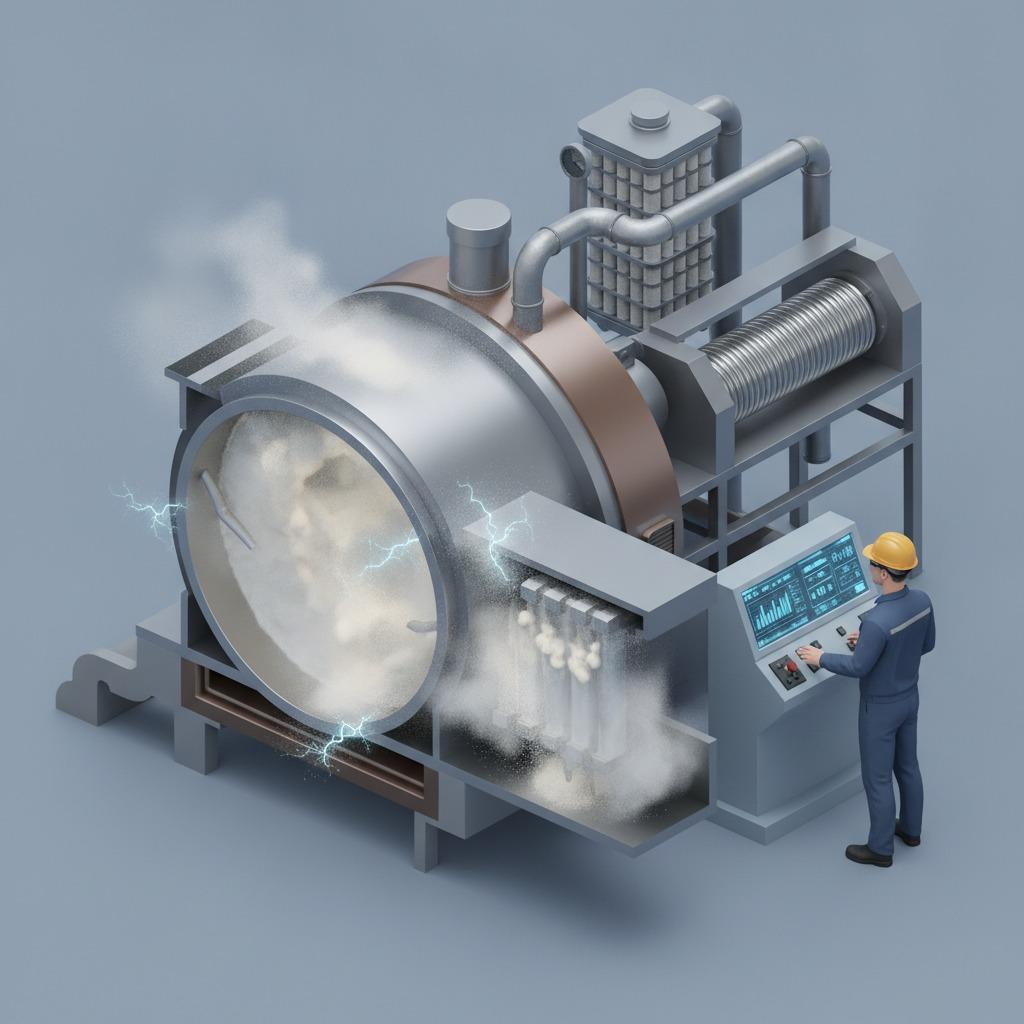
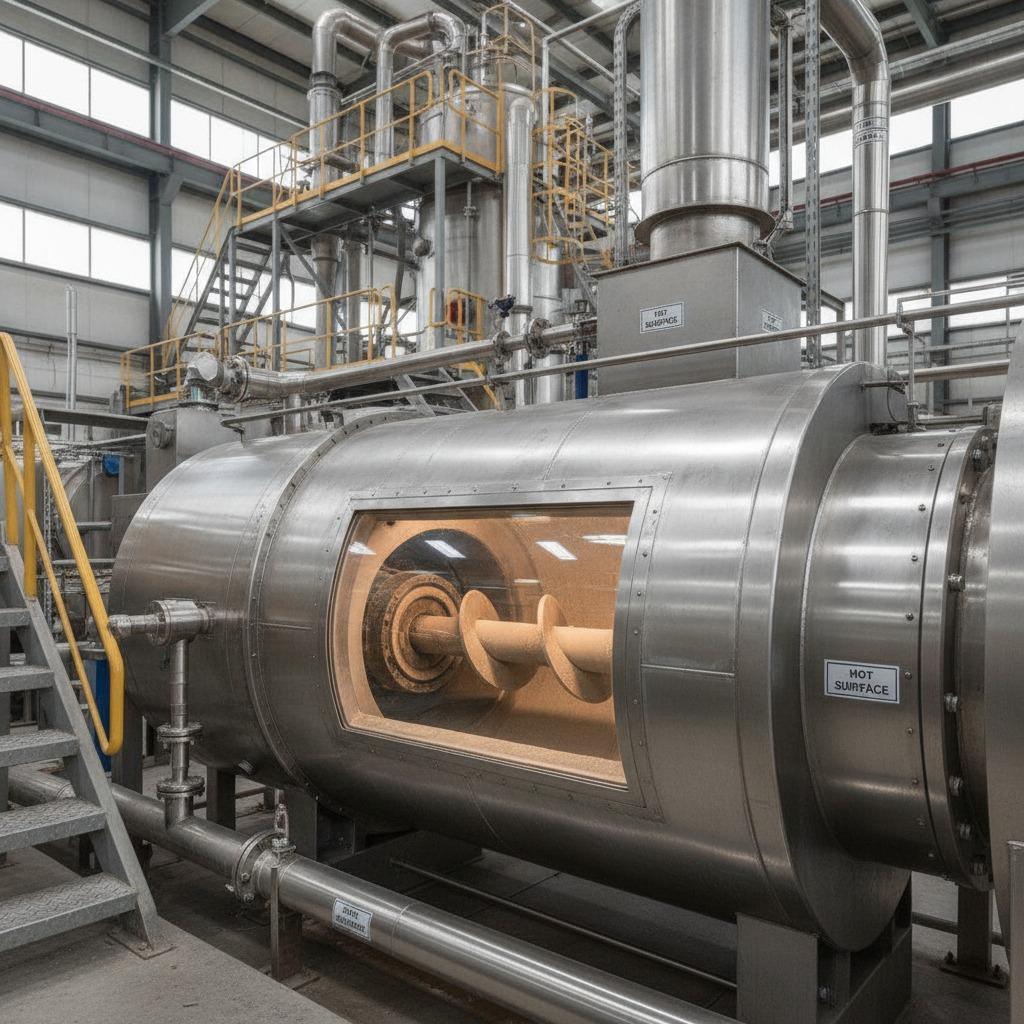
A paddle dryer uses one or more shafts fitted with paddles or hollow blades that rotate through the product bed. The paddles continuously mix, convey, and renew contact between the product and the heated surfaces. Some designs also allow the paddles or shafts to be heated, which increases the available heat transfer area. This makes the equipment attractive when evaporation is slow or the material resists movement.
The practical advantage is more aggressive heat transfer. Because the material is being turned and exposed repeatedly, a paddle dryer can often handle pastes, slurries, sludge-like feeds, and wet filter cakes better than a tumbling vessel. It is also better suited to processes where discharge consistency matters and the product must be worked through the dryer rather than simply rolled around inside it.
The tradeoff is mechanical intensity. Paddle dryers generally involve more moving parts inside the product zone, which can mean more wear surfaces, more attention to sealing, and a more involved cleanout routine. For some products that is acceptable; for very fragile solids, it may be too much.
Choosing between them by material behavior
When teams evaluate Double Conical vs Paddle Dryer, the most useful question is not “which machine is better?” but “what does the material need while it dries?” That is a better lens because drying is not just about removing moisture; it is about controlling how the product changes as moisture leaves.
Free-flowing and fragile materials
If the product is already free-flowing and needs a gentle touch, the double conical dryer usually has the edge. Crystals, granules, and other solids that can break down under shear often benefit from low mechanical stress. The tumbling action also reduces the risk of excessive particle attrition, which can matter when final particle size distribution is tightly controlled.
Sticky, cohesive, or hard-to-dry materials
If the batch tends to smear, bridge, or cake, a paddle dryer is often the more realistic choice. Its active mixing helps break up agglomerates and refresh the material surface. That can be especially useful where the feed enters as a filter cake or paste and must be converted into a dry, manageable powder or granular mass.
Heat-sensitive products
Both machines can be used with vacuum to lower drying temperature, but the process window matters. A double conical dryer can be a strong fit when the product is sensitive and the batch responds well to gentle tumbling. A paddle dryer can also serve heat-sensitive materials if the residence time is controlled carefully and the heat input is managed well. The caution here is obvious: faster heat transfer is useful only if it does not damage the product.
Process efficiency is not just about evaporation rate
It is tempting to compare dryers only by how fast they remove moisture. That is too narrow. Real operating efficiency includes loading and unloading behavior, cycle repeatability, energy use, operator time, and how often the equipment needs intervention.
A double conical dryer can be efficient in a batch environment where the product behaves predictably and the plant values simple operation. Its rotating vessel often supports straightforward batch handling. A paddle dryer may deliver shorter drying times for difficult materials, but it also asks more from the mechanical system and sometimes from maintenance planning. The “more efficient” machine is the one that matches the material without creating new headaches elsewhere in the line.
Cleaning, maintenance, and cross-contamination concerns
This is where buying decisions often become more grounded than brochures suggest. A vessel with fewer internal moving parts may be easier to inspect and less prone to hidden buildup. That can matter in multiproduct plants, especially where flavor carryover, residue retention, or trace contamination must be managed carefully.
Paddle dryers are not inherently difficult to maintain, but they usually present more internal components and tighter attention points. Seals, shafts, bearings, and heating surfaces all deserve scrutiny. On the other hand, if the process material is adhesive or hard to remove, the stronger mixing action of a paddle dryer may actually reduce dead zones that would otherwise collect stubborn residues.
The real buyer caution is to look beyond the cleanout promise and ask how the equipment behaves after several cycles, not just on day one. A dryer that looks clean in the shop can behave differently once it has seen real product, real temperature swings, and a few hurried shut-downs.
Selection criteria engineers and sourcing managers should use
For teams making a sourcing decision, the comparison should be built around a few concrete process questions:
What is the feed form: powder, granule, crystal, paste, slurry, or filter cake?
How sensitive is the product to shear, attrition, or breakage?
Does the batch become sticky during the drying curve?
How important are cleaning, residue removal, and product changeover?
Is vacuum drying required, or is atmospheric drying acceptable?
What kind of discharge is needed: free-flowing solids, dense cake, or a more processed dry mass?
If the answers point toward gentle handling and simple internal geometry, a double conical dryer is often the more natural fit. If the answers point toward difficult rheology, poor heat transfer, or a need to actively work the material, a paddle dryer usually deserves serious consideration.
Common mistakes when comparing the two
One common mistake is to assume a dryer with higher mechanical action is automatically “stronger” and therefore better. In reality, stronger can mean rougher, and rougher can mean damaged product. Another mistake is underestimating how the material changes during drying. A feed that starts as a pumpable paste may become an awkward sticky intermediate before it becomes a powder again. The dryer has to handle that whole journey, not just the beginning and the end.
Buyers also sometimes focus on footprint alone. Yes, floor space matters, but a compact machine that needs constant attention or causes inconsistent moisture profiles is rarely a win. Likewise, selecting only on quoted drying time can mislead if the number comes from a favorable test batch that did not reflect the real feed variation.
What a good supplier conversation should include
If you are talking to an equipment supplier, bring process data instead of broad requirements. Moisture content, particle behavior, bulk density, feed temperature, discharge target, and sensitivity to heat or shear are much more useful than a one-line request for “a drying solution.” If possible, ask how the proposed design handles residues, access for inspection, and the likely maintenance points in the product zone.
It also helps to ask about scale-up logic. Batch dryers often look convincing in pilot trials but become more complicated at production size. A supplier who can explain residence time, mixing pattern, and heat-transfer assumptions clearly is usually a better partner than one who only highlights capacity figures.
FAQ-style buyer notes
Is a double conical dryer always gentler? Generally yes, in terms of mechanical action, but process conditions still matter. Poor loading, overfilling, or unsuitable heat settings can still damage product quality.
Can a paddle dryer handle powders? Yes, but it is often chosen for materials that need active mixing rather than simple tumbling. For already free-flowing powders, it may be more machine than necessary.
Which is better for vacuum drying? Both can be used in vacuum-based processes. The better choice depends on product behavior, desired temperature, and how the material responds to movement during drying.
The practical takeaway for production teams
When comparing Double Conical vs Paddle Dryer, the cleanest decision rule is this: choose the gentler rotating vessel when the product is cooperative and fragile, and choose the actively mixed dryer when the material resists heat transfer or tends to stick. That sounds simple, but it is usually where the right answer sits.
If the process is still uncertain, the safest next step is to map the material’s behavior through the full drying cycle and use that to narrow the equipment type before discussing capacity or layout. In drying projects, the best purchase is often the one that respects what the material actually does, not what the specification sheet hopes it will do.
For a sourcing team, that means gathering real feed data, comparing operating risks, and asking each supplier to explain not just how the machine works, but why it suits your product. That conversation tends to reveal the right choice faster than any brochure comparison ever will.