Why the spray dryer method still matters in modern manufacturing
The spray dryer method remains one of the most practical ways to turn a liquid feed into a free-flowing powder, granule, or agglomerated product. That sounds simple, but the industrial value is in the control it gives engineers over particle size, moisture, bulk density, and flow behavior. For sourcing managers and product teams, the real question is not whether spray drying works; it is whether it is the right route for a specific formulation, throughput target, and downstream process.
In food, pharmaceuticals, ceramics, detergents, and specialty chemicals, manufacturers often choose spray drying when they need a consistent dry product from an emulsion, suspension, or solution. The method can simplify handling, improve shelf life, and make dosing more predictable. It can also create headaches if the feed is unstable, heat-sensitive, or expensive to dry inefficiently. That is why buyers should look past the basic definition and examine how the process behaves in practice.
What the process is really doing
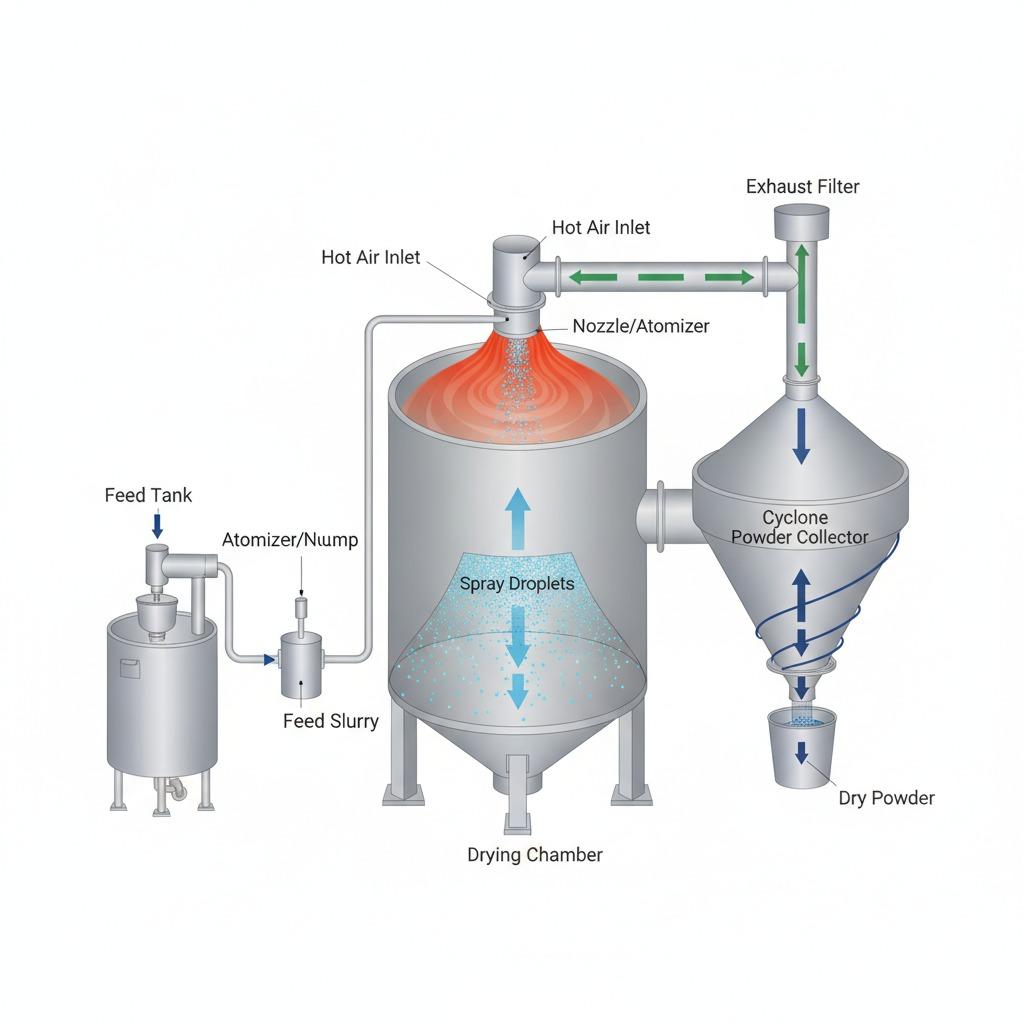
At its core, spray drying atomizes a liquid feed into tiny droplets and contacts those droplets with hot drying gas. The moisture leaves quickly, leaving behind solid particles that are collected and separated from the air stream. Because the droplets are small, drying can happen in seconds rather than minutes or hours.
That speed is the main advantage, but it also shapes the final product. Droplet size, inlet air conditions, feed solids content, and atomization style all influence the powder. A change in nozzle design or rotary atomizer settings can alter the particle profile enough to affect caking, dispersibility, or compressibility downstream. In other words, the process is fast, but it is not indifferent.
Quick reference: what buyers usually care about
Process outcomes
Engineers usually evaluate whether the spray dryer method can deliver:
consistent powder flow
controlled moisture content
acceptable heat exposure for the formulation
particle size distribution that works in the next process step
low dusting or improved agglomeration, when needed
Commercial outcomes
Sourcing teams often focus on:
throughput and scalability
energy efficiency
cleaning requirements
product recovery and yield
whether the system can handle multiple formulations without long changeovers
Those two lists overlap more than people admit. A technically workable system can still be a poor purchasing decision if it is difficult to clean, too energy intensive, or too sensitive to feed variation.
How spray dryer technology typically differs by application
The term spray dryer technology covers a wide range of equipment and operating styles. The basics are shared, but the application changes the design priority.
For food ingredients, the goal may be solubility, instant properties, and flavor retention. Dairy powders, for example, often need a careful balance between particle structure and moisture control. For pharmaceutical or nutraceutical products, uniformity and low thermal stress may matter more than raw throughput. In ceramics and chemicals, the emphasis may shift toward particle shape, size distribution, and consistent feed-to-powder conversion.
This is one reason buyers should be cautious about broad claims. A dryer that performs well on one material may struggle on another with different viscosity, solids content, or stickiness. If a supplier talks only in generalities and avoids discussing feed behavior, that is a warning sign.
Common system components and what they influence
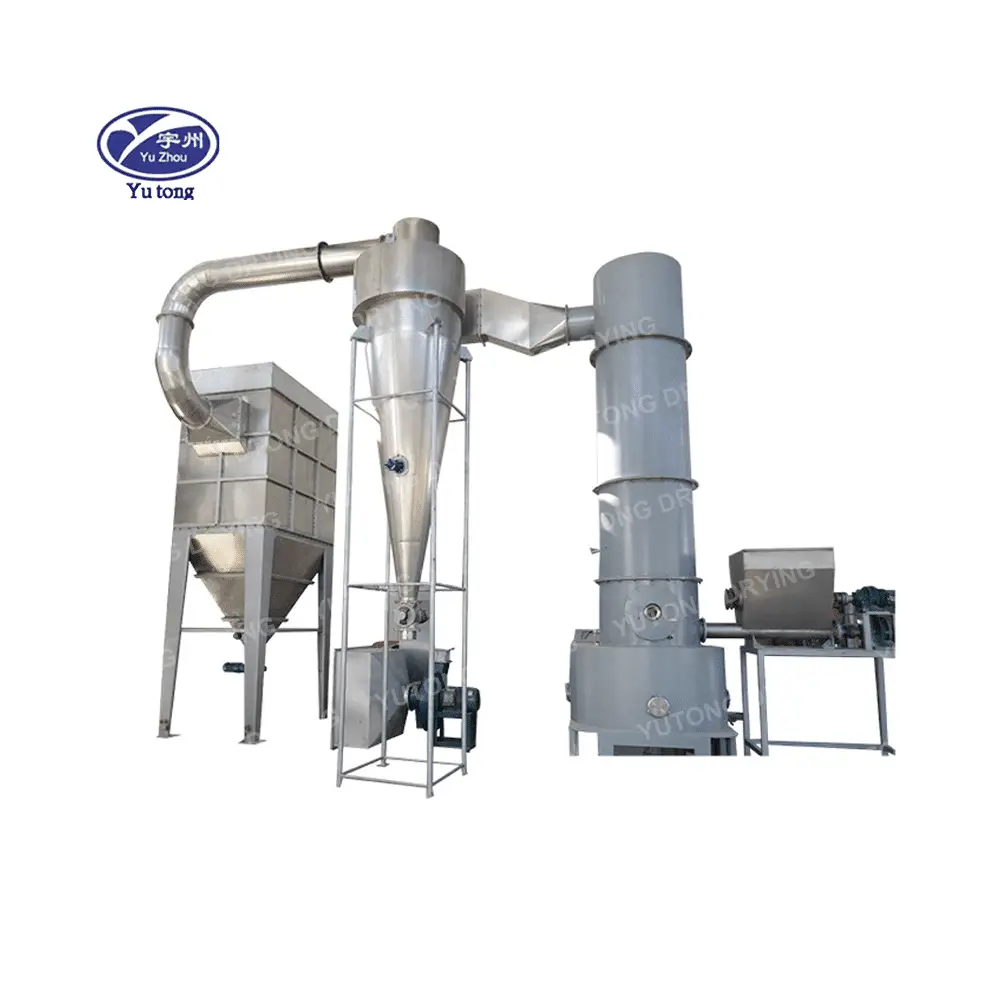
Although configurations vary, most spray dryers include a feed system, atomizer, drying chamber, air heater, cyclone or other powder collection device, and exhaust handling equipment. Each part affects product quality and operating cost.
The atomizer is especially important. Nozzles and rotary atomizers create droplets differently, and that droplet pattern affects everything that follows. Smaller droplets dry faster, but they may also produce more fines. Larger droplets can improve handling in some cases, but they may raise the risk of incomplete drying if the residence time is too short.
The drying chamber geometry also matters. A compact chamber can work well for some products, while others need a larger residence time or a different airflow pattern. Industrial drying is often a compromise among thermal exposure, footprint, and recovery efficiency. That compromise should be discussed early, not after the equipment has already been narrowed down.
Selection criteria that are easy to overlook
Most procurement conversations start with capacity. Capacity matters, but it is only one part of the decision.
Feed characteristics
Before choosing equipment, teams should understand solids content, viscosity, suspendability, foaming tendency, and stickiness. These properties influence atomization and wall deposition. A feed that looks stable in a lab beaker may behave differently at scale, especially after heating or concentration.
Product sensitivity
Some materials can tolerate more thermal exposure than others. If the active component degrades easily, the process window becomes narrower. In that case, the buyer may need to examine inlet temperature, outlet temperature, residence time, and whether alternative drying strategies should be considered.
Cleaning and changeover
This is where a lot of projects lose time. If the dryer will run multiple formulations, residual cross-contamination and cleaning access become practical issues. A system that is efficient on paper may be frustrating in production if it takes too long to clean between campaigns.
Powder handling after drying
The powder is not finished when it leaves the chamber. Conveying, sieving, packaging, and storage all depend on how the powder behaves. Free-flowing powder is easier to manage than a sticky or highly hygroscopic material. Buyers should ask what the dried product will have to endure after collection, not just inside the dryer.
Common mistakes buyers make
One frequent mistake is selecting equipment based on nominal throughput without checking actual feed properties. Another is assuming that all spray dryer method installations can be scaled linearly from the lab to the plant. Scale-up is possible, but it is rarely automatic. Airflow, droplet formation, heat transfer, and wall losses change in ways that are not always intuitive.
A second mistake is ignoring powder recovery. If the product is valuable, losses in exhaust handling or chamber deposition can be costly over time. A third mistake is treating energy consumption as a secondary concern. In drying operations, thermal efficiency can have a real effect on unit cost, especially in high-volume production.
And then there is the habit of underestimating dust and safety considerations. Fine powders can create housekeeping, contamination, and in some industries, combustible dust concerns. The right controls are not a luxury; they are part of the process design.
When the spray dryer method is a strong fit
The method is generally attractive when a manufacturer needs:
rapid removal of moisture from a liquid feed
controlled particle formation from solution or suspension
a powder that is easier to store, ship, or dose than the original liquid
scalable production with repeatable output
compatibility with downstream blending or tableting
It is especially useful when the formulation can tolerate the thermal profile and when the business case depends on turning a difficult-to-handle liquid into a stable dry material. That said, the method is not ideal for every product. Highly heat-sensitive compounds, very sticky feeds, or materials that require very narrow particle morphology may call for a different approach or a more specialized spray dryer configuration.
Practical questions to ask a supplier
A buyer does not need to become a process engineer to ask useful questions. These are the ones that tend to separate a serious supplier from a brochure:
What feed properties did you use when you validated this design?
How does the system handle variation in solids content or viscosity?
What is the expected cleaning approach between runs?
How is powder recovery managed?
What operating range is realistic for this product, not just possible in a demonstration?
What parts of the system are most likely to need adjustment during scale-up?
Those questions force a more honest conversation. They also help the buyer compare vendors on operational fit, not just on equipment size.
A cautious view on performance claims
Spray drying is often described in impressive terms, but performance is always formulation-dependent. A supplier may show excellent results with one material and only moderate results with another. The sensible response is not skepticism for its own sake, but disciplined verification. Pilot trials, sample evaluation, and a clear definition of success are worth the time.
If the project is important, teams should look at the whole chain: feed preparation, atomization, drying, recovery, cleaning, and post-drying handling. The spray dryer method succeeds when all of those elements support one another. It fails when one weak link is ignored because the headline throughput looked good.
What this means for engineering and sourcing teams
For engineers, the process decision comes down to whether the product can survive atomization and thermal exposure while still meeting specs. For sourcing managers, it is a question of lifecycle fit: operating cost, maintenance burden, flexibility, and the supplier’s ability to support real production conditions. For product teams, the central issue is whether the final powder behaves the way the market needs it to behave.
The best decisions usually come from comparing a few realistic scenarios rather than chasing a single ideal setup. In practice, that means asking how the process behaves at the expected feed rate, with the expected formulation changes, under the cleaning and recovery requirements that production will actually face.
FAQ: common buyer questions
Is spray drying only for heat-resistant materials?
No. Many heat-sensitive materials are spray dried successfully, but the operating window needs to be chosen carefully. Short residence times help, yet formulation and process control still matter.
Can the method improve product consistency?
Yes, if the upstream feed is controlled. The process can produce uniform powders, but it cannot fully compensate for unstable feed preparation.
Is pilot testing worth it?
Usually yes. Pilot work can reveal wall sticking, recovery issues, and powder behavior that are easy to miss in early discussions.
Next step for buyers evaluating a project
If your team is considering the spray dryer method for a new product or a process upgrade, start with the feed, not the machine. Define the material behavior, the required powder properties, and the downstream handling needs first. Then compare equipment options against those realities.
That sequence saves time and usually prevents expensive surprises. It is also the most practical way to judge whether spray dryer technology is a fit for your process, or merely a familiar option that looks good on a specification sheet.