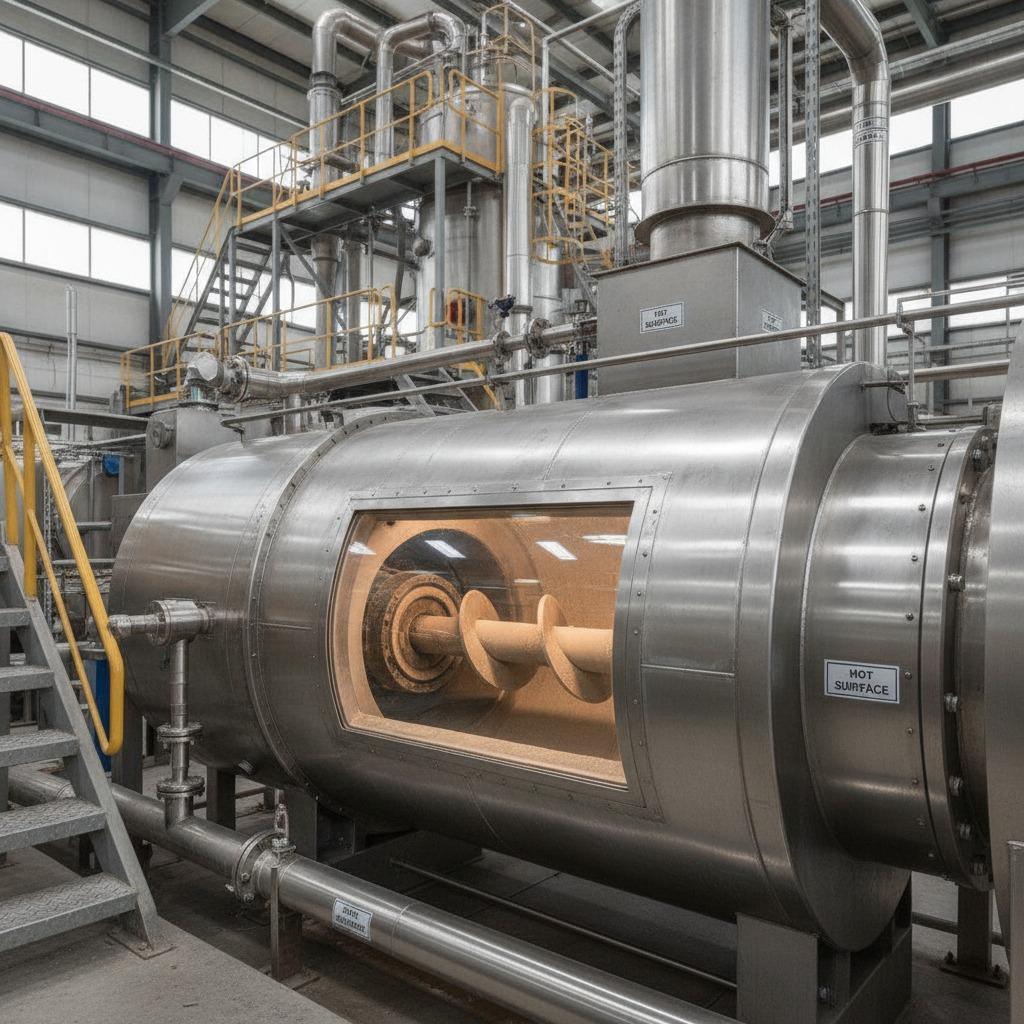
Why buyers keep comparing high-speed drying with bulk-solids handling
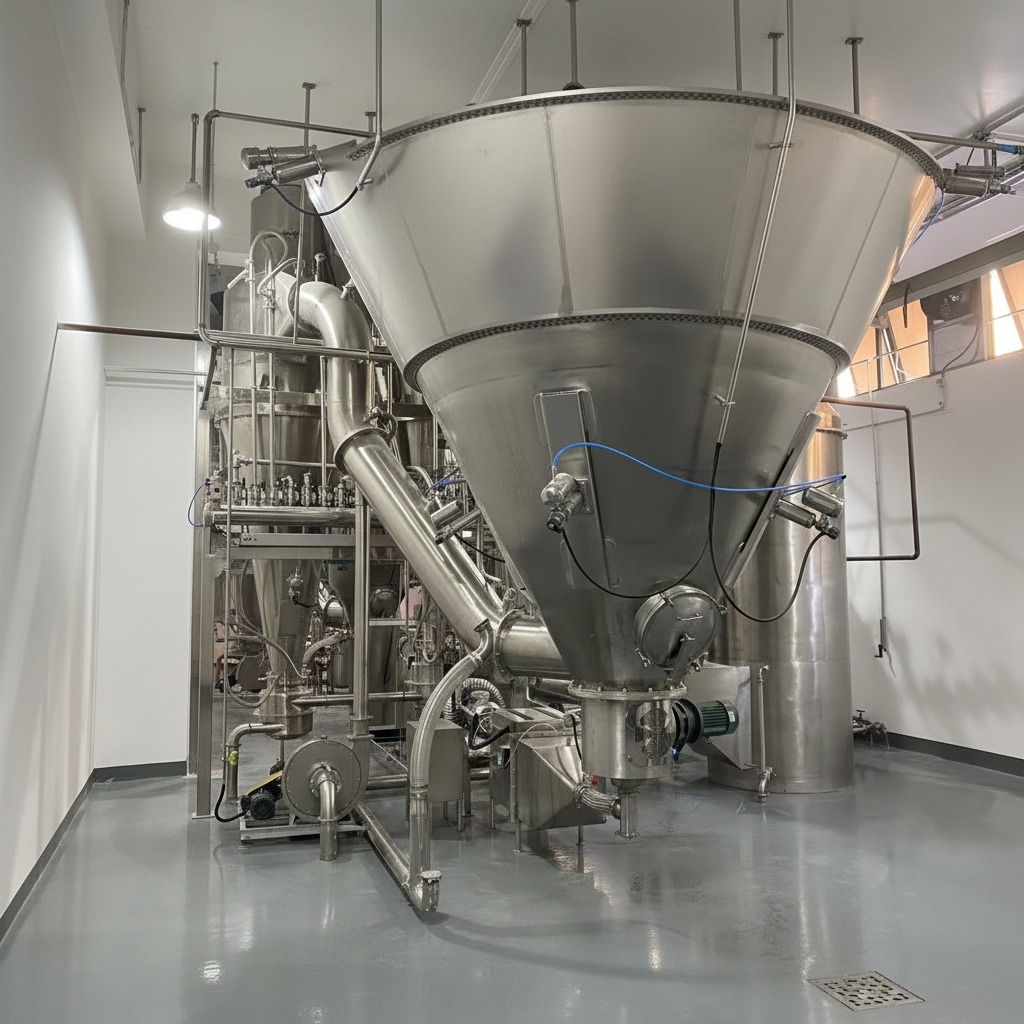
A high speed centrifugal spray dryer is often discussed as if it were just one machine in a line, but in practice it sits inside a broader powder-processing system that can include cyclones, collection vessels, stainless-steel hoppers, ducting, and discharge equipment. That matters because many sourcing teams are not just buying a dryer. They are buying a way to turn a liquid or slurry into a dry, manageable powder, move that powder without contamination, and keep the plant running without constant manual intervention.
From the outside, the equipment family can look confusing. One plant may use a centrifugal spray drying system with large conical separators and access platforms. Another may rely on conical stainless-steel silos or hoppers that feed, store, or transfer dry bulk material between process stages. The hardware looks similar enough that non-specialists sometimes assume the function is the same. It usually is not. The selection problem is less about the shiny vessel in the room and more about the way material enters, dries, separates, collects, and leaves the system.
For engineers and product teams, the decision typically comes down to this: do you need fast, repeatable conversion of a feed into powder, or do you need clean, reliable handling of an already-dry material? In a lot of facilities, both are present. That is why a practical buying review should cover not only the dryer itself, but also the surrounding stainless-steel process equipment that determines whether the installation is easy to clean, easy to maintain, and compatible with hygienic or controlled production areas.
What the visible equipment tells you before you read a datasheet
Even without a nameplate, several construction clues are useful. The equipment described in the supplied data includes cylindrical main vessels, conical cyclone separators, large collection chambers, and floor-standing stainless-steel hoppers or silos with side ports, manways, and piping. That combination points to plant-scale powder or slurry handling rather than a compact lab unit. The visible welded seams, polished or brushed stainless surfaces, and integrated ductwork suggest process-contact equipment built for industrial environments where washdown, corrosion resistance, or controlled contamination risk are concerns.
Some units appear to include support frames, railings, and platforms. That is not decorative. Access matters when a system uses cyclones, discharge cones, valves, and instrumentation points that must be inspected, cleaned, or cleared after a run. In a plant that dries powders or handles dry solids, a bad access layout can quietly become a maintenance problem. People notice it only after the first clog, the first sticky batch, or the first time a technician has to work awkwardly above a lower chute.
How a centrifugal spray drying process usually works
In a typical spray-drying setup, a liquid feed is atomized into fine droplets and exposed to a heated air stream. The droplets dry quickly because of the high surface area created by atomization. A centrifugal spray dryer often uses a rotating disc or similar centrifugal mechanism to break the feed into droplets. The exact internal design is not supplied here, so it would be wrong to claim a specific atomizer geometry, but the operating principle is familiar across food, chemical, and pharmaceutical process lines.
After drying, the particles travel with the process air into cyclone separators or collection chambers, where solids are separated from the gas stream and discharged into hoppers or bins. That is where the rest of the stainless-steel installation becomes important. If the discharge path is poorly designed, fine powder can bridge, build up on walls, or escape into the room during maintenance. If it is well designed, the product flows steadily into downstream packaging, blending, or storage equipment with minimal handling.
Why the surrounding vessels matter as much as the dryer
Buyers sometimes over-focus on the dryer and under-spec the collection and transfer hardware. That is a mistake. A dryer that performs well but discharges into an awkward hopper arrangement can create bottlenecks, product losses, or unnecessary labor. A carefully fabricated stainless-steel hopper or silo, on the other hand, can stabilize the whole line by giving the plant a clean buffer between drying and packaging, or between storage and feeding. The conical bottom geometry visible in the supplied equipment is a common choice because it supports gravity discharge and helps material move toward the outlet.
Common equipment roles in a powder-processing room
The data supplied here describes several categories of stainless-steel process equipment. They are worth separating because the buying criteria are different even when the surfaces look similar.
Spray dryer and separation train
This is the part that handles feed conversion and particle separation. The key issues are atomization consistency, airflow management, solids recovery, and cleanability. For a pharmaceutical spray dryer, those issues become even more sensitive because product consistency, contamination control, and cleaning procedures can affect batch quality and compliance expectations. The exact compliance scope is not supplied, so it should not be assumed, but the general buyer concern is predictable: if the drying step is unstable, the powder downstream is difficult to rescue.
Conical hoppers and silos
The vertical stainless-steel vessels described in the data are likely used for storage, feeding, intermediate transfer, or receiving dry bulk material. Their value lies in controlled discharge and enclosed handling. In powder plants, gravity is helpful but not magical. Wall angle, outlet design, nozzle layout, and any fitted valves all influence whether the material flows smoothly or hangs up in the cone. The visible ports and access fittings suggest the vessels are meant to be integrated into a larger system rather than used as simple standalone tanks.
Conveying and ductwork
Enclosed pipes, ducts, and flanged joints matter because powder handling should not depend on open transfer whenever avoidable. Vacuum or pneumatic conveying may be used in these systems, although the exact method is not confirmed in the supplied data. The buyer-facing point is straightforward: enclosed transfer reduces operator exposure, helps keep the room cleaner, and usually makes the process easier to automate. It also introduces its own maintenance needs, especially around seals, bends, and joints.
Selection criteria that are easy to underestimate
Most teams start with capacity, and they should. But capacity alone does not decide whether a high-speed drying line is a good fit. A more useful short list includes feed properties, powder sensitivity, cleaning strategy, discharge behavior, and floor-space constraints. The supplied equipment descriptions repeatedly mention large floor-standing installations with integrated access platforms and multiple vessels. That suggests plant integration is a major concern, not an afterthought.
Think carefully about the material itself. Free-flowing granules behave differently from fine, cohesive powders. Heat-sensitive ingredients behave differently from robust industrial powders. If the end product is intended for food, chemical, or pharmaceutical use, the acceptable level of residue, dusting, and manual contact can change the entire equipment specification. A system that looks technically strong may still be a poor fit if the operator cannot clean it efficiently or if transfer losses are too high.
Also pay attention to the finish and fabrication quality. The data points to mostly stainless-steel construction with brushed or polished process-contact surfaces and some painted or insulated outer sections. That is common and sensible, but buyers should still ask where the process-contact surfaces stop and where structural or non-contact components begin. It is an easy place for assumptions to creep in during procurement reviews.
Practical cautions before you commit
One caution that rarely gets enough attention: not every shiny cone is a separator, and not every hopper is a buffer bin. If the plant layout is dense, a single mistaken assumption about function can lead to the wrong cleaning method, the wrong discharge connection, or the wrong instrumentation package. Ask for process flow drawings and confirm what each vessel actually does in the line.
Another practical warning is about access. The presence of railings, platforms, manways, and service ports is encouraging, but you still need to know whether those points are placed where maintenance staff can realistically use them. A system can be technically neat and still awkward in daily operation. This is especially true in rooms packed with multiple vertical vessels, duct runs, and lower discharge chutes.
What buyers should ask suppliers
When reviewing a supplier, ask for the information that affects integration rather than just brochure language. Request a clear process description, a system layout, and a material-of-construction breakdown for product-contact and non-product-contact parts. Ask how product is recovered from the air stream, how discharge is controlled, and how cleaning is performed between runs. If the system includes a hopper or silo network, ask what prevents bridging, buildup, or uncontrolled discharge. Those are the questions that reveal whether the equipment was designed for real plant use.
It also helps to ask what is known and what is still uncertain. In this case, the visible equipment strongly suggests stainless-steel bulk solids handling and drying hardware, but exact machine type, capacity, temperature range, automation level, and compliance claims are not supplied. That uncertainty is not a weakness of the equipment. It is a normal procurement issue. Good buyers do not fill in the gaps with wishful thinking.
FAQ
Is a high-speed centrifugal dryer always the right choice for powders?
No. It is often a strong choice when rapid drying and controlled particle formation are needed, but the right answer depends on feed behavior, thermal sensitivity, and the downstream handling system.
Why are stainless-steel hoppers and silos used around dryers?
They provide enclosed, corrosion-resistant bulk handling and can support hygienic or controlled processing environments. They also help reduce manual transfer.
Can the same installation work for food, chemical, and pharmaceutical products?
Possibly, but not automatically. The structure may be similar, yet cleaning, surface finish, material documentation, and process control expectations can differ significantly.
Next step for a sourcing or engineering team
If you are evaluating a centrifugal spray drying system or the stainless-steel vessels that support it, start with the process flow, not the catalog photo. Map how the feed enters, how the powder separates, where it is collected, and how it is discharged into storage or packaging. Then compare that path against your hygiene requirements, floor space, cleaning method, and maintenance access. The right decision is usually the one that keeps the line stable after the first month of real production, not the one that looks simplest on paper.
When the system is clearly defined, the buying conversation becomes much easier: fewer assumptions, fewer surprises, and a better chance that the equipment performs like part of a working plant instead of a showpiece in a sales room.