Can Yeast Survive the Dryer? What Bakers, Food Processors, and Packaging Teams Should Know
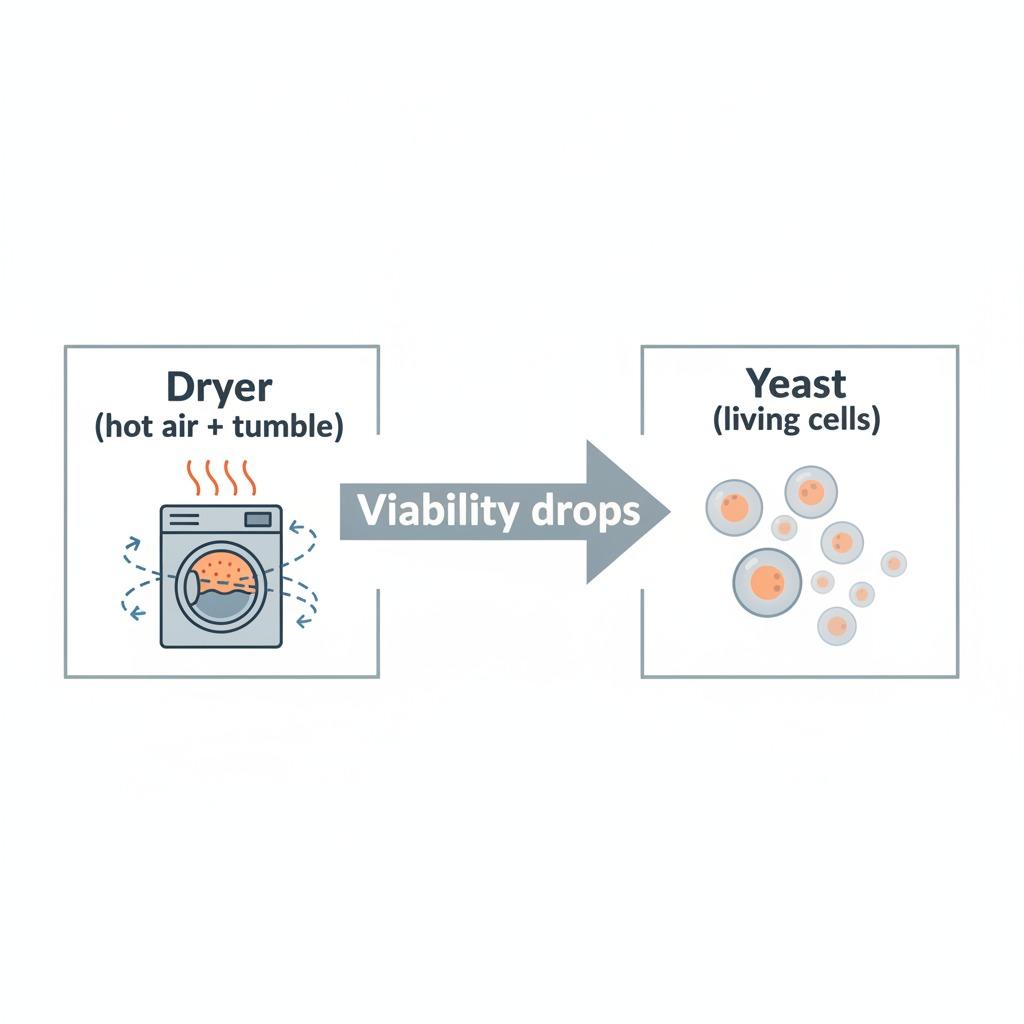
If you are asking can yeast survive the dryer, the short answer is usually no in any meaningful, working sense. Yeast is a living microorganism, and drying conditions that are hot enough for a household dryer or a standard industrial drying cycle will typically reduce viability sharply, sometimes to the point where the yeast is effectively dead. That matters whether you are baking at scale, designing dry-mix products, or trying to understand why a batch of dough behaves differently after storage.
The more useful question is not just whether yeast survives, but what kind of dryness and heat exposure it can tolerate. In food manufacturing, that distinction drives shelf life, fermentation performance, and product consistency. A little moisture loss may be manageable. Heat plus aggressive tumble drying is another matter entirely.
Why yeast is sensitive to drying
Yeast cells depend on intact membranes, stable proteins, and enough internal moisture to keep metabolism alive. When water leaves the cell too quickly, the structure can collapse. Heat makes the problem worse by damaging enzymes and cell walls. In practical terms, drying is not just “removing water”; it is a stress event.
That is why commercial yeast products are handled in controlled ways. Instant yeast, active dry yeast, and fresh yeast are all processed and packaged with moisture content and storage conditions in mind. The goal is to preserve viability, not merely to dry the product further. A clothes dryer, even on a low setting, is not built for that job.
What happens in a typical dryer
A typical dryer combines moving air, mechanical agitation, and heat. For fabrics, that is fine. For living yeast, it is usually harsh. The combination can:
- Raise the temperature above what yeast cells tolerate
- Strip moisture too quickly
- Expose cells to repeated mechanical stress
- Create uneven hot spots, especially in small containers or packets
If yeast is loose in a dryer environment, survival is unlikely. If it is inside a sealed package, the outcome depends on the packaging material, the heat level, and the exposure time, but there is still a real risk of viability loss. Buyers sometimes assume that “dry” means “safe”; in microbiological terms, that is not a reliable assumption.
Survival versus usability
There is an important practical distinction here. A tiny fraction of yeast cells may survive a drying exposure and still be alive under a microscope or in a lab test. That does not mean the yeast is usable for fermentation.
For industrial users, viability and performance are what matter. If the surviving population is too low, proof times lengthen, gas production drops, and batch behavior becomes unpredictable. In bakery operations, that can show up as poor rise, flatter loaf volume, or inconsistent dough timing. In beverage or fermentation applications, the effect can be even more disruptive.
So if you are asking can yeast survive the dryer, the answer should be framed this way: some cells may survive under limited conditions, but the process is generally damaging enough that you should not expect dependable performance afterward.
Drying methods that are used intentionally
Not all drying is the same. Food and fermentation suppliers often use controlled drying to produce shelf-stable yeast products. Those methods are designed around temperature, time, moisture, and protective formulation.
Controlled dehydration
Commercial drying aims to reduce moisture without cooking the organism. The process is usually carefully managed so that cells are not exposed to the kind of thermal shock a clothes dryer creates. Even then, drying can reduce viability somewhat, so formulation and packaging matter.
Protective carriers and packaging
Some yeast products are blended or packaged to buffer stress during storage. That does not make yeast invincible, but it improves survivability under normal transport and warehousing conditions. For sourcing teams, this is one reason packaging specifications matter as much as the yeast strain itself.
Common buyer mistakes
One mistake is assuming all “dried” products behave the same. Another is exposing yeast to uncontrolled heat because it seems like a harmless way to speed up drying or storage prep. It is not.
A few practical missteps show up repeatedly:
- Storing yeast near heat sources or in warm drying rooms
- Using household appliances for product conditioning or tests that should be done under controlled conditions
- Ignoring packaging damage after heat exposure
- Assuming a quick rehydration step will restore lost performance
That last point deserves caution. Rehydration can help commercial dry yeast recover, but it cannot fully reverse heat damage. Once proteins and membranes are compromised, the cell does not simply bounce back.
How engineers and sourcing managers should think about it
For engineers, the key variables are temperature profile, exposure time, humidity, and packaging barrier performance. For sourcing and product teams, the issue is whether the yeast product will still meet functional requirements after storage, shipping, and handling.
A few questions are worth asking before specifying or approving a process:
- What storage temperature range is acceptable?
- How much incidental heat exposure can the product tolerate?
- Is the yeast intended to remain viable, or only to serve as an ingredient component?
- Does the packaging protect against moisture and thermal excursions?
- Has the process been validated under realistic handling conditions?
These are not academic questions. They are the difference between a stable ingredient and a problem batch that shows up later in production.
Household dryer, food dryer, industrial dryer: not the same risk
A household clothes dryer is the least suitable environment for yeast. A food dehydrator or industrial drying system may be more controlled, but even then yeast should only be processed in ways designed for microbial preservation. The phrase “dryer” covers too much ground, and that is where confusion starts.
If the goal is simply to remove surface moisture from a package or container, indirect heat and gentle airflow may be acceptable depending on the product and packaging. If the goal is to dry yeast itself, the process needs to be developed around viability, not convenience.
Signs yeast has been heat-damaged
In a production setting, damaged yeast is usually noticed downstream. Dough may ferment slowly, fail to rise evenly, or behave inconsistently from one lot to the next. In lab or QA settings, viability testing can show reduced live cell counts.
A buyer-facing warning here: if a supplier ships dry yeast that has experienced heat abuse, the product may still look normal. Appearance alone is not a dependable indicator. That is why storage history and packaging integrity are important parts of incoming inspection.
Practical takeaways for product teams
If your question is can yeast survive the dryer, the safest working assumption is that a normal dryer is harmful and should not be used for yeast preservation or processing. Some cells may survive brief or mild exposure, but not enough to rely on for consistent performance.
For real manufacturing decisions, focus on controlled drying methods, verified storage conditions, and packaging that limits heat and moisture swings. If yeast functionality matters to your product, treat it like a living input, not an inert powder.
FAQ
Can yeast survive low heat?
Sometimes some cells do, but low heat can still reduce viability. The acceptable range depends on the yeast type, exposure time, and whether it is protected by formulation or packaging.
Will rehydrating yeast fix heat damage?
Rehydration can restore function in properly handled dry yeast, but it cannot undo significant thermal damage.
Is dried yeast dead?
No. Commercial dried yeast is living yeast in a dormant state. Its value depends on how well that viability is preserved during storage and handling.
Can I use a dryer to speed up yeast storage prep?
Not if you need the yeast to remain active. That is a risky shortcut and usually the wrong tool for the job.
What to do next
If you are evaluating yeast for bakery, beverage, or dry-mix applications, the better next step is to review the storage and handling limits of the specific product you use. Ask your supplier for the recommended temperature and moisture exposure conditions, then match those limits to your warehouse and production environment. A little discipline here prevents a lot of silent product loss later.